



Emerging Trends in Japan's Beauty Industry: A Three-Year Analysis
Rising Trends in Japan's Beauty Industry
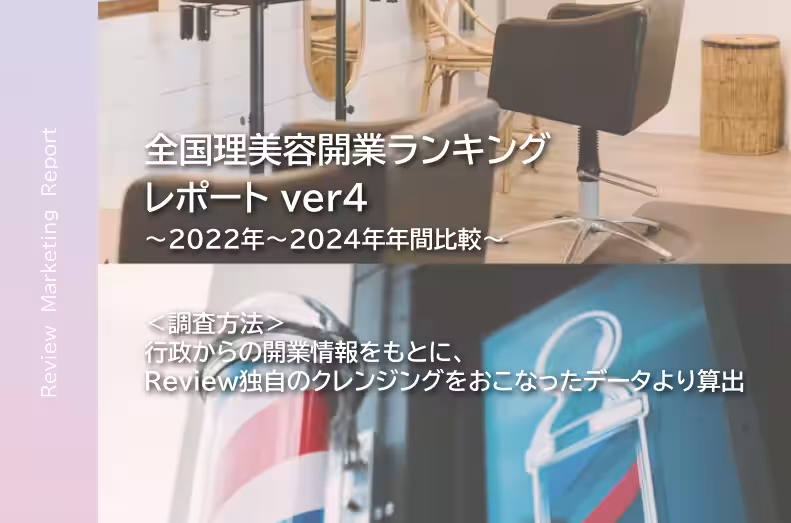
The beauty and hairdressing sector in Japan is undergoing significant transformation, as revealed by a recent report from Review, a data provider based in Osaka. This comprehensive research investigated trends in the beauty industry across the nation from 2022 to 2024, analyzing data from 22,384 locations. The numbers show a noteworthy decline in newly established beauty salons, reflecting shifting priorities towards sustainable business models in the industry.
Overview of the Research
Review's analysis demonstrated that the number of new salon openings decreased from 8,608 in 2022 to 6,093 in 2024, representing a drop of approximately 2,500 establishments. This trend indicates a fundamental change in how beauty professionals perceive the value of opening a salon. No longer is simply launching a business the primary goal; instead, a growing number of professionals are focusing on how to operate in a manner that is both sustainable and authentic to their personal styles.
New Business Models
In today’s evolving landscape, opening a salon is not the only path to success in the beauty industry. Freelancing, commission-based agreements, and shared salon spaces are on the rise, allowing beauty professionals diverse options tailored to their needs. The top five prefectures for new salon openings in 2024 include:
1. Tokyo: 808 openings
2. Osaka: 565 openings
3. Aichi: 424 openings
4. Kanagawa: 330 openings
5. Fukuoka: 290 openings
These urban areas combine a high population density with a strong adaptability to new work styles, fostering an environment that supports innovation in business practices.
In Tokyo, for instance, the trend towards one-on-one services, driven by tech-savvy younger stylists communicating through social media, has paved the way for more individualized experiences. Conversely, in Osaka, there’s a strong emphasis on community-oriented salons and sustainable business practices, utilizing local markets to cultivate stability and success.
The Influence of New Legislation
A crucial factor in this dynamic environment is the recent enactment of the Freelance Law in April 2024. This legislation has improved the working conditions for freelancers and independent contractors in the beauty industry. By mandating clearer contracts, distinct payment terms, and harassment protections, the legislation enables beauty professionals to feel more secure in their choices to work independently or within shared salon frameworks.
Evolving Needs of Society
The aging population in Japan has also led to the emergence of niches within the beauty industry like welfare beauty services, which emphasize home visits and care support without the need for a physical salon. As traditional business models shift to need-centric solutions, beauty professionals are adapting to serve their communities more effectively.
While the number of new salon openings has declined, the overall number of working beauty professionals is on the rise. Currently, nearly 30% of beauty professionals work in independent or freelance roles without necessarily establishing traditional salons. This significant pivot reveals that the industry is moving towards a model where conventional ownership is becoming less critical, emphasizing the importance of adaptability and the ability to co-exist within the professional landscape.
The Future of the Beauty Industry
In conclusion, while the reduction in salon openings may suggest a downturn in the beauty industry, it is, in fact, a signal of evolution. The definition of what it means to operate successfully is changing, allowing for new forms of engagement with clients and diverse pathways for professionals. Review remains committed to supporting these developing narratives and believes that this report will illuminate new possibilities for everyone involved in the beauty sector.
Through continued efforts, Review aims to challenge the preconceived notion that success is defined solely by the number of opened salons or traditional metrics. Instead, the focus is on fostering a more expansive understanding of what it means to thrive in the modern beauty industry.



Topics Consumer Products & Retail)





【About Using Articles】
You can freely use the title and article content by linking to the page where the article is posted.
※ Images cannot be used.
【About Links】
Links are free to use.