




Development of AI-Quantum Unified Platform for Enhanced Quantum Computing Access
Introduction
In a significant step towards advancing quantum computing, ten institutions in Japan, spearheaded by Waseda University, have commenced research and development of an AI-quantum unified platform. This initiative, backed by the New Energy and Industrial Technology Development Organization (NEDO), aims to streamline the utilization of quantum computers, allowing users without specialized knowledge to leverage quantum technologies across various industries.
Background and Objectives
The urgency to integrate quantum computing into various industrial sectors has been intensified due to emerging global competition and Japan's ambitions outlined by the Cabinet Office's Vision for a Quantum Future Society. This vision targets an expansion of quantum technology adoption, aiming for 10 million users and a domestic production value of 50 trillion yen by 2030. As enterprises begin to recognize the potential benefits of quantum technologies, barriers related to technical expertise and operational stability in quantum computing remain prevalent. This project aims to address these challenges.
Waseda University, noted for its strong focus on applied sciences, will specifically research and develop high-performance optimization applications within this AI-quantum unified platform. The project intends to lower the barriers for organizations looking to implement quantum solutions, extending the technology’s reach into diverse sectors such as energy, manufacturing, and logistics.
Current Challenges Facing Quantum Computing Users
While quantum computing holds promise, its effective deployment necessitates a specialized understanding of quantum mechanics and quantum information. At present, potential users face high entry barriers, as conventional strategies for employing quantum systems are not user-friendly, often requiring substantial technical knowledge.
Furthermore, diverse quantum computing methodologies, including superconducting qubits, neutral atom approaches, and photonic systems, add complexity for users who must navigate various computational resources available through cloud services. The need for a more intuitive interface that can abstract these complexities is profoundly evident to enable wider accessibility.
Provider Challenges
Quantum computing providers also factor into this equation. A fundamental challenge lies in the unstable nature of qubits, which complicates long-term stable operations of quantum systems. Overcoming these technical limitations is critical to fostering a thriving ecosystem that accommodates broader usage of quantum technologies.
Project Overview
The collaborative research will tackle two core themes aimed at speeding up the industrial adoption of quantum technology:
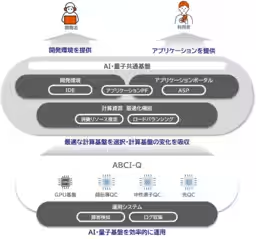
1. Development of Middleware Technologies: This will involve creating an integrated development environment (IDE) that abstracts the complex functionalities of quantum computers through Application Programming Interfaces (APIs) and assists users, regardless of their expertise, in obtaining optimal computational resources automatically. Furthermore, the development of application service providers (ASPs) to facilitate application execution on the platform will also be a priority.
2. Development of Operations Technology for Quantum Systems: This objective focuses on the extraction and accumulation of telemetry data essential for the management of quantum computing systems. By combining various telemetry data from coolers and control devices, the research aims to establish fault detection and management technologies.
Research Collaboration Structure
KDDI Corporation and KDDI Research Institute will oversee the overall project management and technical specifications while collaborating with academic and industrial research teams. Waseda University is tasked with developing the API for the IDE prototype, focusing on enhancing the performance of optimization applications.
Expert Insights
According to Professor Nozomu Togawa from Waseda University's School of Science and Engineering, the collaboration with KDDI and other institutions aims to explore and create tangible use cases in quantum computing. Building on past successes, the project endeavors to merge the outcomes into a coherent development environment, contributing to the realization of the Vision for a Quantum Future Society.
Conclusion
This joint initiative marks a crucial step forward in quantum computing, promising to demystify and democratize the technology for broader usage across Japanese industries. By fostering collaboration and focusing on user-friendly solutions, this project not only addresses existing barriers but also positions Japan as a competitive leader in the global quantum landscape.

Topics Consumer Technology)
【About Using Articles】
You can freely use the title and article content by linking to the page where the article is posted.
※ Images cannot be used.
【About Links】
Links are free to use.