



Understanding Corporate Security Penetration Testing: Insights from Major Companies
Investigating Security Penetration Testing in Corporations
In the realm of corporate cybersecurity, penetration testing has emerged as a pivotal component in safeguarding digital assets. Recently, a comprehensive survey was conducted targeting major companies utilizing the trial services of "MUSHIKAGO", a fully automated security testing device. The study aimed to gauge the security landscape in these organizations as well as their perceptions and practices in penetration testing.
Key Findings on Priorities in Penetration Testing
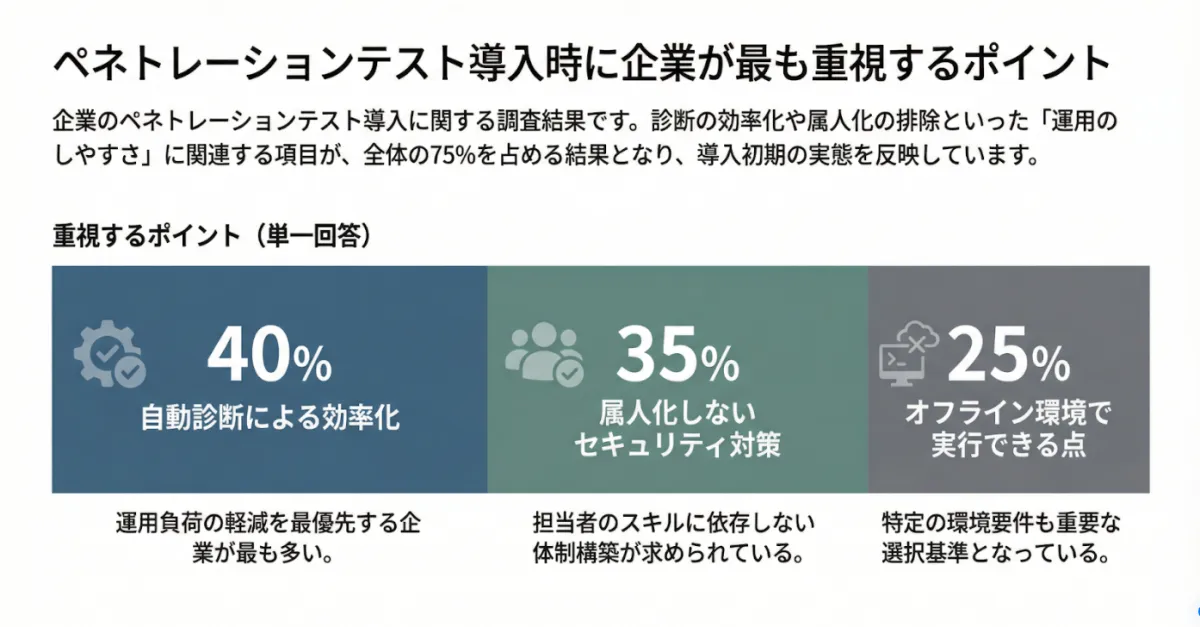
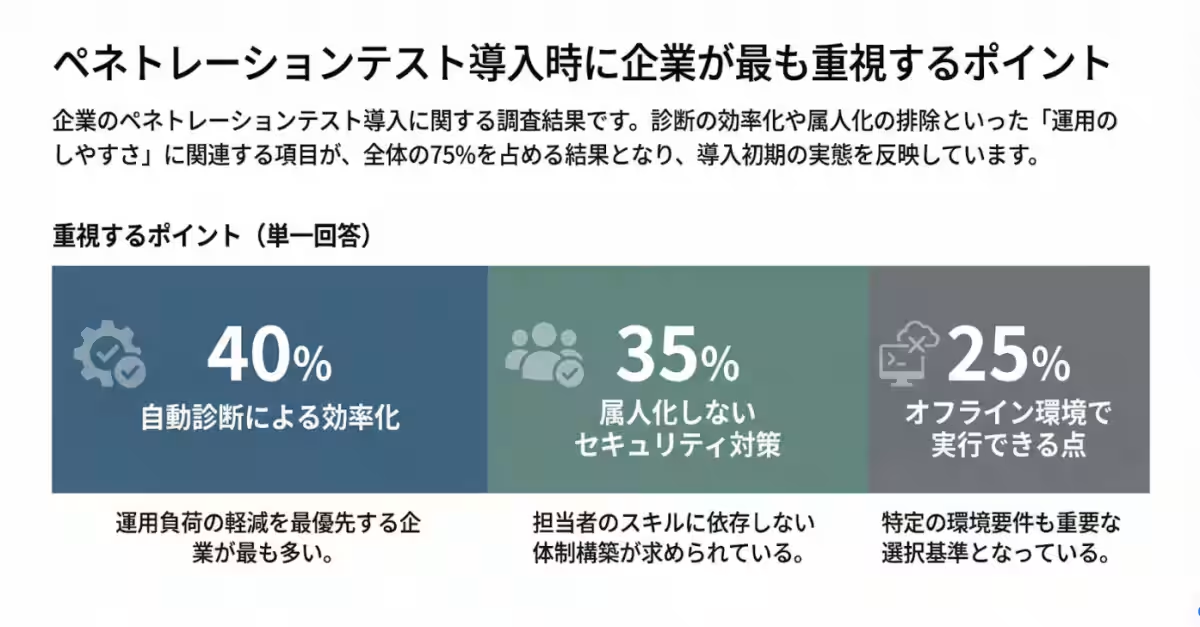
The survey revealed that when choosing to implement security diagnostics and penetration tests, companies prioritize efficiency and operational ease. Approximately 40% of respondents indicated that automating diagnostics is their primary concern, reducing manual labor and making processes more straightforward. This is closely followed by 35% of businesses valuing solutions that do not rely on specific personnel for security measures. Finally, 25% of organizations highlighted the advantage of being able to perform tests in offline environments. This data illustrates that companies favor a structured approach to security testing that facilitates ongoing operations over elevated technical expertise.
Challenges Faced in Security Testing
From the responses, it became clear that while there is a general interest in penetration testing among companies, many struggle with several challenges when first embarking on these assessments. Common issues identified included:
- - Lack of preparation for the testing environment
- - Difficulty in defining the scope of the tests
- - Requirement for specialized knowledge to interpret results
These hurdles are not exclusive to particular industries or businesses but are common across the board for firms initiating their first penetration testing efforts.
Current Landscape and Need for Security Testing
The pressing need for robust cybersecurity practices stems from the rising sophistication of cyberattacks targeting businesses. A report by ITmedia highlighted that ransomware incidents remain at a high level, inflicting prolonged and widespread damage on business operations. Furthermore, vulnerabilities such as zero-day risks have contributed to increasing attacks, affecting companies regardless of their sector or size.
Consequently, the Japan Network Security Association (JNSA) has categorized cyberattacks against enterprises as a "disaster-level risk," suggesting that traditional security measures are no longer sufficient to mitigate such threats. As various studies indicate, the number of publicly reported security incidents in Japan is on the rise, and the actual impact could be several times more significant than indicated.
It has become increasingly evident that while many organizations recognize the importance of security measures, they also face challenges in obtaining qualified personnel, dealing with the complexities of defining and maintaining security assessments, and bearing the costs associated with regular penetration testing.
Background of the Research
With this context in mind, our research sought to clarify what companies are prioritizing when it comes to their first penetration tests and what obstacles they encounter during initial implementations. As the findings illustrated, while many organizations understand the critical points of penetration testing, a significant number remain unsure about how to start the process effectively. This indicates a broader trend where security assessments are becoming necessary not only for large-scale firms but also for businesses embarking on smaller tests to ensure their cybersecurity resilience.
Future Outlook
Looking ahead, our company aims to participate in national research projects and gain recognition at leading international security conferences. Equipped with substantial technological expertise, we are committed to developing our service, "MUSHIKAGO", which opens avenues for safer and more efficient security test operations.
What is Penetration Testing?
Penetration testing, also known as a simulative cyberattack on a target system or network, is a method used to evaluate the security measures in place. By mimicking cyber-attacks, companies can assess whether their defenses against intrusions, sensitive data theft, and unauthorized control measures are effective. While many organizations conduct desk-based risk assessments and incident-response training regularly, fewer test their actual response capabilities against real attacks.
By employing our penetration testing services, organizations can obtain a clear picture of the efficacy of their security measures and frameworks. Each client may have unique requirements regarding the systems, networks, scenarios, and reporting needed, so we work closely with them to determine the specifics of their testing in advance.
About "MUSHIKAGO"
"MUSHIKAGO" is an innovative security testing device developed by our company, specially designed for ease of use. This fully automated device can conduct advanced security tests, including vulnerability detection and simulated attacks, ensuring safety throughout the process. It can be delivered in as little as three days from the application, allowing for immediate deployment without extensive setup requirements.
Conclusion
The increasing prevalence of cyber threats necessitates a shift in how organizations approach security. As companies navigate the complexities of penetration testing, tools like "MUSHIKAGO" offer substantial support, enabling a proactive strategy against evolving risks in cybersecurity.
Topics Consumer Technology)
【About Using Articles】
You can freely use the title and article content by linking to the page where the article is posted.
※ Images cannot be used.
【About Links】
Links are free to use.