



Development of Phase-Free Robots for Disaster Relief and Daily Use
The Launch of Phase-Free Robots Research
In a groundbreaking collaboration, Waseda University, Mitsubishi Electric, and Shimizu Corporation have embarked on a research initiative focused on the development of phase-free robots. These versatile robots are designed to operate effectively in both everyday and emergency situations, with particular emphasis on their application in disaster-stricken areas. The project aims for social implementation of these robots as vital solutions for disaster relief, with a completion target by the end of fiscal year 2027.
Background and Challenges
The urgency for such a solution stems from the increasing risks posed by natural disasters due to global warming, exemplified by the rising frequency of intense rainfall, river flooding, and landslides. Japan, in particular, experiences around 20% of the world’s earthquakes with a magnitude over 6, necessitating robust support systems for disaster scenarios. Given this context, it becomes imperative to develop robots that can provide immediate assistance during disasters while also having practical applications in day-to-day life. However, the integration of phase-free disaster prevention technologies has yet to see substantial progress.
Overview of the Research and Development
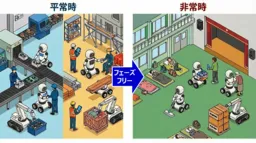
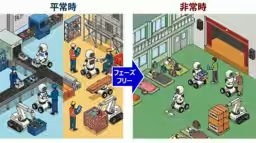
The collaborative research will focus on creating robots capable of diverse functionalities such as manufacturing, logistics, construction, office work, and caregiving in normal times, while transitioning to critical tasks like victim detection, distribution of relief supplies, patrolling, and cleaning during emergencies. The aim is to continually apply the findings of this research towards the partial social implementation of these robots as development progresses, ensuring ongoing validation and enhancement of the technology.
Research Implementation Team
A consortium of the three organizations will lead this research: Waseda University will focus on the hardware and AI aspects of the phase-free robots, Mitsubishi Electric will work on the implementation of robotic solutions through their business activities, and Shimizu Corporation will oversee the overall coordination of the research and development efforts.
Insights from Professor Shigeki Sugano
Professor Shigeki Sugano from Waseda University, the lead researcher for the project, expressed that the university has previously contributed to various initiatives, including the cabinet-level Moonshot
type research and development project, which focuses on enhancing smart robot manipulation technology and AI integration. He emphasizes the aim to elevate past research outcomes and integrate them into the phase-free robots, thus contributing significantly to the support efforts in disaster areas.
Conclusion
As the project unfolds, it promises not only to innovate robotic capabilities that can adapt to both everyday usage and emergency circumstances but also addresses a critical gap in the current disaster response framework with forward-thinking solutions. With this partnership, we can indeed foresee a future where robots become essential partners in both daily life and when crises strike.
Terminology Explanation
Phase-Free Robots: Robots designed with features adaptable to both industrial and caregiving environments, while also addressing disaster relief needs. The term "phase-free" is a trademark registered by the Phase-Free Association, encapsulating the concept of uniting normal operations and emergency responses.
Moonshot-type Research and Development Projects: An initiative by JST aiming to create smart robots that accompany individuals throughout their lives.
For more detailed information about this project, please visit the Waseda University homepage.
Topics Other)
【About Using Articles】
You can freely use the title and article content by linking to the page where the article is posted.
※ Images cannot be used.
【About Links】
Links are free to use.