




Leveraging Decarbonization by Visualizing Environmental Value of Rebuilt Products in Okayama
Decarbonization in Okayama: A New Model for Local Development
In the heart of Okayama, Tsuginohi Inc. is pioneering efforts to lead the charge towards a sustainable future. Their mission is simple yet profound: create a world where global resources are self-sustaining. To achieve this, the company has collaborated with Asuene Inc. for comprehensive carbon footprint (CFP) analysis and life cycle assessment (LCA) services, focusing on their rebuilt products which play a critical role in the circular economy.
Unveiling the Environmental Value of Rebuilt Products
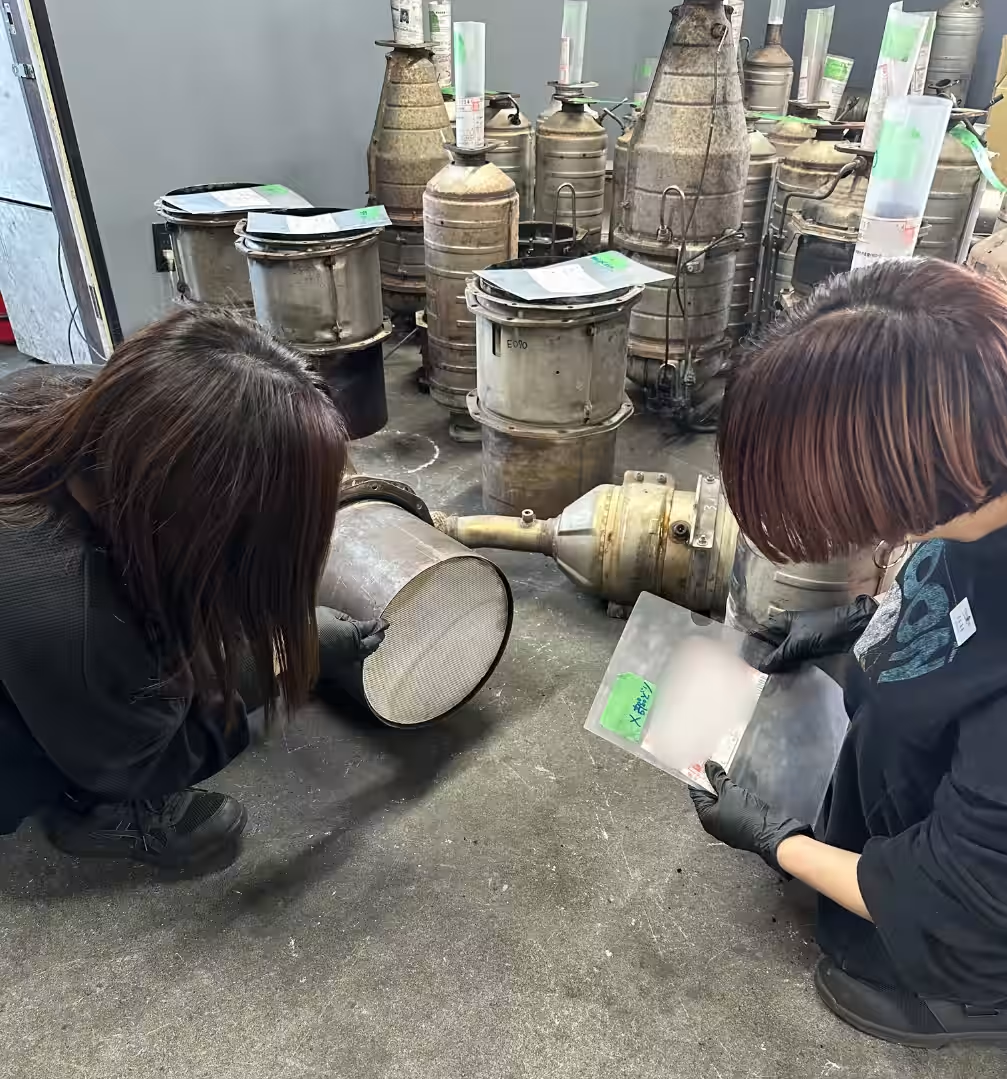
Tsuginohi recently completed a CFP analysis demonstrating that their rebuilt diesel particulate filters (DPF) are capable of reducing carbon dioxide emissions by approximately 60% compared to new products. This revelation not only highlights the environmental benefits of utilizing refurbished components but also assists local companies in pursuing decarbonization management more effectively.
Overcoming the Data Barrier Facing Local Enterprises
As companies across Japan accelerate their green transformation (GX) initiatives, understanding emissions across the entire supply chain (Scope 3) has become essential. However, calculating emissions for individual parts can be daunting due to the complexity and lack of data availability. This challenge persists even for major manufacturers, leaving significant room for improvement in this field.
In particular, the rebuilt parts industry has long struggled to translate perceived environmental benefits into quantifiable data. Tsuginohi is poised to break down these barriers by offering precise measurements from its local production site in Okayama, paving the way for increased adoption among environmentally conscious logistics and construction firms.
Standardizing Emission Calculation Processes
Together with Asuene Inc., Tsuginohi undertook a rigorous six-month validation study. This process meticulously assessed key components of their semi-rebuilt DPF for trucks based on LCA principles.
The study encompassed everything from the collection distance of core parts and the energy and water consumption during cleaning processes, to even the weight of each staple used in packaging. The result was a highly standardized emission calculation process that aligns with public standards.
After thoroughly comparing the values against Japan's Ministry of the Environment’s secondary data, Tsuginohi pinpointed that one unit of rebuilt DPF results in emissions of approximately 165.7 kg-CO2.
Achieving a Noteworthy 60% Reduction in CO2 Emissions
The analysis revealed that utilizing a new DPF, estimated to produce about 405.7 kg-CO2, yields an impressive reduction of around 240 kg of CO2 emissions—equating to a 60% decrease.
To provide perspective, the amount of CO2 reduced by a single DPF is comparable to what roughly 17 cedar trees absorb in one year. Given that Tsuginohi has achieved substantial annual shipment figures, the equivalent of emissions reductions reflects the monthly footprint of about 7,000 average households.
A Business Model Focused on Global Restoration from Okayama
Thanks to this newfound ability to quantify emissions reductions, Tsuginohi's customers can now clearly document and report their Scope 3 reductions (Category 1: Purchased Products & Services) by embracing rebuilt products.
Moving forward, the company aims to broaden its product range and pursue “environmental labeling” for all offerings. The ethos behind this initiative is simple: it is economically and environmentally more sustainable to restore than discard. Tsuginohi intends to share the “Okayama Model” nationwide while contributing to Japan’s transition towards a carbon-neutral society.
About Tsuginohi Inc.
Tsuginohi Inc., operational since July 2, 2018, is dedicated to recycling automotive and industrial machinery parts. Based in Okayama, the company leverages advanced cleaning techniques and unique inspection standards to minimize waste and maximize resource utilization.
To learn more about Tsuginohi, visit their official site.
About Asuene Inc.
Asuene Inc. is on a mission to create a better world for future generations. They specialize in CO2 emission visualization through their cloud platform ASUENE, supply chain management, third-party verification of non-financial information, and an emissions trading platform called Carbon EX. With a global presence spanning countries like the United States, Singapore, Thailand, Europe, and the Philippines, they actively aim to accelerate net-zero operations.
To know more about Asuene, check out their official site.



Topics Environment)
【About Using Articles】
You can freely use the title and article content by linking to the page where the article is posted.
※ Images cannot be used.
【About Links】
Links are free to use.