



POST GROWTH CITY LAB: Redefining Urban Relations for a Sustainable Future
POST GROWTH CITY LAB: A New Urban Paradigm
In a bold step towards sustainable urban development, Nittetsu Kowa Real Estate Co., Ltd. and Zebras and Company have launched a collaborative research initiative dubbed the POST GROWTH CITY LAB (PGCL). This project aims to explore and redefine the relationship between cities and regions against the backdrop of declining population, climate change, and shifting social structures. Set to commence in December 2025, the PGCL signifies a pivotal transition from traditional growth models to innovative, sustainable alternatives.
Addressing the Limits of Growth
As conventional models that prioritize expansion face critical limitations, PGCL seeks to answer the pressing question: “Where will the future growth of cities come from?” Through lenses of real estate investment, corporate strategy, and regional management, the project endeavors to conceptualize urban environments apt for the times ahead.
As part of the initiative, New Local Co. and RE:PUBLIC will join forces, conducting co-creation projects that add practical insights to the ongoing research. The primary goal is to formulate actionable models by combining field research with hypothesized concepts.
Research Themes and Methodology
The PGCL will analyze urban regions in Japan using a three-tiered structure: Block Bases, Hub Bases, and Small Bases. Each segment will be examined for its functional roles and interdependencies, allowing researchers to create a “map of changes in sustainable urban and regional development.” This map will integrate four crucial elements of analysis:
1. Economy: Utilizing external capital
2. Culture and Resources: Unearthing local intrinsic values
3. Living Infrastructure: Providing essential support for daily life
4. Ways of Living: Embracing diverse values and perspectives
This map aims to establish a shared language for communities to envision their futures while also serving as a compass for real estate and investment strategies.
Project Overview and Participants
The PGCL is driven by a consortium of four expert organizations, each specializing in various aspects of sustainability, investment, and regional development:
- - Future Style Research Institute, guiding project directives from a future-focused perspective.
- - Zebras and Company, leading the overall design and social implementation of the project with an emphasis on enhancing societal sustainability.
- - NEWLOCAL, conducting macro desktop research informed by practical knowledge.
- - RE:PUBLIC, utilizing field research to capture regional realities and validate emerging hypotheses.
By working collaboratively, these organizations aim to ensure a seamless transition from conceptualization to practical implementation in urban sustainability initiatives.
Project Timeline and Future Engagements
The PGCL is set to run until the end of 2026, with research results to be publicly shared approximately every three months. The second report meeting is scheduled for March 2026, wherein the findings will continue to refine urban and regional self-sufficiency outcomes.
Kickoff Presentation for Initial Research Findings
To unveil its foundational findings, the PGCL will host a kickoff presentation on December 16, 2025, at Akasaka Intercity Conference Center. The agenda includes:
- - Explanation of the research project’s objectives
- - Presentation of initial hypotheses and research themes
- - Sharing of desktop and field research outcomes
- - Cross-talk sessions with project members
- - An open Q&A session
Closing Insights from Project Leaders
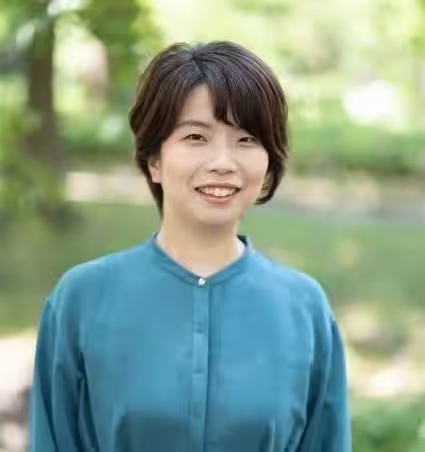
Project leaders from Future Style and Zebras and Company voiced their commitment to redefining urban futures through sustainable practices. Yuki Sato, representing Future Style, emphasized the urgency of imagining future cities amidst a shrinking workforce. Meanwhile, Yohei Azakami from Zebras and Company reiterated the project’s goal of reconstructing urban and regional relations, asserting that enduring societal models can emerge from shared insights.
As the PGCL forges ahead, it not only aims to explore new horizons for urban living but also seeks to nurture collaborations that will lead to healthier, more sustainable communities. This venture marks a significant milestone in triggering a broader dialogue around urban sustainability and its implications for investment in real estate and beyond.


Topics Other)
【About Using Articles】
You can freely use the title and article content by linking to the page where the article is posted.
※ Images cannot be used.
【About Links】
Links are free to use.