



Pioneering Demonstration of Hybrid Millimeter-Wave and Terahertz Beamforming Communication for 6G Era
Introduction to the Breakthrough
A revolutionary advancement in wireless communication has taken place with the successful demonstration of the world's first integrated beamforming communication using both millimeter-wave and terahertz-wave technologies. This development is led by the National Institute of Information and Communications Technology (NICT) and is a significant step towards establishing a super-fast and highly reliable wireless foundation for the upcoming 6G era.
Key Points of the Demonstration
- - The unique architecture allows for automatic switching between millimeter waves (60 GHz) and terahertz waves (300 GHz), adapting to the communication environment to enhance reliability.
- - This integrated approach addresses the issues previously faced with terahertz communication, such as shielding and connection interruptions, and significantly improves the performance of beam tracking.
- - As data communication volumes surge due to digital transformation and the rapid integration of IoT and AI, this technology promises to support next-gen applications, including XR and ultra-high-definition video transmission.
Background of the Necessity
In light of the exponential growth of data communication driven by advancements like digital transformation, IoT proliferation, and AI enhancement, concerns have been raised that the current 5G systems may not sufficiently meet future demands. Therefore, establishing foundational technologies for 'Beyond 5G' and '6G' has become an urgent necessity.
Terahertz waves, categorized as high-frequency radio waves, present a unique opportunity to vastly exceed current communication speeds, potentially enabling data transfer rates of over tens of Gbps – crucial for the support of services like XR and smart factories.
Challenges of Terahertz Communication
Despite its potential, terahertz waves have inherent challenges due to their limited reach and susceptibility to obstruction by buildings and other barriers. These high-frequency signals maintain a strong line-of-sight characteristic, making them difficult to utilize effectively under typical environmental conditions. Previous solutions failed to provide a viable means of stable communication concerning the drastic attenuation rates and beam direction requirements, thus hampering their practical implementation.
The Role of Beamforming Technology
Beamforming is crucial in overcoming terahertz communication's challenges. It utilizes multiple antenna elements to control wave phases and intensities, primarily focusing energy in specific directions to enhance communication quality and reach. However, due to the narrow beam requirements for terahertz communication, even minor movements of users can lead to misalignment, resulting in connection drops.
To mitigate these risks, advanced beam tracking technologies are necessary, but traditional methods face significant overhead and delays in their implementation.
Innovative Solution via Combined Wave Communication
In response to these challenges, NICT has developed a pioneering communication device that integrates automatic switching between millimeter-wave and terahertz communication, utilizing their respective strengths. The stability and maturity of millimeter-wave communication have made it a robust candidate for maintaining connectivity and tracking beams, thus accommodating user mobility effectively.
Success of the Experiments
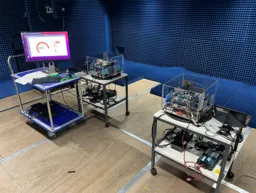
During the experimental trials conducted in a radio anechoic chamber, NICT achieved significant breakthroughs:
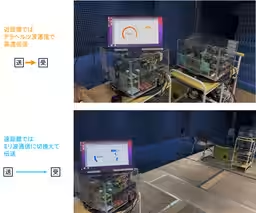
1. The device maintained high-speed terahertz communication at close distances while seamlessly transitioning to millimeter-wave communication over longer ranges.
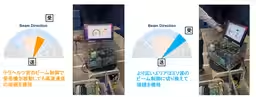
2. The communication system adjusted the beam direction dynamically based on the receiver's position, ensuring consistent connectivity.
3. With the integration of these two wave technologies, the transmission speed soared from a standard 2.2 Gbps on millimeter waves to an impressive 7.5 Gbps using terahertz waves, showcasing remarkable performance improvements.
By implementing high-precision beamforming control alongside automatic frequency switching based on environmental feedback, NICT has opened doors to a new era of ultra-high-speed, high-capacity, and low-latency communication standards vital for the successful realization of 'Beyond 5G' and '6G' solutions.
Future Prospects
Looking ahead, NICT plans to further broaden terahertz wireless signal bandwidth and enhance antenna technology to realize even more reliable high-speed communication links. This includes improving beamforming functionalities to optimize communication quality and spatial resolution, transitioning towards standardized methodologies in commercial applications.
The groundbreaking technology will be showcased at the upcoming 'Wireless Japan × Wireless Technology Park 2026' event at Tokyo Big Sight from May 27, demonstrating the practical implications of these advancements in real-world scenarios.



Topics Telecommunications)


【About Using Articles】
You can freely use the title and article content by linking to the page where the article is posted.
※ Images cannot be used.
【About Links】
Links are free to use.