



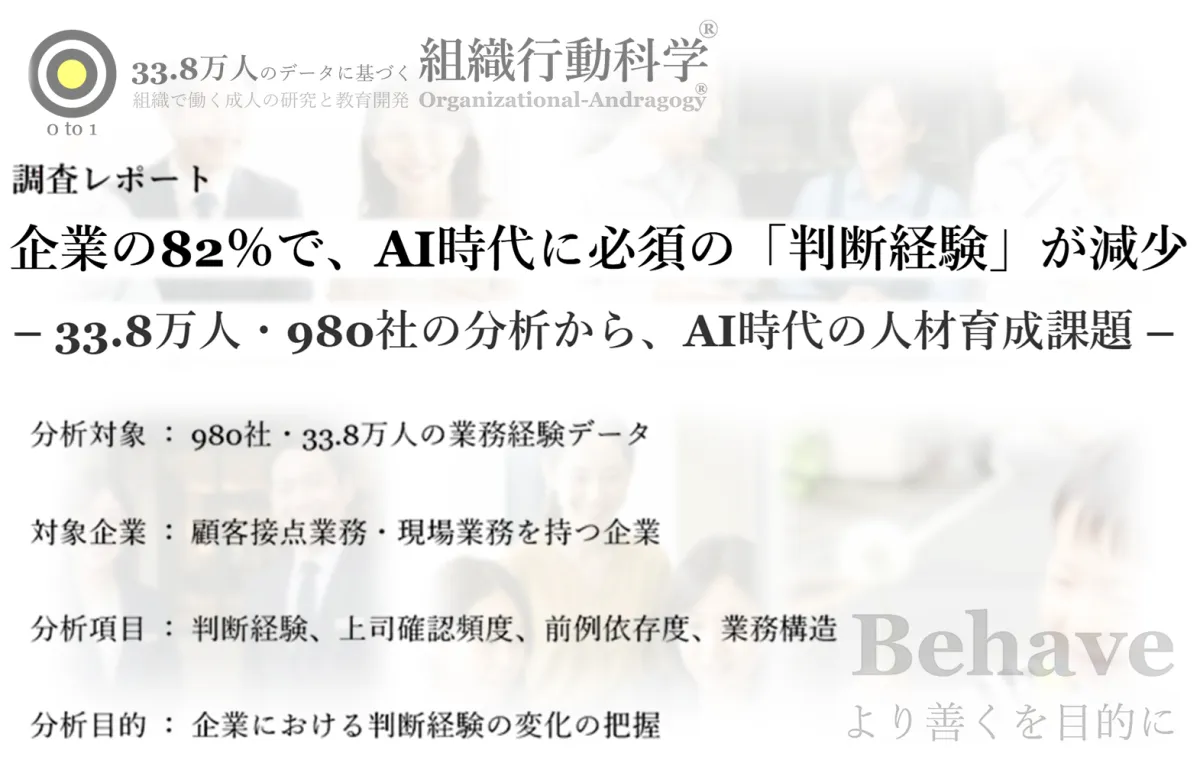
The Decline of Judgement Experience in the Age of AI: Insights from 980 Companies
The Decline of Judgement Experience in the Age of AI
Recently released research by Request Inc., based in Shinjuku, Tokyo, sheds light on a significant trend among companies in the age of artificial intelligence. This investigation reviewed operational data from 980 companies and 338,000 employees, revealing a staggering 82% of businesses are witnessing a decline in what is referred to as "judgement experience"—a critical skill in today’s workforce.
Understanding Judgement Experience
Judgement experience is defined as the ability to make decisions based on situational parameters rather than relying solely on established precedents or automated systems. As AI technologies become increasingly capable of performing tasks such as report writing, data organization, and information synthesis, many organizations have transitioned towards more standardized workflows which often dilute the need for nuanced human judgement.
In light of AI proliferation, operational demands have changed. Industries including construction, healthcare, and B2B services require tailored solutions for unique customer needs and diverse project specifications. However, the reliance on AI-driven automation has inadvertently reduced the opportunities for individuals to grow their judgement skills in real-world scenarios.
Key Findings of the Study
The study highlighted several key trends:
- - Judgement experience is declining: 82% of companies reported a reduction in critical decision-making opportunities among employees.
- - Increase in supervisor confirmations: 58% of organizations found that employees are increasingly verifying decisions with managers, an indicator of diminished confidence in autonomous decision-making.
- - Rising reliance on precedents: A majority, 64%, indicated a growing tendency to depend on past experiences or guidelines rather than fostering uniqueness in decision-making.
This analysis was conducted over several years (2022-2025), focusing on industries where precedents do not directly apply, covering roles from construction managers to healthcare practitioners and technical designers. Each of these roles requires individuals to navigate distinct conditions regularly, showcasing the importance of cultivating judgement skills.
Factors Behind the Decline
Several factors contribute to this trend within corporations:
1. Standardization of Operations: With more tasks being performed following set procedures, the need for individual judgement is diminished.
2. Manualization of Tasks: Standard methods and checklists can replace the complex reasoning associated with professional tasks.
3. Reliance on Technology: An increased dependency on systems and technology to perform tasks leaves less room for human decision-making.
4. Work Style Reforms: Efforts to increase efficiency often result in fewer opportunities for employees to engage in decision-making practices that bolster their judgement skills.
This fundamental shift towards tasks that are predictable and standardized leads to a work environment where employees may find their ability to make decisions stunted, jeopardizing their personal and career development.
The Critical Need for Judgement Skills
As an example of AI’s strengths and weaknesses, it excels at handling knowledge processing and repetitive tasks but falls short on nuanced assessments that require prioritization, risk evaluation, and contextual judgement. Going forward, businesses will find their competitive edge reliant on fostering a workforce capable of making sound decisions beyond the capabilities of AI.
Restructuring Talent Development
Given these findings, organizations must rethink their approach to training and development. Rather than waiting for employees to naturally acquire judgement experience, companies need to design roles and environments that explicitly encourage and cultivate this critical skill.
Programs need to pivot from traditional knowledge-based education to creating opportunities for employees to engage in complex decision-making processes. This transition is crucial to ensure that employees are prepared not just to operate within their roles but to navigate the complexities inherent in modern business landscapes, especially with the pressure of impending AI capabilities.
Conclusion
The rise of generative AI is reshaping the way work is performed in organizations, posing a challenge to the cultivation of judgement experience among employees. As research indicates, a significant portion of companies is grappling with the decline of this essential skill, suggesting an urgent need for a targeted approach to employee development in the AI era.
To enhance organizational competitiveness, businesses must take proactive measures to create environments where judgement and decision-making are fostered rather than hindered.
Company Overview
Request Inc. aims to understand and enhance organizational behavior through extensive research based on data from over 338,000 working individuals. With a focus on uncovering the mechanisms behind organizational actions and motivations, the company is committed to supporting organizations in navigating the changing landscape effectively. For more details, visit Request Inc.’s official website.

Topics Business Technology)
【About Using Articles】
You can freely use the title and article content by linking to the page where the article is posted.
※ Images cannot be used.
【About Links】
Links are free to use.