



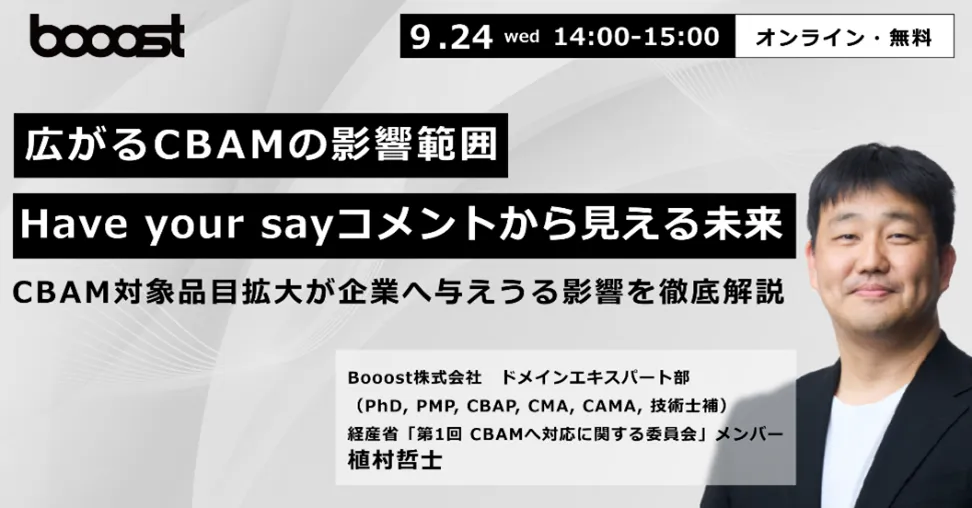
Booost Responds to EU and UK Carbon Border Adjustment Public Comments
Booost's Engagement with EU and UK Environmental Policies
Booost Inc., renowned for its leading position in the Sustainability ERP sector within major corporations, actively supports businesses in their Sustainability Transformation (SX). Located in Shinagawa, Tokyo, the company, headed by CEO Hiroki Aoi, recently addressed critical public consultations concerning the Carbon Border Adjustment Mechanism (CBAM) in the UK and the EU. These consultations, which closed in August 2025, focused on presenting the challenges that Japanese enterprises face in light of newly imposed regulations.
Background to Public Comments
The EU and UK have embraced a dialogical approach in their policy-making processes, such as the “Have Your Say” initiative and Technical Consultations. These public comment systems allow stakeholders, spanning from local companies to international entities from the US, Brazil, China, and India, to contribute their voices. However, Japan's contribution has often been limited to responses from a few industry organizations. Consequently, the unique reality faced by Japanese firms has frequently been overlooked, leading to scenarios where they are unwittingly subjected to stringent environmental regulations.
In light of this, Booost has systematically organized the challenges faced by Japanese enterprises based on insights gathered from their services and seminars. By formally communicating these issues to the EU and UK governments, Booost aims to ensure that the voices of Japanese businesses can influence international policy-making processes.
Key Insights Provided by Booost in Public Comments
Regarding the EU:
- - Booost emphasized the significant impact of the EU and UK environmental regulations on global value chains.
- - While the expansion of CBAM's scope is justified for preventing carbon leakage, concerns were raised regarding the severe economic implications for crucial sectors like steel and aluminum.
- - The complex structure of value chains, including manufacturers and trading companies, has inadvertently led to an exceedingly lengthy and intricate compliance process.
- - There are substantial challenges for small and medium-sized enterprises (SMEs) in adapting to the intricacies of EU regulations.
- - The necessity for consistency between EU CBAM and UK CBAM was highlighted to alleviate the burdens on third-country companies.
- - Booost proposed the establishment of minimum reporting thresholds based on CN codes and exporting sources to enable efficient compliance and reduce unnecessary burdens.
Regarding the UK:
- - Booost pointed out potential ambiguities in emissions scope, which might be interpreted more broadly than the EU CBAM.
- - Concerns were raised about the unclear definition of the target range, which seems limited to upstream facilities like blast furnaces but requires clarification.
- - The possibility of default values being set per country implies a heightened need for comprehensive origin information throughout the supply chain, leading to increased business burdens.
- - While utilizing actual measured values is seen as beneficial, uncertainties surrounding third-party verification costs and calculation methods were noted.
- - There is a lack of clarity about the timetable for the UK government's carbon price calculations, potentially putting companies under pressure to respond swiftly.
- - The connection between the UK's emissions trading system and those of other countries lacks a clear definition, raising concerns about potential difficulties arising from differences in carbon tax rates.
- - Finally, Booost underscored the possibility of double compliance and price adjustments required due to differences between the UK and EU CBAM regulations.
Booost’s Role in Supporting Sustainability Initiatives
As Japan aspires to become a leader in SX, Booost is committed to creating an environment conducive for companies to undertake effective sustainability initiatives. The company is keen on leveraging opportunities for feedback from various governments to clearly communicate the challenges and potential solutions for Japanese enterprises in response to environmental regulations globally.
Upcoming Seminar on CBAM’s Impact
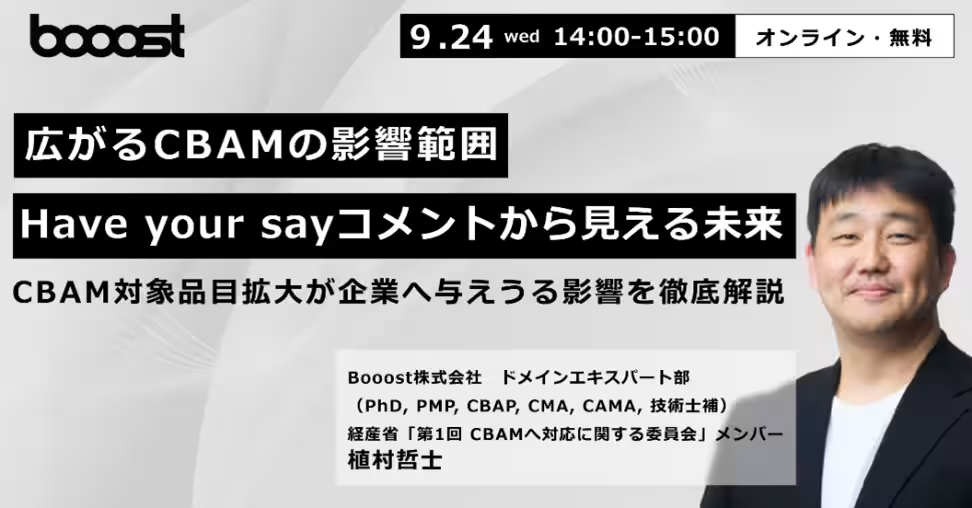
Booost will hold a seminar titled “How Far Will CBAM Coverage Expand? Insights From EU Public Comments” to delve into the implications of recent public comments on the EU's Carbon Border Adjustment Mechanism. This seminar is particularly aimed at companies involved in the manufacturing and exporting of components and products utilizing steel and aluminum, as their compliance with CBAM will be crucial for navigating upcoming regulations. The session will analyze the insights gathered from the public comments and discuss how their findings may influence the anticipated EU CBAM delegated legislation.
Conclusion
Booost remains steadfast in its mission to foster a productive environment for sustainability initiatives across Japan. Through continuous engagement in international policy discussions, the company endeavors to illuminate Japanese enterprises' challenges and strategies to adapt to evolving environmental standards.
For inquiries, please reach out to: [email protected] (Attn: Tetsushi Uemura)

Topics Consumer Products & Retail)
【About Using Articles】
You can freely use the title and article content by linking to the page where the article is posted.
※ Images cannot be used.
【About Links】
Links are free to use.