



Quantifying Thermal Design Through LTspice: A Practical Seminar on Thermal Circuit Networks and Self-Heating Analysis
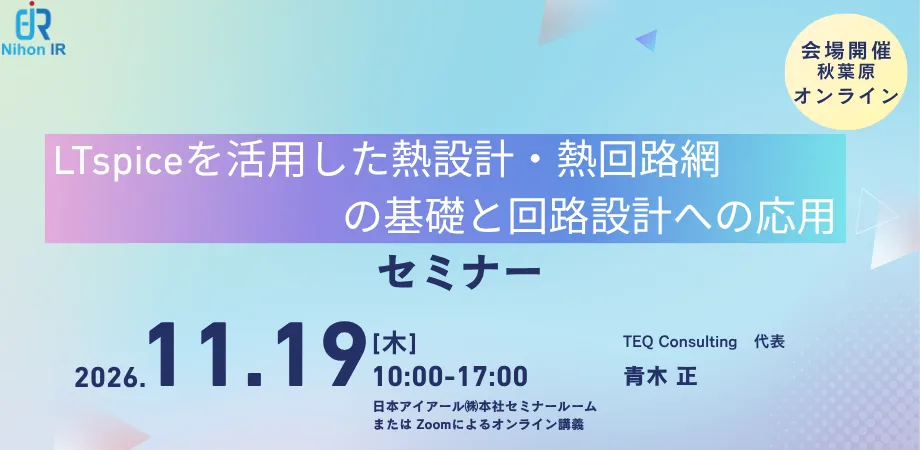
Practical Seminar on Thermal Design Using LTspice
The IR Technical Education Institute is set to hold a seminar designed to provide engineers with structured knowledge on thermal circuit networks, transient thermal analysis, and self-heating models for MOSFETs, all through the lens of LTspice software. This seminar is crucial as electronic devices and circuits evolve toward higher performance and denser packaging, making the management of heat generation a critical factor in ensuring reliability and functionality.
Importance of Thermal Design
As components exhibit enhanced performance, issues arise from elevated temperature levels that can lead to functional failures or reduce reliability. Increased temperatures can cause circuit malfunctions, thermal runaway, degradation of components, metal fatigue due to repeated temperature variations, and even low-temperature burns. Consequently, design engineers must step beyond empirical knowledge and develop a deep understanding of heat generation and transfer mechanisms, utilizing calculations and simulations for a quantitative examination of thermal designs.
Seminar Overview
Seminar Name:
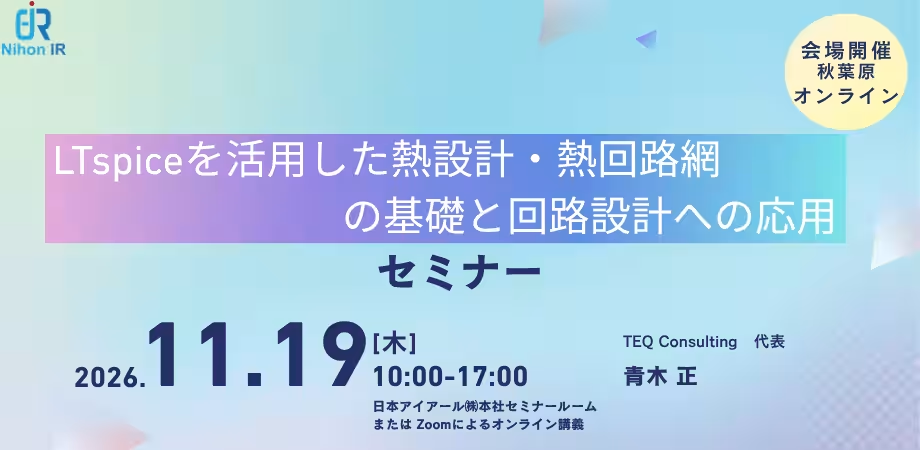
Fundamentals of Thermal Design and Circuit Applications Using LTspice
Location:
Japan IR's Headquarters Seminar Room or Online via Zoom
Date:
November 19, 2026 (Thursday), 10:00 AM – 5:00 PM
Fee:
49,500 JPY per participant (including tax)
Instructor:
Masashi Aoki (Representative of TEQ Consulting)
Course Content
The seminar will cover:
- - Fundamentals of heat conduction, modeling thermal circuits, simulations using SPICE, and MOSFET self-heating models.
Seminar Program Details
1. Introduction
Overview of seminar objectives and content.
2. Need for Thermal Design
- Problems arising from elevated temperatures, including functional failure and thermal runaway.
- Accelerated component degradation in high-temperature environments.
- Issues of metal fatigue due to thermal cycling.
- Risks of low-temperature burns from rising temperatures.
3. Three Elements of Heat Conduction
- Conduction, Convection, and Radiation.
4. Thermal Calculations
- Comparison of heat and electricity, definition of thermal calculation parameters, fundamental calculations of thermal resistance, practical thermal calculations, and understanding thermal characteristics parameters.
5. MOSFET Current-Voltage Characteristics
- Theoretical expressions and SPICE models.
6. Thermal Circuit Networks and SPICE Simulation
- Overview and practical implementation of thermal circuit models, including experimental setups, real measurement versus SPICE simulation, temperature settings in SPICE, and self-heating models.
7. Self-Heating in MOSFETs
- Current consumption in MOS inverters and its temperature dependence.
- Development of simple self-heating models for MOSFETs and their use in transient thermal simulations.
8. Creating Self-Heating MOSFET Models
- Methodology for creating self-heating models and performing transient thermal simulations.
Target Audience
This seminar is aimed at:
- - Circuit and thermal design engineers.
- - Professionals interested in performing thermal simulations using SPICE.
- - Individuals with intermediate or advanced experience in electrical and thermal design.
- - Aspiring leaders in electrical design fields who can navigate LTspice installations and transient analysis operations.
For more details on this seminar, visit here.
About Japan IR
Japan IR has over 50 years of experience in providing patent and intellectual property solutions, technical information research and analysis, education for manufacturing engineers, and producing technical content. Through its services, it continuously offers valuable knowledge and expertise transferable to the workplace.
Company Website: Japan IR
Technical Education Institute: Engineer Education
Address: 3rd Floor, CYK Kanda Iwamoto-cho, 15-1 Kanda Iwamoto-cho, Chiyoda-ku, Tokyo 101-0033
Contact: 03-6206-4966
Topics Consumer Technology)
【About Using Articles】
You can freely use the title and article content by linking to the page where the article is posted.
※ Images cannot be used.
【About Links】
Links are free to use.