



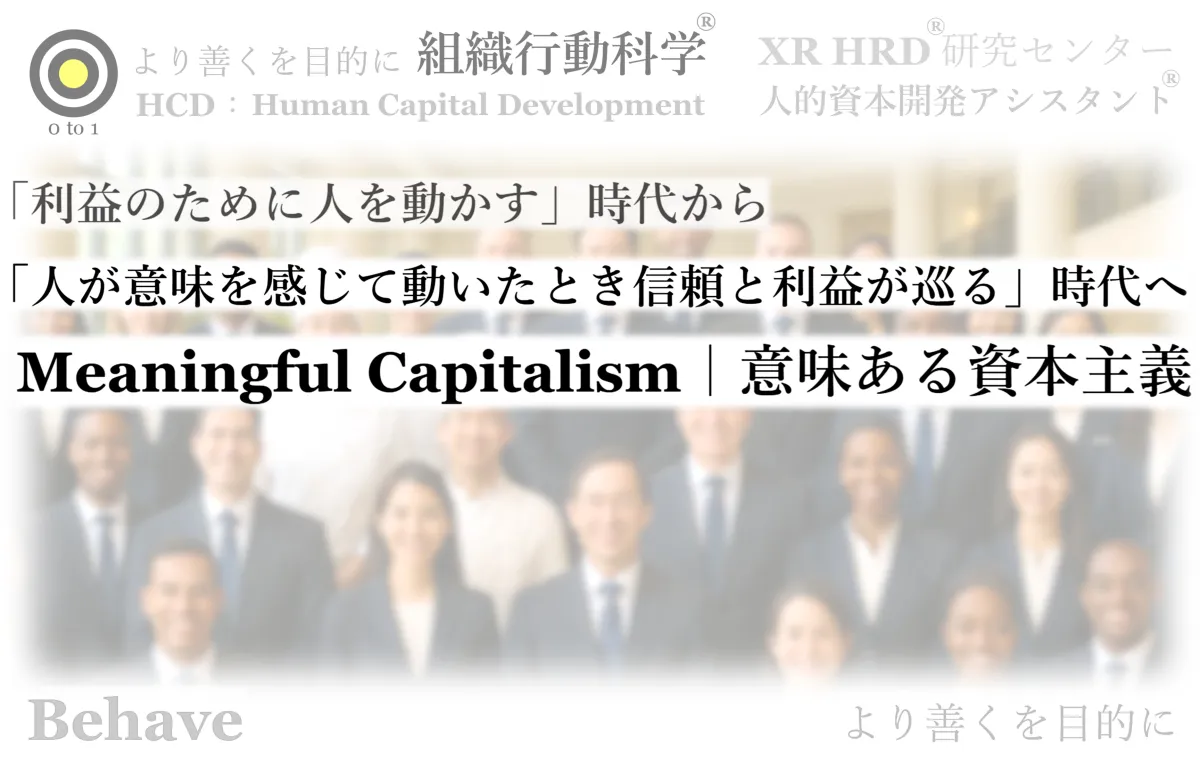
The Shift from Profit-Driven to Meaning-Driven Business Practices: Understanding Meaningful Capitalism
The Shift to Meaningful Capitalism
In the ever-evolving landscape of business, the pursuit of efficiency and outcomes is giving way to a more profound understanding of purpose. Professionals increasingly find themselves questioning their accomplishments despite meeting numerical targets. Why, they wonder, do these achievements feel unfulfilling?
Recognizing this pervasive discomfort, Request Co., a leading company in Organizational Behavior Science based in Shinjuku, Tokyo, has introduced a groundbreaking concept: Meaningful Capitalism. This innovative framework is founded on extensive research involving over 338,000 organizational behavior data points, advocating a paradigm where individuals are encouraged to act based on meaningful experiences, thus nurturing trust and generating profits organically.
Background: The Evolutionary Signals of Discomfort
Today’s corporate structures often render individual contributions devoid of meaning. Division of labor and performance indicators create an atmosphere where employees struggle to grasp the significance of their roles.
Key questions such as "What is the purpose of this task?" and "Who benefits from my work?" often remain unaddressed. Consequently, even with satisfactory performance metrics, many workers report a lack of fulfillment and pride. This subtle yet widespread sense of dissatisfaction is emerging in discussions across various organizational settings. However, it is essential to understand that this discomfort is not merely fatigue but a signal of an intrinsic evolution toward a new era.
Understanding Meaningful Capitalism
Meaningful Capitalism is presented by Request Co. as a novel economic model that shifts the focus:
- - From: Moving people for profit
- - To: People moving for meaningful experiences, thereby fostering trust and facilitating profit.
This new economic structure is characterized by several key distinctions:
| Traditional Capitalism | Meaningful Capitalism |
|---|---|
| --------- | --------- |
| Initiatives stem from commands and efficiency | Initiatives stem from intention and empathy |
| Outcomes assessed numerically | Outcomes evaluated through metrics, trust, relationships, and engagement |
| Role of organizations centered on processing and division | Role of organizations includes translating meaning and fostering connections |
| Focus on maximizing profits | Focus on unlocking intrinsic human value and its circulation |
The core technology to implement this structure within organizations is Organizational Behavior Science.
Organizational Behavior Science: Cultivating Meaning and Trust
Based on over 338,000 workplace behavior data points, Organizational Behavior Science employs various tools including:
- - Quick-Q (Reflective Questions): Stimuli that encourage employees to find deeper meaning in their tasks.
- - Behavior Trigger®: Techniques aimed at reducing barriers to desired behaviors.
- - Psychological Rewards: Incentives that resonate at a psychological level to invigorate employees.
- - Log Design for Value Capital and Trust Capital: Systems designed to accumulate meaning and trust over time.
For instance, simply asking employees weekly, “Who benefited from your efforts?” has shown to increase intrinsic motivation and improve overall employee relations, leading to lower turnover rates and enhanced collaboration.
Case Studies: Transformative Outcomes That Extend Beyond Numbers
The meaningful contributions foster the following outcomes that often go unnoticed by typical KPIs:
- - Meaningful Proposals: Enhance collaborative co-creation with clients.
- - Accumulation of Trust: Leads to re-engagement and referrals from partners and clients.
- - Nurturing Positive Actions: Enriches relationships within communities and society at large.
While these outcomes may not be quantifiable in traditional terms, they are increasingly recognized as attributes of sustainable and admired organizations.
What’s considered “good” under this framework isn’t limited to extraordinary actions; it encompasses proximity to others’ challenges and supporting them through their journey. Such interactions infuse meaning into relationships, engendering sentiments like, “I’m grateful for their presence.” This represents a resurgence of “humanity” within business practices.
Embracing this cycle of “goodness” at the grassroots level can serve as a quiet yet potent driver of organizational evolution.
Moving Toward a Human-Centric Evolution Strategy
To transcend traditional metrics and efficiency-focused paradigms, corporations today must adopt a strategy that resonates with human-centric evolution. Human actions are guided by meaning; connections flourish through trust, and authenticity fosters growth.Meaningful Capitalism embodies this human-centric evolution, embedding values, inquiries, and relationships into the operational framework of businesses.
For Businesses and Media Representatives
Organizations or media entities interested in the Meaningful Capitalism initiative are encouraged to reach out. Request Co. is open to supporting the implementation of this concept within organizations, offering consultancy, talks, or articles tailored to your needs.
For further inquiries, please contact:
Request Co. – Human Capital Development XR HRD® Team
E-mail: [email protected]
About Request Co.
Headquartered in Shinjuku, Tokyo, with a commitment to enhancing human action for the better, Request Co. has driven the development of organizational behavior science, aiding over 980 organizations in human capital advancement.
Corporate Website
Representative Profile
Company Brochure Download
Topics Business Technology)

【About Using Articles】
You can freely use the title and article content by linking to the page where the article is posted.
※ Images cannot be used.
【About Links】
Links are free to use.