


Exploring Corporate Employee Development and Senior Transition Strategies in Japan
Exploring Corporate Employee Development and Senior Transition Strategies in Japan
The Industrial Employment Stability Center, headquartered in Koto, Tokyo, under the leadership of Junichi Okazaki, recently conducted an extensive survey focusing on employee training and the promotion of career transitions among senior employees. In July 2026, their findings were compiled based on responses from 1,000 HR executives and organizational leaders across various companies. This study aimed to enhance strategies regarding in-house secondments and the facilitation of smooth labor mobility without unemployment.
Key Findings of the Survey
Corporate Implementation of Secondments
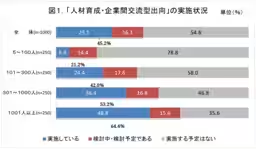
The survey reveals that approximately 29.1% of companies have actively engaged in a program termed "employee development and inter-company exchange secondment," which allows employees to work at an external organization for a specified duration. When combined with the 16.1% of enterprises currently contemplating such an initiative, over 45% of respondents express interest in implementing or testing this kind of secondment. Notably, larger companies are more likely to engage in such practices, with 64.4% of companies with over 1,001 employees participating in or considering secondments.
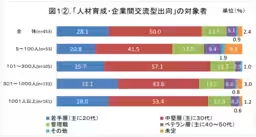
Additionally, those participating mainly target mid-career professionals (50.0%) and young employees (28.1%), indicating a strong focus on cultivating these talent segments.
Anticipated Benefits
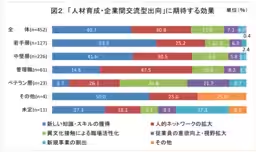
Companies that implement or plan to implement these secondment initiatives primarily expect several benefits: 40.7% anticipate better acquisition of new knowledge and skills, followed closely by 30.8%, who see it as a means to expand professional networks. This is particularly prominent among younger employees, where 53.5% expect skill acquisition, as opposed to their more senior counterparts, who value network expansion at 47.5%.
Challenges and Solutions
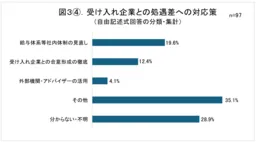
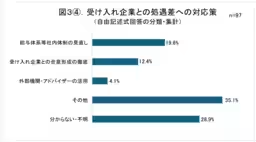
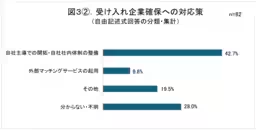
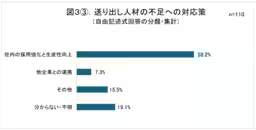
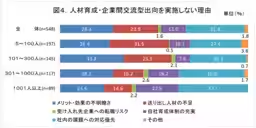
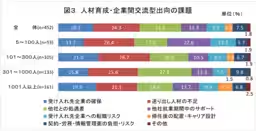
Despite the enthusiasm for secondments, several challenges exist. A significant 24.3% of respondents pointed out a lack of available employees for such transfers, which was the leading concern. Other challenges highlighted include discrepancies in employee treatment at partner companies and securing placement opportunities. Notably, only 31.4% were in favor of not pursuing inter-company secondments due to other pressing priorities within their organizations.
Senior Employee Transition Support
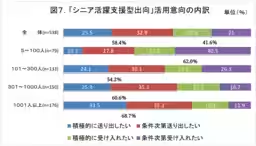
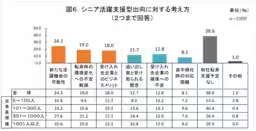
As for the support systems concerning career shifts for senior employees, the responses were a mix of stagnation and progressive strategies. While 38.6% reported no plans to offer secondment support for senior transitions, around 24.3% expressed optimism about aligning employees with new opportunities, and 19.0% acknowledged that this could ease anxiety about environmental changes during transitions.
Furthermore, when asked about the feasibility of implementing support for seniors through secondments, 58.4% showed a willingness to facilitate transfers, either conditionally or actively. Larger firms particularly showed a higher intent to support sending employees to new opportunities as opposed to merely accepting junior staff.
Conclusion
The survey conducted by the Industrial Employment Stability Center underscores a significant trend toward embracing employee development and enhancing inter-company relationships through strategic secondments. Despite the challenges, the willingness from a substantial number of companies to embrace this model could lead to constructive changes in how organizations approach workforce management and career transitions. It not only points to a potential shift in corporate culture but also emphasizes the increasing necessity for adaptive and forward-thinking strategies in human resource management.
This commitment could significantly reduce unemployment during labor mobility and reaffirms the importance of investing in employee capabilities, largely considered a competitive edge in today's dynamic work environment.
Topics People & Culture)

【About Using Articles】
You can freely use the title and article content by linking to the page where the article is posted.
※ Images cannot be used.
【About Links】
Links are free to use.