



Visa Unveils the Value of B2B Card Payments for Suppliers in Japan
Visa's New White Paper on B2B Card Payments
Visa Worldwide Japan, headquartered in Chiyoda, Tokyo, has announced the release of the Japanese version of its white paper titled "The Value of B2B Card Payment Adoption: From Transaction to Transformation - A Report on Major Suppliers in the Asia-Pacific Region".
This white paper has been prepared based on a comprehensive study conducted by KoreFusion, which ran from August to October 2024, targeting 1,000 large enterprises across 12 regions in the Asia-Pacific, including Australia, mainland China, Hong Kong, Indonesia, Japan, Malaysia, New Zealand, the Philippines, Singapore, South Korea, Thailand, and Vietnam. Additionally, qualitative insights were gathered from detailed interviews with 100 businesses in these 13 regions (including India), focusing on 25% card payment adopters and 75% non-adopters to highlight the current state of B2B card payment adoption and the financial and operational advantages for suppliers.
The findings reveal that large enterprises are burdened by significant and often hidden costs when accepting B2B payments through traditional methods like bank transfers, reaching up to 4.7% of B2B sales volume. By adopting card payments, businesses can drastically cut these costs while also experiencing added benefits such as increased revenue, leading to an overall value equivalent to 4.75% of their total B2B sales volume. After accounting for card payment fees, this still results in a profit equivalent to 2.77% of B2B sales, potentially enhancing profit margins by up to 52 basis points.
Key Findings
1. High Billing and Collection Costs: Suppliers face high billing and collection costs equivalent to 4.7% of billed amounts. This includes various directly attributable costs such as billing processing, reconciliation, exception handling, accounts receivable collection, fees, and external financing costs; as well as indirect costs comprising working capital and bad debts.
2. Increased Card Payment Adoption: Businesses that are already using card payments express a desire to increase their card transaction volume. Although card payments currently account for less than 4% of B2B transactions, 96% of businesses adopting card payments are keen on increasing their volume for anticipated revenue growth and reduced acceptance costs. A comparative analysis across industries reveals a trend where the rate of card payments rises, leading to a decrease in overall acceptance costs.
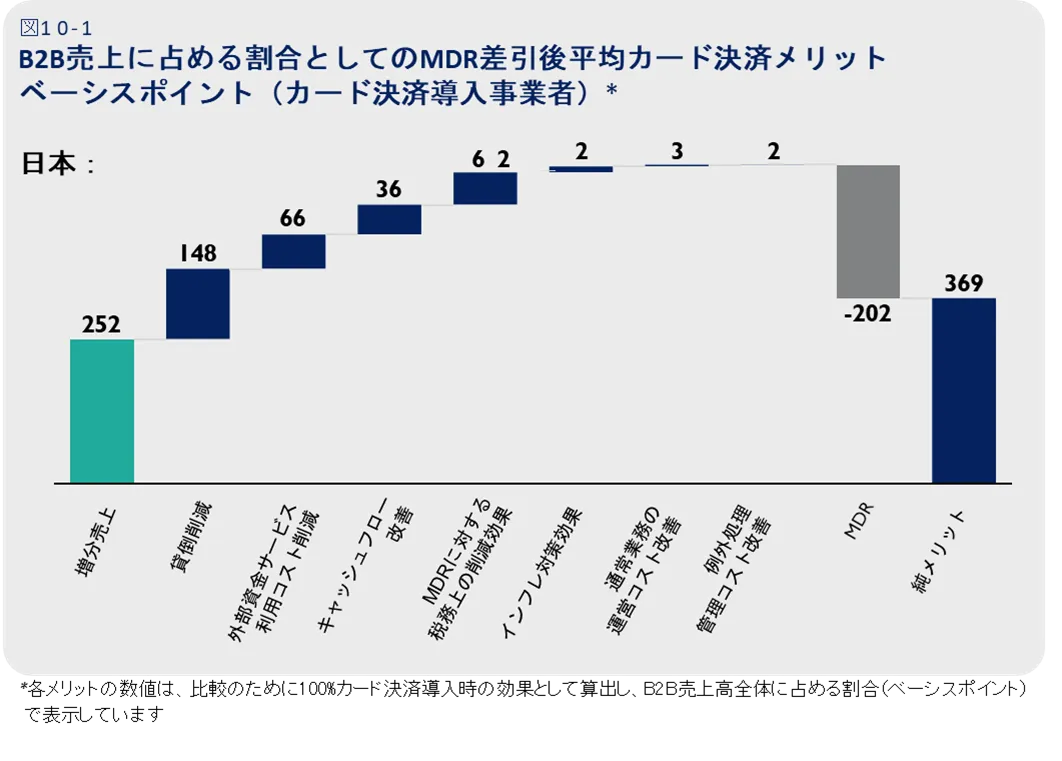
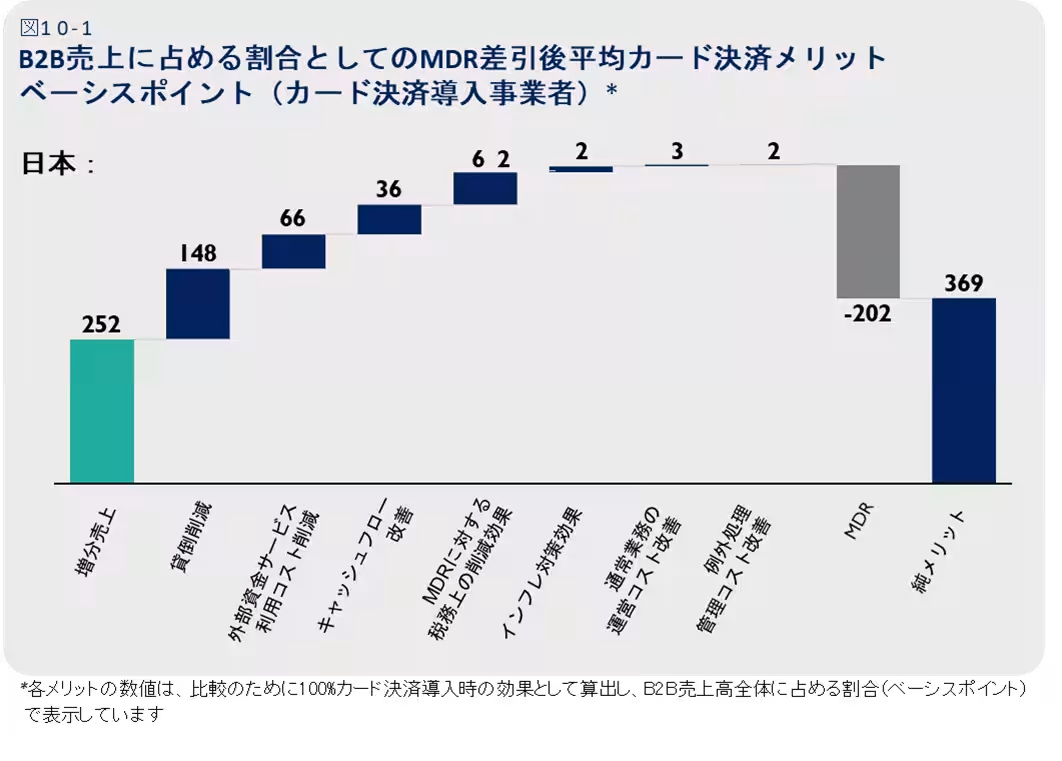
3. Eight Key Advantages of Card Payment Adoption: Adopting card payments can provide suppliers with eight significant benefits: revenue growth, decreased bad debts, reduced external financing costs, improved cash flow, early recovery to mitigate future pricing risks due to inflation, tax advantages, improved operational efficiency, and streamlined exception handling processes. Altogether, these benefits could enable card-adopting businesses to create value equivalent to 475 basis points.
4. Value Exceeding Costs: The research indicates that the value generated from adopting card payments is not only significant but immediate. Even after deducting card fees, there is potential for a maximum benefit of 277 basis points, including a 2.14% revenue increase from B2B sales. Notably, for Japanese enterprises, the potential benefit might reach up to 369 basis points.
For those interested, the Japanese version of the white paper "The Value of B2B Card Payment Adoption: From Transaction to Transformation - A Report on Major Suppliers in the Asia-Pacific Region" can be downloaded from Visa's website.
Visa remains committed to promoting the adoption of B2B card payments, aiming to enhance operational efficiency for businesses and contribute positively to their success.
About Visa
Visa is a global leader in electronic payments, connecting consumers, merchants, financial institutions, and governments through transactions across more than 200 countries and regions. Visa's mission is to link the world with the most innovative, convenient, reliable, and secure payment networks to contribute to the prosperity of individuals, businesses, and economies. We believe that an inclusive economy that serves everyone improves lives and connects them in a future of payments. For more details, visit Visa.com (English site) or www.visa.co.jp (Japanese site).
Topics Business Technology)
【About Using Articles】
You can freely use the title and article content by linking to the page where the article is posted.
※ Images cannot be used.
【About Links】
Links are free to use.