



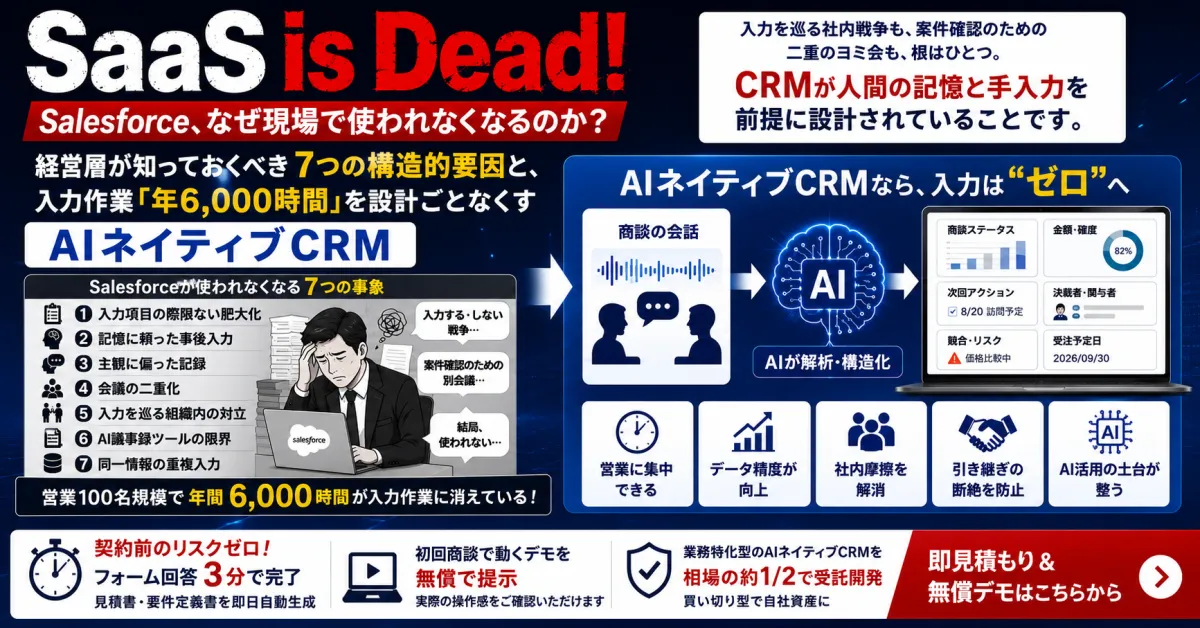
Why Salesforce is Becoming Obsolete in the Workforce: A Deep Dive
Salesforces' Obsolescence in Modern Workplaces
In recent years, the perception of Software as a Service (SaaS) has rapidly evolved, giving rise to questions about its lasting impact on business practices. Notably, Salesforce, a giant in the CRM (Customer Relationship Management) sector, is increasingly viewed as an application that fails to meet the demands of modern sales environments. This article delves into the structural deficits that leave Salesforce ineffective and proposes a transformative solution: an AI-native CRM designed to tackle the foundational issues causing this decline.
The Traditional CRM Problem
Traditional CRMs, including Salesforce, are designed based on manual data entry and human memory. This dependency on remembering and inputting details can create friction between management and staff, ultimately reducing productivity. As organizations grow, so do the complexities and data requirements. Consequently, sales teams often find themselves bogged down by administrative burdens instead of focusing on customer engagement.
The Inefficiency of Data Entry
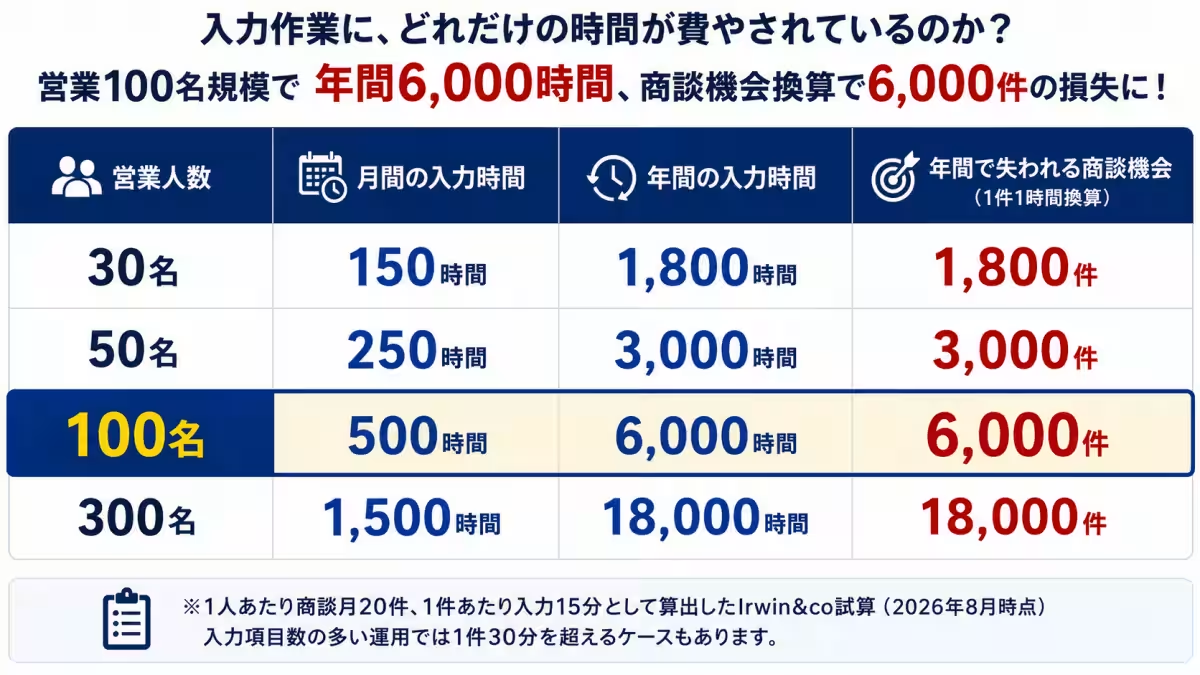
It's estimated that a sales team of 100 employees may spend around 6,000 hours a year just on data input tasks. This substantial amount of time detracts from the primary goal of sales: engaging with customers. Input tasks often rely heavily on memory, resulting in inconsistent records that lack the accuracy needed to derive insights effectively.
Why Sales Teams Are Moving Away from Salesforce
The reasons behind the dwindling adoption of Salesforce in active workflows can be traced back to seven recurring issues:
1. Endless Input Requirements: The continuous augmenting of input fields means that sales personnel must fill in dozens of data points for each deal, leading to frustration and inefficiency.
2. Memory-Dependent Entries: Salespeople often try to recall details of meetings at a later point, resulting in incomplete or imprecise records as time passes.
3. Subjective Reporting: Most entries reflect personal perceptions rather than factual accounts of conversations, compromising the integrity of the data.
4. Duplicated Meetings: Low confidence in data quality leads to repeated verification meetings, thus negating the purpose of the CRM itself.
5. Organizational Friction: Varying input diligence can create tensions within teams, where high performers feel rewarded for their sales efforts but not for entry tasks, leading to resentment.
6. Limitations of AI Tools: Attempts to augment traditional meetings with recording tools often fall short, as extracting precise data for CRM entries remains a manual task.
7. Redundant Data Entry Processes: Sales teams frequently find themselves entering the same data across multiple platforms, increasing redundancy and wasting valuable time.
A Structural Solution: AI-Native CRM
Irwin&co is at the forefront of addressing these challenges with its AI-native CRM solution. Unlike traditional models, this innovative system eradicates the manual input process entirely by automatically structuring and storing conversation data.
Key Benefits of AI-Native CRM
1. Elimination of Manual Input: Using AI, details from sales conversations are directly converted and stored in the relevant CRM fields, ensuring seamless data integration without redundancy.
2. Enhanced Data Accuracy: By recording actual conversations instead of relying on memory, the accuracy and reliability of customer insights significantly improve.
3. Reduced Organizational Conflict: With no manual entry tasks to compare, organizational tensions can dissipate, allowing managers to focus on strategic decisions rather than data supervision.
4. Protection Against Customer Loss: Complete and contextual historical data remains available, which can be critical during employee turnover, allowing new team members to maintain strong customer relationships.
5. Foundation for AI Utilization: High-quality accumulative data provides a rich resource for AI-driven insights, advancing the organization’s analytical capabilities.
Irwin&co’s solution thus lays the groundwork for an efficient, data-driven approach to customer relationship management, freeing sales teams from administrative burdens while empowering them to focus on what truly matters: building customer relationships.
FAQs about AI-Native CRM
Q: How does an AI-native CRM differ from traditional CRMs?
A: The fundamental difference lies in its design, which eliminates the manual data entry process altogether by automatically recording and structuring conversation data.
Q: Can the issues with input rates be resolved through better operational rules?
A: Past experiences show that solutions based on operational enforcement fail to address core design flaws that lead to inconsistent data entry.
Q: Are there capabilities that traditional AI tools cannot replicate in CRMs?
A: Yes. Standard AI-based note-taking can provide summaries but falls short by still requiring manual translation into structured data for usage within CRM systems.
For organizations struggling with Salesforce or exploring better alternatives, Irwin&co offers a chance to revolutionize their CRM practices through innovative technologies designed for a data-driven future.
Topics Business Technology)
【About Using Articles】
You can freely use the title and article content by linking to the page where the article is posted.
※ Images cannot be used.
【About Links】
Links are free to use.