




World Record Achieved: 450 Terabits Per Second Over Existing Fiber Optics
World Record Achieved: 450 Terabits Per Second Over Existing Fiber Optics
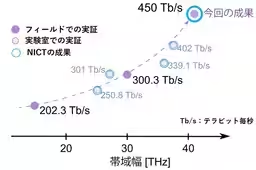
An international research team, led by the National Institute of Information and Communications Technology (NICT) in Japan, has achieved a remarkable milestone in optical communication. They successfully demonstrated a data transmission rate of 450 terabits per second using existing optical fibers laid in urban areas, specifically between University College London (UCL) and the Telehouse North data center in London. This achievement marks a new world record for data capacity over traditional fiber optics, surpassing the previous record of 430 terabits per second established in 2025.
Experimental Highlights
The research utilized a groundbreaking transmission system that incorporated a frequency band expanding beyond the standard C and L bands, typically used in commercial optical communication systems. By integrating additional wavelengths from the O, E, and S bands, the team enhanced the usable bandwidth by over four times, achieving a colossal 42.4 terahertz frequency range. This innovative approach demonstrates the ability to vastly increase transmission capacity without the need for massive infrastructure investments.
This field demonstration, conducted in a real operating environment instead of a controlled laboratory setting, signifies a crucial step towards maximizing the potential of existing optical communication infrastructure. The innovative method not only presents a cost-effective solution for urban areas where laying new fiber cables is difficult but also lays the groundwork for future developments in ultra-high-capacity mobile systems beyond 5G, which are expected to rely heavily on next-generation communication networks.
Research Background
With the rise of new technologies such as artificial intelligence, the demand for ultra-high-capacity communication networks is rapidly increasing. To address this need, research and development efforts have focused on multi-band wavelength multiplexing (WDM) technologies designed to add new wavelength bands to optical fiber communication, thereby increasing transmission capacity. This new approach intends to optimize existing fiber optics, especially in urban environments where new construction is challenging.
Historically, experiments demonstrating multi-band WDM systems have been conducted in laboratory settings. However, implementing these systems in real-world conditions poses significant challenges due to higher losses and inconsistencies present in operational environments compared to controlled experiments. Therefore, this latest field demonstration is a crucial evaluation step contributing to the practical application of these technologies.
Insights from the Experiment
The NICT-led research group achieved what is now the most extensive bandwidth optical fiber transmission system reported to date. The system includes up to 1,273 wavelength channels spreading across the O, E, S, C, and L bands, creating a frequency bandwidth of 42.4 terahertz (spanning from 1,264.0 nm to 1,617.8 nm). Utilizing advanced modulation schemes—polarization multiplexed QPSK, 16QAM, 64QAM, and 256QAM—facilitated high data rates.
In this field trial, the optical fiber connecting UCL and the Telehouse North data center encompassed a distance of 19.5 kilometers. Despite bearing similar specifications to conventional commercial optical fibers, the fibers utilized in the test were part of an existing underground infrastructure. Factors such as connector losses and past repairs contributed to increased light loss compared to laboratory-grade fibers, reflecting real-world conditions.
Returning the wideband WDM optical signal over 39 kilometers of fiber, the obtained effective data rate, assuming ideal error correction coding, reached 450 terabits per second—setting a new world record in existing optical fiber transmission capacity, confirming the viability of exploiting new wavelength bands for significant expansion without exorbitant costs or lengthy implementation times.
Future Prospects
Going forward, NICT aims to extend frequency bandwidth and develop new transmission techniques to facilitate ultra-high-capacity and long-distance communication. By integrating this technology into existing communication infrastructures, the team hopes to pave the way for next-generation communication networks capable of meeting future demands.
The findings from this experiment were presented at the upcoming Optical Fiber Communication Conference 2026 in Los Angeles, where they received high praise and were honored as a best hot topic paper. The presentation is set for March 19, 2026, showcasing the pioneering efforts in the field of optical communication and shedding light on the future of high-capacity communications.


Topics Consumer Technology)
【About Using Articles】
You can freely use the title and article content by linking to the page where the article is posted.
※ Images cannot be used.
【About Links】
Links are free to use.