



Revealing the Mechanisms of Neuron Movement in Fetal Brain Development Using Computer Models
Investigating Neuron Movement In the Fetal Brain
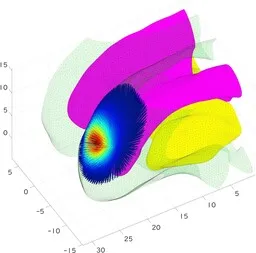
Recent research involving a collaboration between Tokai University, Kochi University, and the Medical University of Vienna has made significant strides in understanding the development of the human fetal brain. Led by Professor Fumitaka Homae, this study has utilized computational models to virtually construct the radial scaffolds that support neuron movement during critical periods of brain formation. The research highlights the patterns of neuron movement in the fetal brain and unveils crucial insights into the biological foundations behind cerebral development.
Overview of the Research
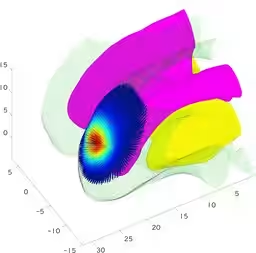
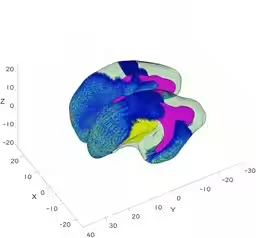
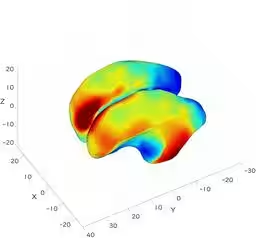
The study centers around the mechanisms that enable neurons to migrate within the fetal brain, focusing specifically on the brain's ventricular areas and cortical plate layers. Utilizing a unique mathematical framework, researchers incorporated the geometric relationships between the ventricular surfaces and the underlying cortical plate to simulate the spatial gradients where neurons are generated. The result of this meticulously designed model reveals that the distribution of scaffolds is not uniform across the brain; rather, they are concentrated in specific regions, particularly around the Sylvian fissure. It suggests that this area may play a vital role in developmental processes and the formation of intricate folding structures in the brain.
This research integrated biological knowledge with neuroimaging data within a computational model, shedding light on the significant factors contributing to large-scale cerebral morphology that previous biological studies had not fully addressed.
Key Points of Discovery
- - Construction of virtual scaffolds that support neuron movement during fetal brain development.
- - The design of a computational model that incorporates the morphologies and positions of the ventricular systems and cortical layers along with neuron generation gradients.
- - Reproduction of observed patterns of neuron migration, showing a concentration of neural movement particularly around the Sylvian fissure.
- - Implications for understanding the neural bases for distinctly human functions such as language and cognitive development.
Background of the Study
The human cerebral cortex undergoes rapid growth during fetal development, especially from mid to late pregnancy. During this period, the surface of the brain expands significantly, leading to the formation of complex features such as sulci and gyri. The encasement of the insular cortex by surrounding brain regions—a phenomenon known as the
Topics Other)









【About Using Articles】
You can freely use the title and article content by linking to the page where the article is posted.
※ Images cannot be used.
【About Links】
Links are free to use.