



Tradom and JPYC Launch Japan's First Cross-Border Stablecoin Payment Service
Tradom and JPYC: Pioneering Cross-Border Stablecoin Payments in Japan
In a groundbreaking move, Tradom Inc. and JPYC Corp. have officially launched Japan's first cross-border stablecoin payment service, named "Tradom Payment," set to enhance international trade for Japanese businesses. Announced on May 22, 2026, this service represents a significant innovation in Japan's payment infrastructure, allowing transactions that bridge digital currencies and traditional fiat.
Service Overview
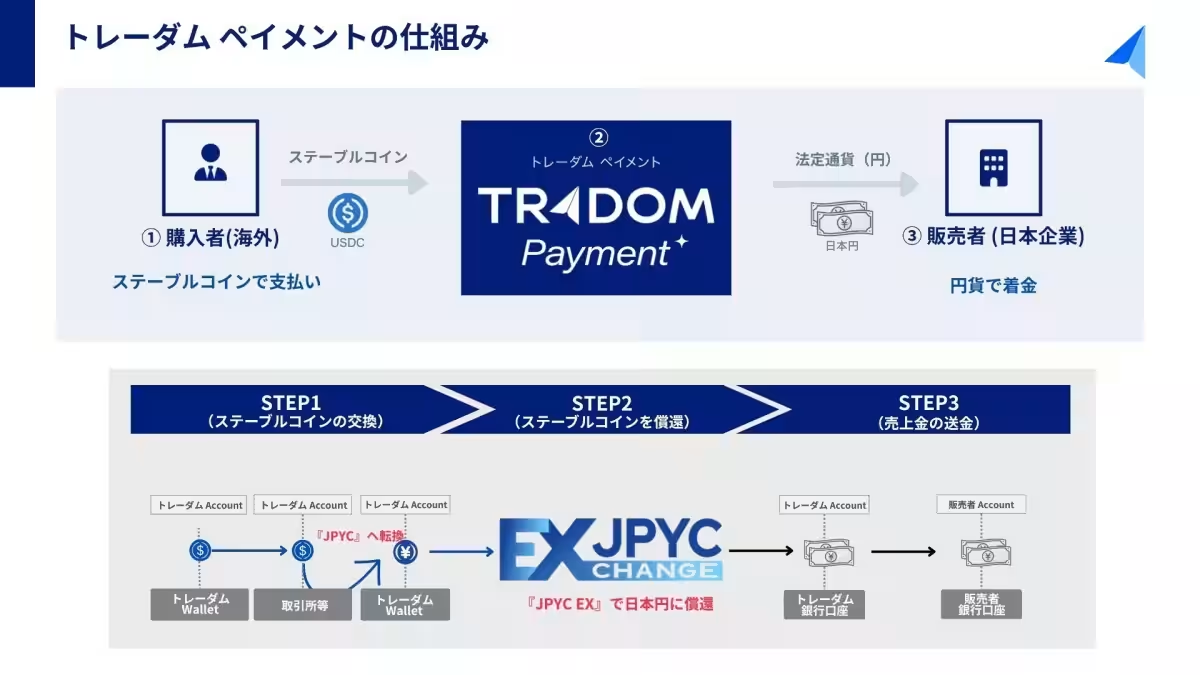
The primary objective of this initiative is to streamline cross-border transactions, particularly focusing on incorporating stablecoins into everyday business operations without requiring firms to hold these digital assets directly. The process operates as follows:
1. A foreign buyer makes a payment using stablecoins through the "Tradom Payment" service.
2. JPYC Corp.'s service, "JPYC EX," facilitates the conversion of stablecoins to Japanese yen, enabling the payment to be settled in Japan's local currency.
3. Finally, the transaction is completed with the Japanese domestic business receiving the payment in yen.
This innovative model represents the dawn of a new era in cross-border dealings, with a distinct separation of stablecoin use overseas and fiat currency transactions within Japan.
Real Transactions, Not Just PoC
Unlike many experimental proof-of-concept (PoC) initiatives, this project has successfully transitioned into a fully operational payment service. The trial has already established actual commercial transactions, making it a remarkable benchmark for Japan's international payment framework.
Moving forward, the collaboration between Tradom and JPYC aims to streamline large-scale transaction processing through API integrations, while enhancing real-time cross-border payment capabilities. Applications for this service range across various domains, including cross-border e-commerce, trade exchanges, digital content sales, and global B2B payments.
Future Outlook
Both firms are gearing towards automatic yen conversion processing via API integration, positioning themselves to accommodate a surge in transaction volume. The ambition is clear: to facilitate not only the swift conversion of currencies but also to enhance the seamless flow of international commerce, aiding Japanese companies to expand their global reach.
Leadership Vision
Shinchiro Urashima and Shinichi Sakan, Co-CEOs of Tradom, hailed the successful implementation of this stablecoin transaction model as a substantial advancement in Japan's international payment infrastructure. They have emphasized the importance of creating an environment where stablecoins can thrive alongside fiat currencies within the domestic market. The executives remain committed to continuous innovation, focusing on the creation of a user-friendly cross-border payment ecosystem.
Correspondingly, Noritaka Okabe, CEO of JPYC Corp., expressed his pride in collaborating with Tradom to actualize cross-border stablecoin payments. He highlighted how utilizing the JPYC stablecoin would address long-standing issues in traditional overseas transfers, such as exorbitant fees and lengthy processing times.
This partnership signifies a transformative leap, setting the stage for enhanced economic interactions beyond borders and ultimately reinforcing the growth of Japanese businesses in the international marketplace.
About Tradom Inc.
Tradom Inc. is a financial technology firm specializing in solutions to manage foreign exchange risk – a critical challenge for global businesses. By integrating advanced quantitative models and artificial intelligence into their financial systems, Tradom focuses on empowering companies to navigate the complexities of international finance. The firm was established in January 2015 and continues to evolve alongside the dynamic fintech landscape, committed to accelerating innovation.
Company Details
- - Company Name: Tradom Inc.
- - Headquarters: 1-6-1 Otemachi, Chiyoda, Tokyo, Japan
- - Capital: ¥683,813,266
- - Website: Tradom Website
- - Registration Number: Kanto Finance Bureau No. 3329
- - Certificate: ISO/IEC 27001:2022


Topics Financial Services & Investing)
【About Using Articles】
You can freely use the title and article content by linking to the page where the article is posted.
※ Images cannot be used.
【About Links】
Links are free to use.