


Revolutionizing Disaster Response: The New Flood Warning DX System for Prefectures
Revolutionizing Disaster Response with a New System
In a world increasingly plagued by severe weather events, the need for effective disaster response systems has never been more pressing. The Construction Technology Research Institute, headquartered in Chuo Ward, Tokyo, has taken significant strides towards enhancing disaster management by digitizing flood warning announcement operations. This innovation, termed the Flood Warning Support System, aims to streamline the dissemination of flood warnings and water level information, ultimately lightening the burden on local authorities’ disaster response teams.
A Comprehensive Solution for Prefectures
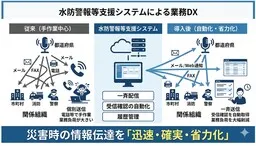
The Flood Warning Support System provides a unified web-based platform that supports local governments in issuing flood warnings, relaying water level attainment information, and communicating flood forecasts for nationally managed rivers. By automating administrative tasks previously reliant on manual processes, this system significantly reduces the workload of government employees tasked with disaster response, allowing them to focus on critical operations rather than procedural minutiae.
Key features of the system include:
- - Drafting warning announcements
- - Verifying recipients within relevant agencies
- - Sending announcements via FAX and email
- - Monitoring the confirmation of receipts
- - Creating official documentation for records
By centralizing these operations, the system minimizes reliance on individual personnel and reduces the occurrence of manual errors, thus enhancing overall efficiency.
Embracing Digital Transformation (DX)
The adaptability of the Flood Warning Support System is one of its standout features. It is built to accommodate various modes of communication, seamlessly integrating emails and faxes into one coherent process. This ensures that municipalities of different sizes and capabilities can implement it easily.
Notably, the system visualizes the receipt confirmation status from all institutions on screen, eliminating the need for government personnel to make individual follow-up calls. Moreover, it can automatically output receipt confirmation logs in Excel format, easing the post-event reporting process and simplifying record-keeping.
In addition to these functionalities, the Flood Warning Support System also integrates with the company's Flood Risk Mapping System, named RisKma. This added layer aids local authorities in making informed decisions based on real-time data, such as rainfall forecasts and water level predictions.
Ensuring Accuracy During Crises
During disaster situations, it is crucial for officials to efficiently ascertain whether messages have been accurately relayed and received by all relevant parties. The Flood Warning Support System facilitates this by offering a detailed overview of who confirmed receipt, when, and through which channels. This transparency not only assures the reliability of communications but also enables personnel to effectively manage the overall situation.
Proven Track Record in Gunma
The Flood Warning Support System boasts an impressive track record, having been operational in Gunma Prefecture for around five years. It has proven its worth in real-world situations, providing effective support during flood events and streamlining operations significantly. Building on its success in Gunma, the company has recently secured a new contract to implement the system in Mie Prefecture, further expanding its usage.
Future Prospects
The Construction Technology Research Institute is committed to advancing the Flood Warning Support System as a pioneering digital infrastructure for flood disaster management. Future initiatives include:
- - Strengthening synergies with disaster information systems
- - Improving usability and visibility
Looking ahead, there are plans to roll out this system across other prefectures nationally while enhancing the entire flood management process by incorporating water level monitoring and inundation predictions into its operations. This innovation not only signifies a technological advancement but also enhances the resilience of communities facing increasingly frequent flooding events.
Topics Policy & Public Interest)

【About Using Articles】
You can freely use the title and article content by linking to the page where the article is posted.
※ Images cannot be used.
【About Links】
Links are free to use.