



New Technique Evaluates Nanostructures in Polyethylene Glycol Using Melting Point Measurement Alone
Overview of the Breakthrough in Nanostructure Evaluation
A collaborative research initiative led by Toray Research Center, Inc. (TRC) in Tokyo, in partnership with Toray Industries Europe GmbH, Ulm University, and the Hahn-Schickard Association for Applied Research, has achieved a significant breakthrough in nanotechnology. The team has developed a new method to effectively evaluate the nanoscale structures formed by Polyethylene Glycol (PEG) in aqueous solutions through melting point measurements alone. This innovative technique not only enhances the understanding of PEG's behavior in a water medium but also significantly contributes to the optimization of its applications in pharmaceuticals and cosmetics.
Importance of Polyethylene Glycol in Various Fields
Polyethylene Glycol (PEG) has become a substance of paramount importance across a range of sectors, such as medicine, cosmetics, and food due to its excellent safety profile and hydrophilicity. The structural integrity and thermal properties of PEG when mixed with water are critical factors that influence product quality and efficacy. Traditional analysis methods have struggled to assess these properties accurately, particularly because the structures in question often fall at the nanoscale, making conventional techniques insufficient.
The Novel Evaluation Technique
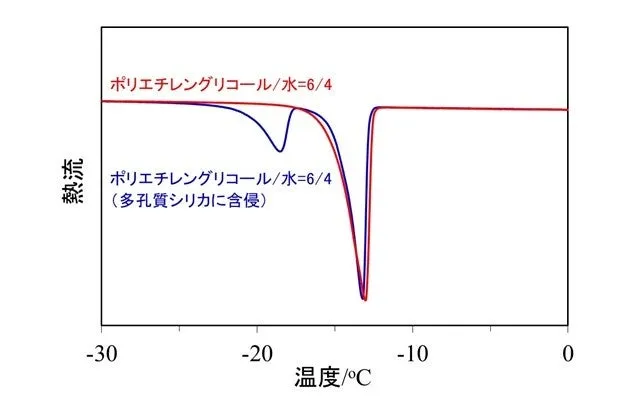
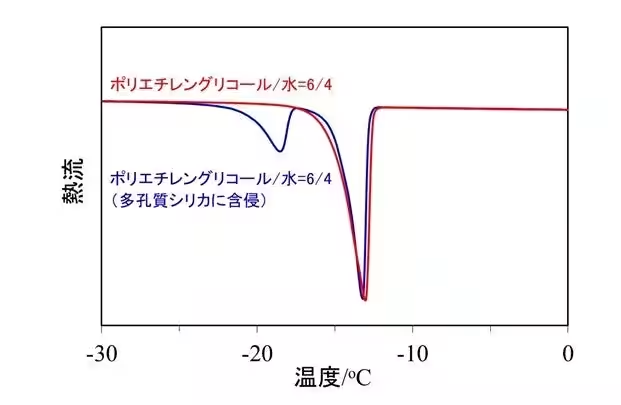
The researchers focused on how the melting point of PEG changes when it is confined in nanoscale environments, which reveals critical information about its structure. By saturating silica-based porous materials with PEG solutions and employing Differential Scanning Calorimetry (DSC) to measure melting points, they observed distinct peaks corresponding to different states of PEG. This dual peak phenomenon indicated that the melting point decreases when PEG is confined, which is linked to the aggregation size (domain size) of PEG.
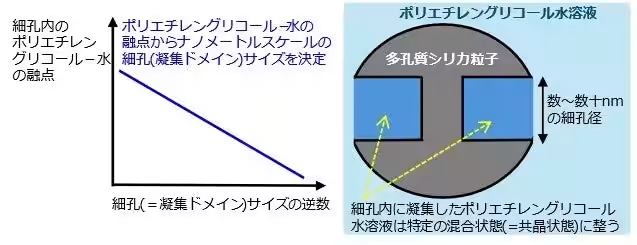
What's particularly noteworthy is the established inverse relationship between the low-temperature melting point and the inverse of the PEG aggregation size. This correlation suggests that simply measuring the melting point can provide insights into the nanoscale domain size of PEG in water, presenting a streamlined evaluation approach for PEG nanoparticles.
Implications for Future Applications
The results of this research can lead to substantial advancements in various sectors. For instance, the new technique is expected to enhance the efficiency of drug carrier designs in pharmaceutical applications, improve quality assessments for cosmetic and food products, and enable the development of novel separation and concentration technologies that employ nanoporosity for high-purity pharmaceuticals.
Furthermore, the researchers found that when confined in nanosized pores, PEG solutions tend to organize into a specific mixed state that is energetically favored, irrespective of concentration. This finding has profound implications for enhancing PEG solution separation, purification, and concentration techniques.
Figure 1: DSC curves of a 60% PEG aqueous solution showing melting behavior.
Figure 2: Correlation between the low-temperature melting point and aggregation size of PEG in nanoscale spaces.
Conclusion and Future Prospects
This innovative evaluation method promises to accelerate materials assessment processes, streamline drug carrier design, and elevate quality control efforts across industries. Toray Research Center is committed to delivering cutting-edge and reliable analytical techniques to support progress in various fields related to polymer materials. As this research is further disseminated through publications such as ACS Omega, it inspires future investigations into the complex interactions of polymer solutions at the nanoscale.
Published Research
The findings of this research have been published in the well-respected open-access journal, ACS Omega, which is known for its broad coverage of materials science, medicinal chemistry, and environmental science. The paper titled "Melting point as a nanoscale ruler: domain sizes in polyethylene glycol–water system" serves as a foundational reference for future inquiries into polymer behavior and applications.
The authors of the publication include Yoshitomo Furushima, E. Billur Sevinis Ozbulut, Yuki Yoshida among others. For more details, the full article can be accessed here.
Topics Consumer Technology)
【About Using Articles】
You can freely use the title and article content by linking to the page where the article is posted.
※ Images cannot be used.
【About Links】
Links are free to use.