



Hitachi's Successful Experiment Automates Business Transactions Using Tokenized Deposits
Hitachi's Successful Experiment in Automating Business Transactions Using Tokenized Deposits
Hitachi Ltd. has achieved a significant milestone in automating business transactions by successfully conducting a proof-of-concept that utilizes tokenized deposits. This innovative experiment focuses on automating the entire business process flow—from order placements to payment and accounting. The results indicate a substantial reduction in the workload for financial and accounting departments, while also highlighting the potential for full automation in the future.
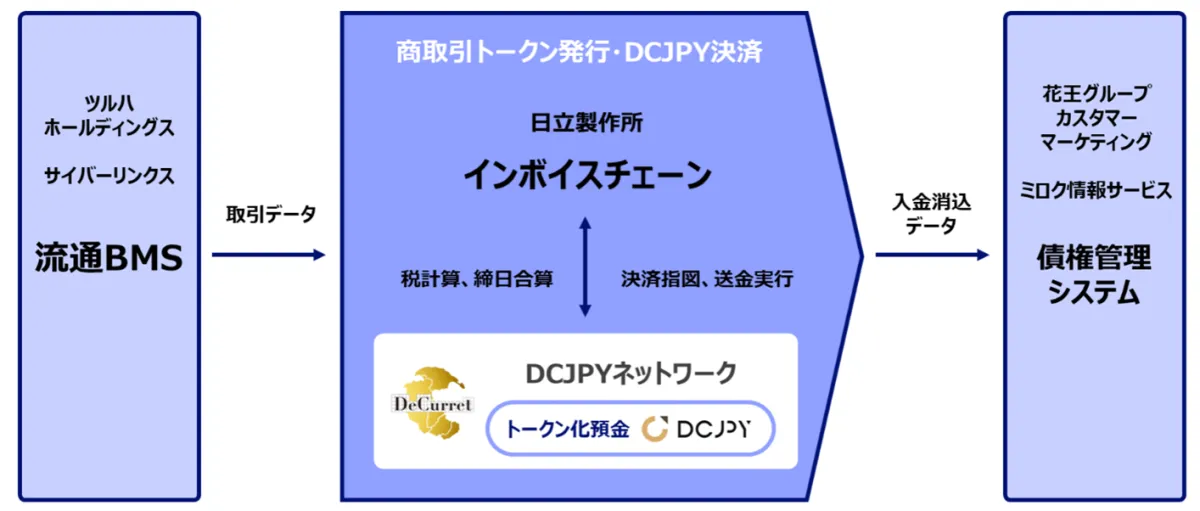
In this experiment, Hitachi leveraged blockchain technology to develop and provide key functionalities for a common platform known as the "Invoice Chain." This platform integrates payment processing through tokenized deposits—specifically the DCJPY—and order processing using the Business Message Standards (BMS) on a blockchain infrastructure. By doing so, Hitachi aims to execute commercial flows and financial flows in a one-stop manner. This will lead to faster and more automated transaction processing and provide a reliable framework to prevent inconsistencies between order details and payment information.
The proof-of-concept was a collaborative effort involving nine companies that share a commitment to its goals, with the Digital Currency Forum's Invoice Chain Subcommittee acting as the organizing body. The participating companies included significant players such as AEON Smart Technology, Ikeda Senshu Bank, Kao Group Customer Marketing, Cyberlinks, Tsuruha Holdings, Decurret DCP, Fujitsu, and Miroku Information Service.
Background: Challenges in Business Transactions and Expectations from Tokenized Deposits
Many companies today are still heavily dependent on manual procedures in their internal systems, resulting in fragmented workflows across various business applications. This silos issue often leads to time-consuming tasks, such as issuing invoices, confirming payments, and reconciling receipts. The Invoice Chain concept aims to address these pressing challenges by utilizing the DCJPY tokenized deposit to integrate commercial and financial flows, thereby creating seamless business transactions.
The Invoice Chain operates on a blockchain foundation, which ensures the integrity and transparency of transaction data. By following predetermined conditions, payments can be executed automatically while synchronous transaction details are transferred securely to accounting departments. This is expected to significantly enhance efficiency in inter-company transactions.
As a founding member of the Invoice Chain Subcommittee, Hitachi has utilized its extensive experience in constructing systems across various sectors, including finance and distribution. The company contributed to the design and development of solutions for the tokenized transaction framework discussed in the Subcommittee, helping facilitate critical discussions and decisions, as well as providing necessary functionalities for the Invoice Chain.
Experiment Overview: Seamless Integration of Transactions via the Invoice Chain
The proof-of-concept focused on the automation of business transactions within the consumer goods distribution sector using the standard EDI specifications defined in the BMS. Hitachi successfully enabled three integral processing steps in a single platform—utilizing the Invoice Chain:
1. Linking Order Data with Payment Information
Receipt and return data were gathered from Tsuruha Group's order management system to generate a commercial transaction token (NFT) for the Kao Group Customer Marketing.
2. Payment via Tokenized Deposits
Payment processing was completed through the DCJPY token based on the generated commercial transaction token.
3. Automatic Generation of Reconciliation Files
Upon completion of the payment, reconciliation files based on receivables data from the debt management system were generated, confirming no issues in the reconciliation process.
These processes successfully connected existing order management systems and receivables management systems, integrating and streamlining the inter-company transaction procedure via the Invoice Chain, aiming to reduce the workload across finance and accounting departments significantly.
Future Perspectives: Realizing a Trustworthy DX with Human and AI Collaboration
Moving forward, Hitachi aims to promote efficiency and automation in inter-company transactions utilizing tokenized deposits, alongside participating companies in the Invoice Chain Subcommittee. By expanding the application of the blockchain across various sectors, the company is committed to enabling secure circulation of goods and funds and fostering trustworthy transactions within a "Token Economy."
Further, as society moves toward a future where AI agents handle procurement and payments on behalf of humans, Hitachi seeks to provide reliable digital infrastructures that do not allow for fraud or tampering. This will contribute to the realization of a trustworthy digital transformation (DX), enabling safe transactions between humans and AI.
For further information regarding Hitachi's blockchain initiatives or this proof-of-concept, visit the relevant websites mentioned below:
- - Hitachi Blockchain Overview: Hitachi Blockchain Introduction
- - Hitachi Digital Evolution Headline Case Study: Navigating the Wall of Proof
- - Decurret DCP Press Release: Decurret DCP News Release
In this rapidly changing landscape, Hitachi is poised to lead the charge in revolutionary business automation, blending innovative technologies with robust practices for generations to come.
Topics Business Technology)
【About Using Articles】
You can freely use the title and article content by linking to the page where the article is posted.
※ Images cannot be used.
【About Links】
Links are free to use.