



Innovative Dielectric Material Developed for High-Temperature Capacitors in Automotive Applications
Development of a High-Temperature Dielectric Material
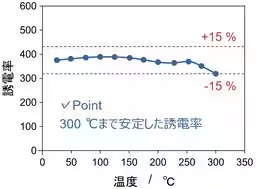
In a significant advancement for automotive technology, researchers at the Tokyo Metropolitan Industrial Technology Research Institute have developed a novel dielectric material capable of withstanding temperatures up to 300℃. This breakthrough aims to improve the performance and reliability of capacitors operating in high-temperature environments, such as automotive engine rooms. Traditionally, dielectric materials used in capacitors have exhibited critical fluctuations in dielectric constant at temperatures exceeding 120℃, leading to a demand for materials that maintain stability up to at least 200℃.
To tackle this challenge, the research team has introduced a “glass-composite dielectric material,” which shows stable dielectric properties within the specified temperature range. The new material not only provides stability at elevated temperatures but also contributes to enhancing the overall performance of electronic devices subjected to high heat.
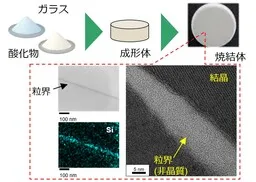
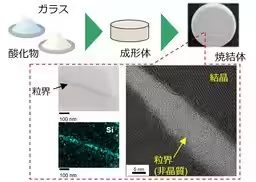
The development process involves the innovative synthesis of PNb9O25 crystals, which are joined together using glass. This novel method allows for simultaneous crystal synthesis and glass bonding through a simplified process. Results indicate that the dielectric constant changes by no more than ±15% up to 300℃, effectively addressing the previous limitations faced by conventional dielectric materials. Additionally, the new material demonstrates a remarkable reduction in electrical conductivity by two orders of magnitude, significantly improving its insulating properties compared to typically synthesized PNb9O25.
Key Features of the Development
1. Synthesis Method: The team has created a glass-composite dielectric material by fusing PNb9O25 crystals with glass, a process that simplifies the manufacturing approach while ensuring high performance.
2. Temperature Stability: The newly developed material maintains a stable dielectric constant, with variability remaining within ±15% up to 300℃, which is crucial for high-temperature applications.
3. Insulation Improvement: The electrical conductivity has been minimized, offering far superior insulation compared to standard materials, thus enhancing the reliability of capacitors in extreme environments.
Impact on Automotive Technology
The impact of this innovative dielectric material is expected to be substantial, particularly for electronic components used in diverse automotive applications. This advancement not only boosts the reliability of capacitors under extreme thermal conditions but also opens new opportunities for the development of high-performance electronic devices in other industries that face similar heat challenges.
The findings of this research have been published in the journal Materials Today Communications, with a paper titled High-Temperature Capacitance Stability and Insulating Properties of PNb9O25 Synthesized via Liquid-Phase Sintering: Strategic Utilization of Glass-Oxide Interfacial Reactions. Authored by researchers Keisuke Shimamura, Daisuke Ogawa, Chihayuki Fujiwara, Hiroshi Namiki, and Naoki Tachibana, the paper is scheduled for online release on June 11, 2026. The team has also filed a patent application under the number 2025-183682, ensuring the protection of their innovative work on high-temperature dielectric materials.
As industries continue to push for advancements in technology that require enhanced thermal performance, this glass-composite dielectric material stands out as a promising solution for future applications. The ongoing research at the Tokyo Metropolitan Industrial Technology Research Institute exemplifies how innovative approaches can lead to breakthroughs in essential materials science, ultimately propelling the automotive sector forward into a new era of high-performance electronics.
Topics Consumer Technology)
【About Using Articles】
You can freely use the title and article content by linking to the page where the article is posted.
※ Images cannot be used.
【About Links】
Links are free to use.