



Innovative Catalyst Synthesized to Transform CO₂ into Resourceful Materials
Groundbreaking Catalyst Development
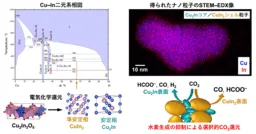
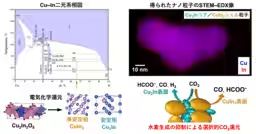
In an impressive leap for material science, a research group led by Soichi Kikkawa from Tokyo Metropolitan University has succeeded in synthesizing a copper-indium intermetallic compound, CuIn2, as nanoparticles using electrochemical reduction methods. This compound, previously thought unattainable, showcases significant potential for catalyzing CO₂ reduction reactions. The innovative approach utilizes complex metal oxides as precursors, leading to the formation of a core-shell structure that suppresses hydrogen production in favor of valuable chemical products like carbon monoxide and formate.
Understanding Metastability and Its Relevance
The concept of metastability plays a crucial role in this research. Unlike stable phases which are thermodynamically favored, metastable phases can exist under specific conditions, offering unique electronic properties and reaction characteristics that differ from their stable counterparts. This research validates that utilizing electrochemical reactions can yield metastable intermetallic compounds that conventional thermodynamic methods cannot achieve. The ability to synthesize such materials points to new paths for future catalyst designs and functional materials, particularly in the realm of CO₂ conversion.
Novel Synthesis Approach
Beginning with complex metal oxide Cu2In2O5, the research team performed CO₂ reduction, which involved a non-equilibrium restructuring process that led to the formation of a core of Cu2In with a CuIn2 shell. Through advanced techniques such as X-ray diffraction and scanning transmission electron microscopy, researchers confirmed the unique structure of these nanoparticles. Specifically, they found that the CuIn2 layer heavily contained indium while maintaining copper indium as the core, highlighting how careful manipulation of atomic arrangements can lead to unprecedented material properties.
To test the stability of the synthesized particles, the team subjected them to heat treatment at 523 K. Results indicated that CuIn2 disappeared and transformed into stable phases like Cu11In9 and indium oxide (In2O3). However, upon reintroducing these particles into an electrochemical reduction environment, CuIn2 could be regenerated, further underscoring its metastable nature.
Implications for CO₂ Reduction
When assessing the catalytic activity of the nanoparticles for CO₂ reduction reactions, the team found that the formation of hydrogen gas was significantly inhibited, enabling the selective production of carbon monoxide and formate. Notably, this introduces a novel method for enhancing product selectivity in carbon dioxide reduction—crucial for maximizing efficiency in carbon capture technologies. The theoretical calculations indicated a competitive adsorption of carbon monoxide and hydrogen on the same site of the CuIn2 surface, suggesting that the presence of carbon monoxide inhibits the hydrogen evolution reaction (HER), which is otherwise often problematic in electrochemical systems seeking to convert CO₂.
Future Directions and Broader Impact
This breakthrough opens avenues not just for catalyzing CO₂ reduction, but also for innovative applications in electronic and magnetic materials, suggesting a versatility that extends beyond merely serving as catalysts. Future research could adapt these findings to other complex metal oxides, promoting the synthesis and discovery of various metastable intermetallic compounds previously unattainable through conventional methods. Additionally, these findings could significantly impact the development of advanced functional materials in diverse fields, hinting at a new era in material science propelled by the principles of non-equilibrium restructuring.
In conclusion, the implications of this research, supported by the strategic funding from organizations such as JST and JSPS, are profound, hinting at the potential for developing novel catalysts and functional materials critical in tackling pressing global challenges like climate change and sustainable energy production. As the world strives for innovative solutions, this exciting research paves the way for groundbreaking advancements in material synthesis and catalysis.
Topics Consumer Technology)
【About Using Articles】
You can freely use the title and article content by linking to the page where the article is posted.
※ Images cannot be used.
【About Links】
Links are free to use.