




New Research Identifies Source of Turban Shells Used in Mother-of-Pearl Art
New Research Identifies Source of Turban Shells Used in Mother-of-Pearl Art
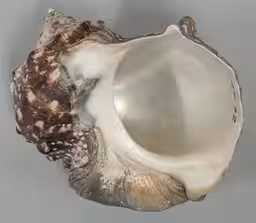
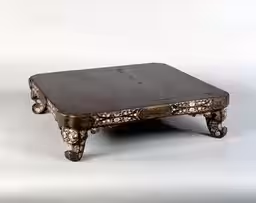
Recent collaborative research conducted by a group of scientists from Kanazawa University and the MOA Museum has made significant progress in tracing the origins of turban shells, specifically Turbo marmoratus, which are utilized in traditional mother-of-pearl craftsmanship known as raden. This successful identification of their habitat could illuminate historical trade routes and cultural exchanges in East and Southeast Asia, particularly regarding the art of raden.
Background of the Research
Turbo marmoratus is a large marine snail with a shell diameter exceeding 20 cm and a weight of up to 2 kg. It thrives in the tropical coral reefs of the Indian Ocean and the western Pacific. Known for its beautiful nacreous layer, it has been a primary material in making mother-of-pearl decorative art since the Nara period in Japan and the Tang dynasty in China. In Japan, 20 national treasures and 64 important cultural properties designated as tangible cultural assets include items made from this shell, underscoring its high cultural significance.
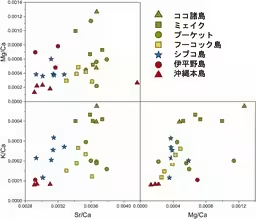
The breakthrough study was led by the museum's director, Tokugo Uchida. By analyzing trace elements found in the shells collected from various locations, the researchers demonstrated the unique elemental ratios of Turbo marmoratus in different habitats. They identified ratios of strontium to calcium (Sr/Ca), magnesium to calcium (Mg/Ca), and potassium to calcium (K/Ca) that vary regionally, reflecting the environmental conditions that influence these elements' concentrations.
Methodology and Findings
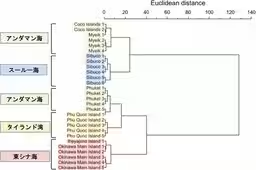
The research team collected samples from four regions: the Andaman Sea (Coco Islands and Myanmar), the Gulf of Thailand (Phu Quoc Island, Vietnam), the Sulu Sea (Sibuco, Philippines), and the East China Sea (Ie Island and Okinawa, Japan). They used methods like ICP-MS, ICP-OES, and non-destructive X-Ray Fluorescence (XRF) to analyze 30 shells for trace elements.
The results indicated a tendency for samples collected from the same sea to group together in cluster analyses, validating the hypothesis that elemental ratios could serve as reliable indicators of origin. There was a significant positive correlation between values obtained through XRF and those from more conventional methods (ICP-MS and ICP-OES), affirming that non-destructive analysis can be effectively applied to cultural properties, preserving their integrity while studying their origins.
Future Implications
Understanding the elemental makeup of these shells not only aids in sourcing the turban shells used in traditional craftsmanship but also aids in uncovering historical trade routes, referred to as the



Topics Other)

【About Using Articles】
You can freely use the title and article content by linking to the page where the article is posted.
※ Images cannot be used.
【About Links】
Links are free to use.