



Revolutionary Mechanism Discovered for Myosin XI in Salt Stress Resistance
Understanding the Role of Myosin XI-1 in Plant Salt Stress Resistance
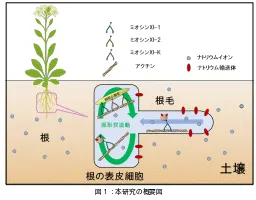
Recent research from Waseda University has uncovered a crucial mechanism by which the myosin XI-1 gene plays a significant role in enhancing salt tolerance in plants. In their examination, researchers particularly focused on a model plant, Arabidopsis thaliana, to analyze how plants adapt to excessive salt conditions through advanced physiological processes. The study is expected to facilitate improved agricultural practices aimed at increasing crop resilience in saline environments.
Key Findings
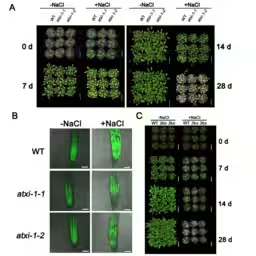
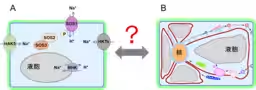
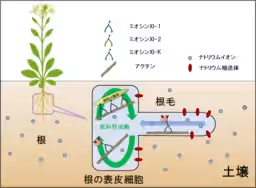
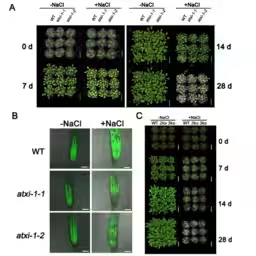
The research established that among the thirteen types of myosin XI present in Arabidopsis, only the mutant variant lacking the myosin XI-1 gene exhibited heightened salt resistance. This finding is transformative as it suggests that myosin XI-1 operates as a negative regulatory factor in the salt stress response. Furthermore, it was discovered that the atxi-1 mutant showed reduced accumulation of sodium ions (Na⁺) under salt stress, indicating that myosin XI-1 plays a pivotal role in regulating sodium transport and maintaining ion homeostasis within cells. This adds a new dimension to our understanding of plants’ environmental adaptation strategies.
Mechanism Behind Salt Tolerance
The team investigated how myosin XI, specifically the XI-K, XI-2, and XI-1 variants, responds to salinity. They revealed that expression levels of these myosins varied under salt treatment conditions. Importantly, the atxi-1 mutant maintained a lower Na⁺ accumulation while sustaining chlorophyll and proline levels, crucial components for plant health and survival under stress.
Moreover, while the atxi-k and atxi-2 mutants' salt sensitivity remained comparable to wild-type plants, the distinct functions of myosin XI-1 in salt regulation now indicate a specialized role, emphasizing the need for future research on its unique molecular mechanisms.
Broader Implications for Agriculture
Salt stress is a predominant environmental challenge, particularly in dry and irrigated agricultural regions, causing significant yield reductions worldwide. The research highlights that by modifying specific myosin XI functions, it may be possible to enhance salt tolerance in crops, laying the groundwork for innovative breeding strategies. The implications of this discovery are vast, enabling the development of next-generation salt-tolerant crops that can thrive in conditions of climate change and limited water resources.
Next Steps in Research
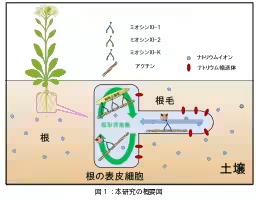
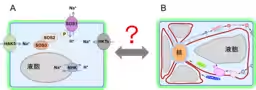
Although the study has illuminated the role of myosin XI-1 in salt stress, the exact cellular mechanisms at play remain to be fully unveiled. Further investigations will focus on how myosin XI-1 regulates Na⁺ transporters and the transportation of regulatory factors. Future research aims to elucidate the interplay between myosin XI-1 and known salt stress response pathways, ultimately providing a comprehensive picture of how plants maintain ion homeostasis and survive in saline conditions.
Conclusion
The study not only showcases the essential role of myosin XI-1 in ionic regulation during salt stress but also revolutionizes our conception of these proteins from mere transporters to vital signaling and regulatory components in plant cells. As researchers delve deeper into the underlying mechanisms, we anticipate significant advancements in agricultural techniques, possibly preventing crop losses due to salinity and promoting sustainable farming practices in increasingly saline environments.
Topics Other)









【About Using Articles】
You can freely use the title and article content by linking to the page where the article is posted.
※ Images cannot be used.
【About Links】
Links are free to use.