



Challenges and Realities of Pre-Assignment Training for Japanese Firms Sending Employees Abroad
The State of Pre-Assignment Training in Japanese Corporations
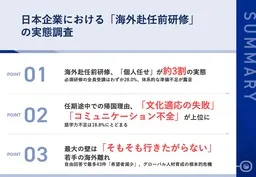
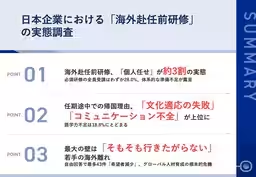
A recent survey conducted by Bizmates Corporation sheds light on the current state of pre-assignment training for Japanese employees being sent abroad. Out of 400 human resources professionals from Japanese companies with more than 500 employees, the results indicate that fewer than 30% of companies have established mandatory training programs for overseas assignments. Moreover, over 90% reported cases of early return from assignments, predominantly attributed to failures in cultural adaptation rather than language barriers. This underscores the pressing need for comprehensive training that addresses these emerging challenges.
Findings from the Survey
The survey, titled _“Reality of Pre-Assignment Training in Japanese Corporations”_, utilized IDEATECH's research marketing tool and was conducted between September 9 and September 10, 2025. The data revealed significant disparities in training systems, with over one-third of companies relying on personal discretion or lacking any structured training at all. This lack of systematic preparation leads to underperformance and potential failures in expatriate assignments.
Early Returns: The Core Reasons
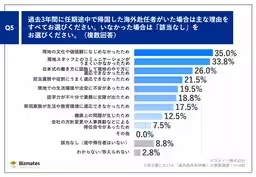
The primary reasons for early returns from assignments were shocking: a staggering 35% cited issues with cultural adaptability, while 33.8% struggled with local staff communication. In contrast, only 18.8% attributed early returns to inadequate language skills. The results highlight that language training alone is insufficient, revealing an urgent need for intercultural understanding training to effectively support Japanese business professionals in foreign environments.
The Prevalence of Overseas Assignments
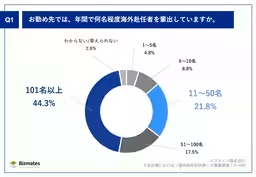
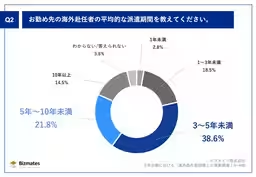
Interestingly, the survey indicated that over 44% of companies deploy more than 101 employees annually abroad, illustrating a trend toward broader engagement in international business operations across various sectors. Furthermore, the average assignment duration for about 38.6% of companies is between 3 to 5 years, emphasizing a commitment not only to expansion but also to long-term human resource development overseas.
Key Selection Criteria for Expatriates
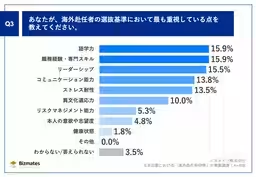
When selecting candidates for overseas assignments, companies prioritized a combination of language proficiency, professional experience, and leadership skills. Language proficiency ranked highest at 15.9%, closely followed by job experience at 15.9% and leadership qualities at 15.5%. However, it is evident that merely possessing language skills isn't enough; a compelling combination of interpersonal skills, adaptability, and resilience is necessary for effective performance in a foreign setting.
Building the Right Skills for Success
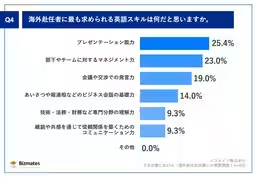
The most sought-after English skills among expatriates include presentation abilities (25.4%), team management skills (23.0%), and active participation in negotiations (19.0%). This suggests that companies require their employees to possess advanced communication skills that transcend basic conversational English, crucial for achieving business objectives in international environments.
Gaps in Training Effectiveness
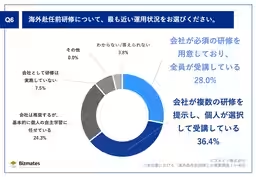
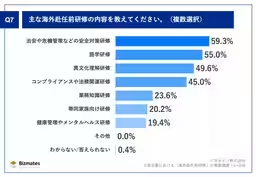
Despite the acknowledgment of the necessity for comprehensive training, only 28% of the firms mandated everyone to undertake the training. The training topics mainly revolved around safety measures (59.3%), language training (55.0%), and intercultural training (49.6%). However, support for accompanying families and mental health resources lagged significantly, showing a failure to address the various facets of expatriate life adequately.
The Financial Implications of Training
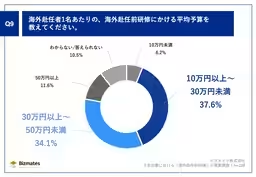
Training budgets revealed that more than 70% of companies allocate between 10,000 to 50,000 yen for pre-assignment training, indicating a plateau in investment that might not sufficiently enhance training quality. According to recent forecasts, the corporate training service market is expected to grow, yet simply increasing budgets will not resolve the fundamental issues surrounding effective training outcomes.
The Broader Picture
In light of the survey, it has become increasingly clear that attracting young talent to overseas assignments is becoming more challenging. Many professionals are deterred by the perceived difficulties associated with international work, especially in navigating cultural differences and the complexities of settling in foreign environments.
Conclusion
Moving forward, Japanese companies need to transition from traditional language-focused training to a curriculum that emphasizes intercultural understanding, collaboration with local teams, and thorough engagement with family support programs. Creating an environment that cultivates a desire for growth and adventure abroad is paramount. The findings stress the importance of building a comprehensive, strategic training framework that not only prepares employees for challenges abroad but also makes international assignments an appealing trajectory within their career paths.
As companies strategize their global talent initiatives, embracing holistic training that nurtures comprehensive skills will be crucial for reducing the high early-return rate and fostering the next generation of globally minded professionals.
Topics Business Technology)
【About Using Articles】
You can freely use the title and article content by linking to the page where the article is posted.
※ Images cannot be used.
【About Links】
Links are free to use.