



Groundbreaking Development of Plants for High Protein Production
Introduction
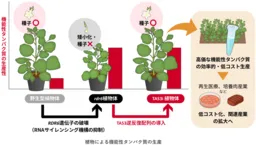
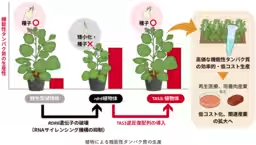
In a significant breakthrough, a team from the National Institute of Advanced Industrial Science and Technology (AIST) has engineered a new type of plant capable of producing large quantities of functional proteins. This advancement tackles a common challenge in plant-based production: the negative impact of RNA silencing mechanisms that usually inhibit foreign gene expression.
The RNA Silencing Mechanism
Plants possess an RNA silencing mechanism intended to protect them from pathogens by breaking down foreign RNA, including messenger RNA (mRNA) that is essential for the expression of desired proteins. This natural defense can considerably lower the efficiency of producing functional proteins from foreign genes, such as those introduced for vaccine antigens or enzymes.
To counter this issue, researchers previously developed a plant termed "rdr6 plant" by knocking out the RNA-dependent RNA polymerase 6 (RDR6) gene, a key player in the RNA silencing pathway. While this rdr6 plant demonstrated an excellent ability to produce functional proteins, it faced limitations in growth and seed production, which hindered its practical applications.
The Innovative TAS3i Plant
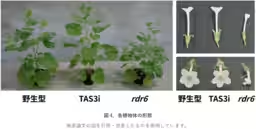
In a recent study, the research team focused on a specific DNA sequence called TAS3, closely linked to the plant's morphological development. By introducing an inverted repeat of the TAS3 sequence into the rdr6 plant, scientists have successfully created the new "TAS3i plant." This innovative plant exhibits an impressive ability to produce functional proteins and grows to sizes comparable to wild-type plants, capable of producing seeds as well.
This combination of high protein production and normal growth characteristics allows TAS3i plants to serve as viable sources for functional proteins. Their potential applications span regenerative medicine to cultured meat production, where substantial amounts of proteins are typically required for cell culturing processes. TAS3i plants can dramatically reduce costs and improve the stability of protein supplies in various industries, particularly in pharmaceuticals and diagnostic sectors.
The Science Behind the Breakthrough
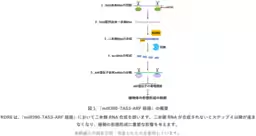
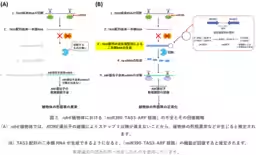
Mechanistically, the generation of targeted proteins becomes challenging due to the RDR6’s role in the miR390–TAS3–ARF signaling pathway, which regulates the expression of ARF genes crucial for plant growth and morphology. Normally, this pathway relies on the production of double-stranded RNA (dsRNA) from the TAS3 sequence, which RDR6 facilitates. However, due to the destruction of the RDR6 gene in the rdr6 plants, this pathway does not function correctly, leading to stunted growth and infertility.
Recognizing this, the researchers sought to restore the function of this pathway by ensuring that the TAS3 sequence could indeed produce dsRNA. They achieved this by integrating a construct that enables the generation of dsRNA without depending on RDR6, thus reviving the signaling pathway's capability and promoting normal morphological development.
Experimental Results
Upon analyzing the expression levels of ARF genes across wild-type, rdr6, and TAS3i plants, it was observed that the expression of ARF genes was low in the rdr6 plants. In contrast, TAS3i plants exhibited a recovery and regulation of ARF gene expression close to that of wild-type plants, confirming that the signaling pathway had been successfully restored.
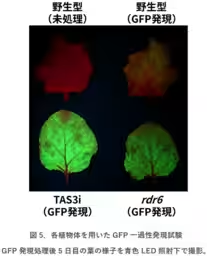
Additionally, the TAS3i plants displayed leaf sizes and growth rates similar to wild-type plants while also forming seeds, marking a significant leap from their predecessors. Furthermore, the transient expression of green fluorescent protein (GFP) indicated that TAS3i plants generated substantial amounts of proteins, confirming their high-capacity production abilities.
Future Prospects
The development of TAS3i plants represents a revolutionary step in the production of high-efficiency functional proteins using plants. Moving forward, efforts will focus on establishing this protein production system for industrial and medical applications, alongside investigating the molecular mechanisms underlying the miR390–TAS3–ARF pathway and the RNA silencing mechanism.
Conclusion
This groundbreaking research underscores the potential of genetically engineered plants to overcome previous limitations related to protein production. The successful creation of TAS3i plants not only opens up new avenues for cost-effective and sustainable protein production but also highlights the progress in the field of biotechnology, paving the way for innovative solutions to contemporary challenges in health and industry.


Topics Consumer Products & Retail)
【About Using Articles】
You can freely use the title and article content by linking to the page where the article is posted.
※ Images cannot be used.
【About Links】
Links are free to use.