



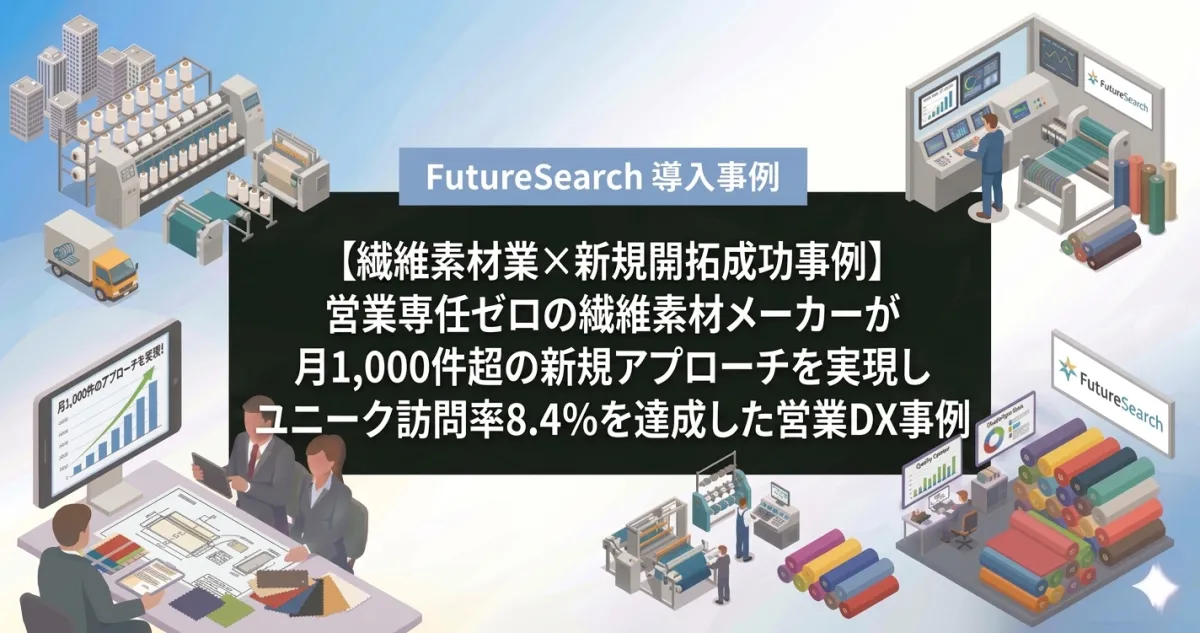
How a Textile Manufacturer Achieved Sales Success with No Dedicated Sales Staff
Case Study: Sales Transformation in Textile Industry
The successful case of a textile manufacturer, Company C, showcases how leveraging the B2B sales support tool, FutureSearch, enabled them to conduct over 1,000 new outreach attempts every month without a dedicated sales team, achieving a unique visit rate of 8.4%.
Background: The Crisis of Over-Reliance on Existing Clients
Company C, based in the Kanto region and with about 30 employees, specializes in high-performance synthetic leather and functional textiles. It thrives on unique twisting techniques that offer over 150 color variations and materials that meet eight years of durability tests. However, their revenue was heavily reliant on only a few existing clients. When one key partner drastically reduced orders due to a shift in business strategy, the inherent risks of their existing-client-dependent model became alarmingly apparent. With no sales personnel available, technical staff were managing outreach alongside their primary responsibilities, leading to a lack of know-how for acquiring new customers.
Initial Attempts: Limitations of Manual Outreach
Initially, Company C embarked on manual outreach via their company's website contact forms. Although this method allowed for outreach without regarding the recipient's availability, the workload was overwhelmingly burdensome due to tasks like selecting target companies, confirming form availability, and manual entry. The result was a stagnant outreach rate with only a handful of attempts feasible daily. Sales personnel reflected on this, stating, “The results were promising, but the volume was unsustainable for our technical staff.”
Automation through FutureSearch
Recognizing the limitations of manual form outreach, Company C turned its attention to FutureSearch, a tool that automates the entire process from list creation to distribution.
Key Benefits:
1. Free Trial for Hands-On Experience: The tool offered a free trial that allowed Company C to gauge usability before committing. The flexibility in targeting, alongside the ability to search by industry and geographic location, ensured they could hone in on niche markets.
2. Confidence in Target Availability: Company C felt reassured after determining during the trial that there was a sufficient pool of potential targets, removing initial uncertainties surrounding their outreach.
3. Exploration as Value: The most significant realization was that creating outreach lists was more than just automation; it served as a tool for market exploration. By varying the keywords and industry types, Company C could discover which segments their products resonated with, uncovering potential markets through the list-making process.
Targeting Unexplored Markets
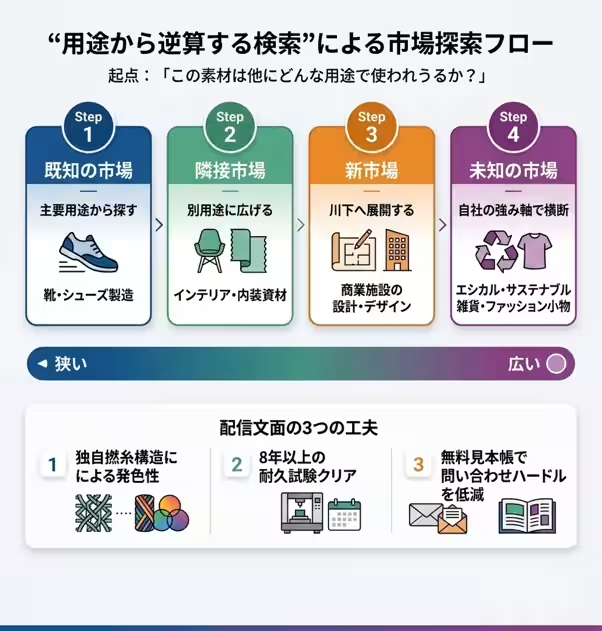
Using a unique approach, Company C began reverse-engineering their targeting based on key applications. They first targeted shoe manufacturers, gradually expanding their outreach to interior materials and commercial design firms. Moreover, leveraging their strength in recycled materials, they adopted keywords like 'ethical' and 'sustainable' to search industries across the board.
Their communications highlighted the uniqueness of their products, showcasing attributes like color vibrancy due to unique twisting structures and durability claims while offering free sample catalogs, effectively lowering customer engagement hurdles.
Impressive Results in Just 18 Months
After approximately eighteen months of incorporating FutureSearch, Company C reported remarkable achievements:
- - Total attempts: 17,400 (average of 967 monthly)
- - Unique visits: 1,460
- - Unique visit rate: 8.4%
- - Recent average monthly outreach: 1,080 (a 19% increase over the average from the entire period)
Typically, the response rate for outreach form initiatives hovers around 5%, but refined targeting and engaging communication led Company C to surpass that at 8.4%. The process evidenced not only consistent utilization of the tool but an acceleration in sales efforts.
Reimagining Sales Tools for Market Exploration
Company C’s experience exemplifies a paradigm shift in sales strategy, viewing the sales support tool not merely as a means for extensive outreach but as a 'market exploration engine' for discovering viable markets for their products. Even in the absence of dedicated sales staff and new lead generation expertise, utilizing tools like FutureSearch facilitates addressing market demands and securing new client opportunities.
For a deeper dive into Company C's successful methodology and access to the complete case study, please visit FutureSearch Case Study.
FutureSearch stands to empower B2B companies by streamlining the process from lead list creation to direct outreach automatically, paving a path for successful new client acquisition even within compact organizational structures. To find out how FutureSearch can tailor its solutions to your specific industry needs, check our service details here.



Topics Business Technology)




【About Using Articles】
You can freely use the title and article content by linking to the page where the article is posted.
※ Images cannot be used.
【About Links】
Links are free to use.