




Okayama University Unveils a Dual-Function Nano Structure for Light Manipulation
Introduction
In an exciting collaboration between Okayama University and Hokkaido University, researchers have made a significant breakthrough in optical technology. They have successfully integrated two critical functions of light—collection and storage—within a single two-dimensional nanostructure utilizing a special material known as molybdenum oxychloride (MoOCl2). This dual functionality could revolutionize applications in high-sensitivity optical sensors, optical switches, and information processing devices.
Highlights of the Research
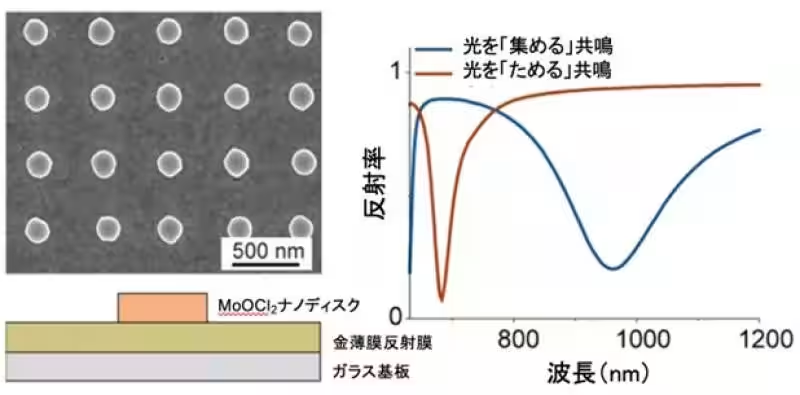
The research team, led by Professor Hiroaki Misawa from Okayama University's Institute of Basic Science, along with researchers from Hokkaido University and Peking University, demonstrated that MoOCl2 can behave differently depending on the orientation of its crystal structure. In one direction, it exhibits metallic properties, while in another, it mimics the behavior of glass or semiconductors. By fabricating MoOCl2 into a disk-shaped nanostructure and enhancing it with a gold thin film reflector, the team effectively improved its light storage capacity.
What sets this study apart is the ability to switch these two functions independently by merely changing the polarization direction of the light. This achievement signifies that the two roles of light can coexist without interference, allowing for selective control over each function within the same wavelength range.
Potential Applications
The implications of this research are vast. The newly developed nanostructure can push the boundaries of high-sensitivity optical sensors and contribute to the design of advanced optical switches, enabling faster and more efficient data transmission and processing. Furthermore, as the technology evolves, we could see innovative applications in various fields ranging from telecommunications to medical diagnostics.
Conclusion
Professor Hiroaki Misawa expressed his enthusiasm about the findings, stating, "We have shown that a small nanostructure can host both light collection and storage capabilities, allowing for their seamless switching. This discovery paves the way for novel designs in high-sensitivity optical sensors and optical information processing devices."
The detailed findings were published in the journal ACS Nano on June 20, 2026, underscoring the significant advancements in nanotechnology and optics brought forth by this research.
References
Additional Information
Research support for this project came from various grants including those from the Scientific Research Fund (Grant Nos. JP23H05464, JP23K04902) and the Ministry of Education, Culture, Sports, Science and Technology (MEXT) of Japan.
With the ongoing advancements at Okayama University, the future promises transformative developments in optical technologies, radically enhancing how we capture and process light.








Topics Consumer Technology)
【About Using Articles】
You can freely use the title and article content by linking to the page where the article is posted.
※ Images cannot be used.
【About Links】
Links are free to use.