



Challenging the Inefficiencies in Large-Scale System Development with P3 PPM
Addressing Project Inefficiencies in System Development
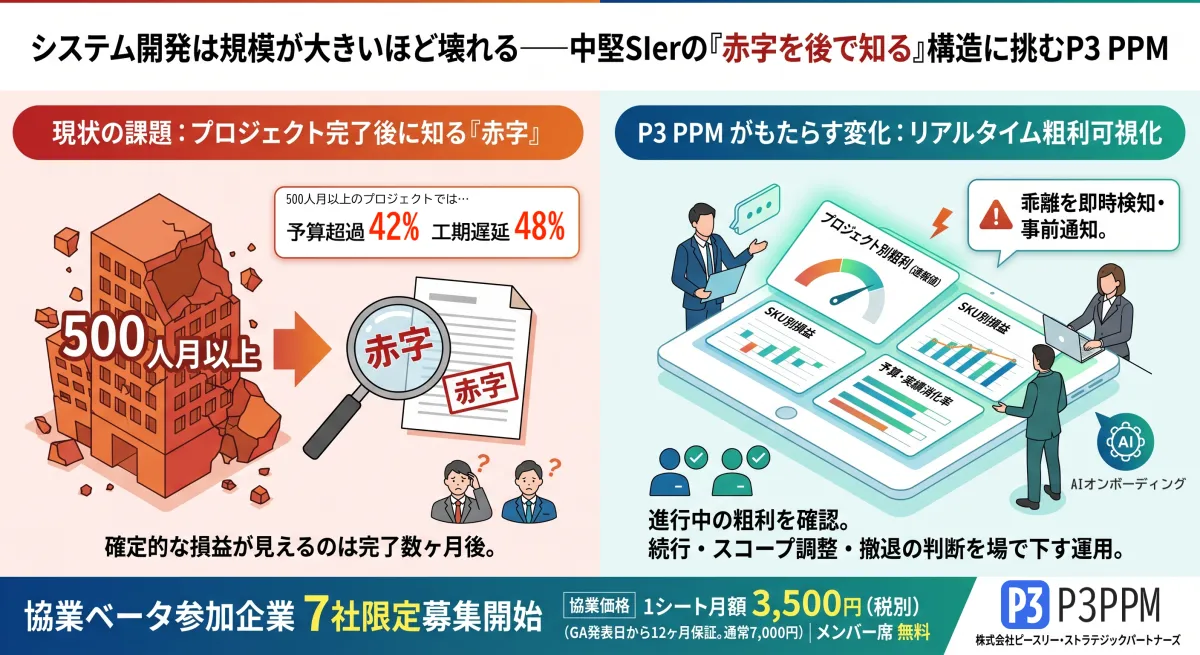
The structure of IT system development has increasingly come under scrutiny, especially regarding large-scale projects. Recent research indicates that as project sizes grow, they frequently exceed budgets and miss deadlines. A shocking 42% of projects involving over 500 person-months exceed their budget, and 48% experience delays. This troubling trend highlights systemic inefficiencies faced by the majority of medium-sized IT vendors, who often lack mechanisms to identify these issues until the project is completed, sometimes months later.
The Systemic Dilemma
A recent survey by JUAS (Japan Users Association for Information Systems) reveals stark realities about system development. The findings suggest a significant disparity in project management practices between the initial planning phases and the later execution stages. Key insights show that 70.9% of the groundwork around initial project planning is performed in-house, while critical design, implementation, and testing phases are increasingly outsourced, comprising 63.4% of total project efforts. This trend can lead to disconnection in assessing project health from both the vendor's and client's perspective, ultimately resulting in unanticipated financial risks.
Identifying Failures in System Development
To uncover the root causes behind these failures, the JUAS survey underscores three main observations:
1. Failure Rates Increase with Size: Larger initiatives show a concerning trend where compliance with quality, budget, and deadlines diminishes significantly. Projects below 10 person-months have a fault rate below 10%, while projects exceeding 500 person-months report 42.2% budget overruns and 47.8% delays.
2. Root Causes of Budget Overruns: A primary factor for exceeding budgets is often attributed to a lack of proper planning (51.0%) and the complexity of existing systems (51.4%). A further 48.6% report frequent changes in specifications as a significant challenge. Moreover, vendor skill deficiency was cited as the leading cause of quality issues, highlighting the urgent need for enhanced vendor capabilities.
3. Global Insights Confirm Domestic Trends: International studies, such as those conducted by McKinsey, reinforce these findings. Their research indicates that half of the cost overruns arise from unclear objectives and fluctuating requirements, failure patterns that are generically applicable across various project scales and regions.
A New Approach with P3 PPM
To combat these challenges, the newly developed PPM SaaS, P3 PPM, seeks to empower medium-sized IT vendors by providing an integrated framework for project visibility and management.
At the core of P3 PPM is the SKU (Skill-Keeper-Unit) design that simplifies project tracking by consolidating skills, roles, pricing, and deliverables into a single unit. This structural reorganization allows management and project managers to have coherent discussions around the same data, creating an instant overview that enables real-time visibility into project profitability. With this tool, monthly and quarterly review meetings evolve from reports of past performance into proactive discussions about current project profitability, allowing for timely adjustments to scope or project continuation decisions.
Accessible Setup and Support Features
A key advantage of P3 PPM is the reduced burden of initial setup; traditionally, establishing a project management tool could take 6 to 12 weeks, but P3 PPM uses AI-powered onboarding to cut this time to about a week. Project tracking is further enhanced through its PMO agent, PiMO, which assists in identifying risks and budget deviations, thereby supporting, rather than replacing, human decision-making.
Pricing Structure Designed for Accessibility
Unlike traditional SaaS offerings that increase costs with organizational size, P3 PPM adopts a pricing model that charges only for administrative users, while allowing team members unlimited access without fees. This model aims to alleviate financial barriers for project execution.
Collaboration Opportunities
P3 PPM is currently inviting companies to participate in a closed beta, offering the chance to provide feedback for product improvements. Selected participants will benefit from reduced costs during the beta phase, enabling deeper collaboration potential. They will be required to assist with case studies and provide input for enhancements, ensuring that the tool evolves in alignment with real-world challenges.
A Call to Action
Interested businesses in joining the closed beta can reach out via [email protected] or visit the P3 PPM website to learn more about the product and participate in a free PPM maturity assessment.
Final Thoughts
As medium-sized IT firms face mounting pressures from larger competitors, the implementation of project portfolio management solutions like P3 PPM can no longer be seen as optional. By addressing the very structure that leads to project failures, this solution aims to empower companies to harness their true potential and navigate the intricate web of modern IT projects successfully.
Topics Business Technology)
【About Using Articles】
You can freely use the title and article content by linking to the page where the article is posted.
※ Images cannot be used.
【About Links】
Links are free to use.