



The Shocking Truth About Japan's Most Common Passwords in 2025
Alarming Password Trends in Japan for 2025
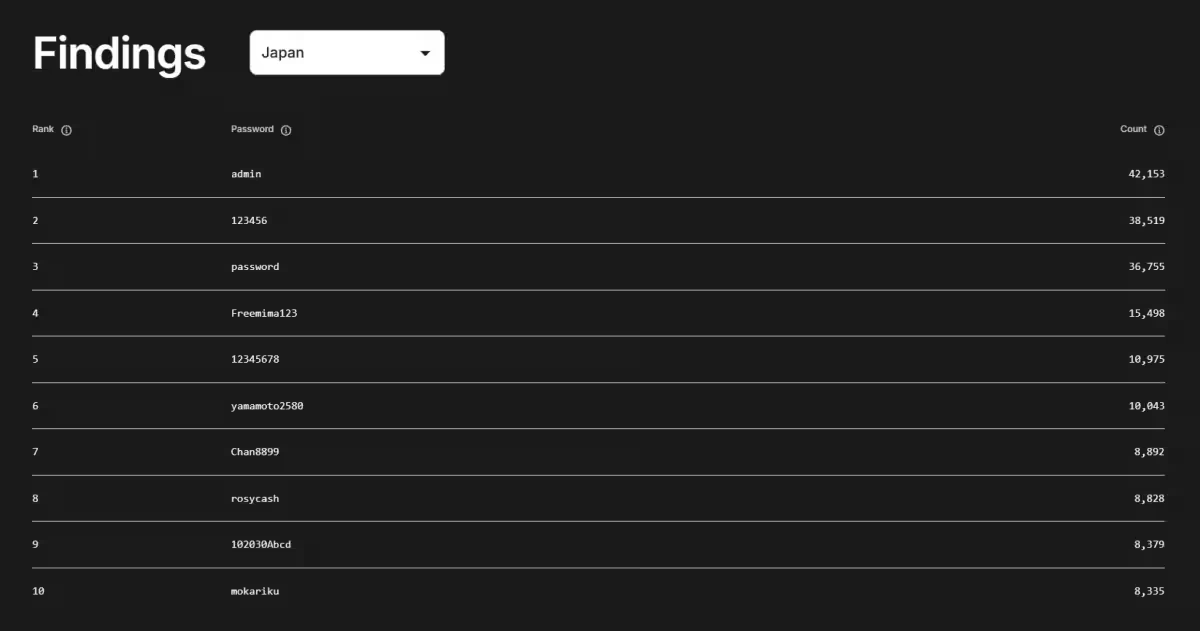
In a revealing study conducted by NordVPN, one of the leading personal security service providers, the most commonly used password in Japan for 2025 is shockingly not the infamous "123456", but rather the default admin password "admin". This alarming trend highlights a significant shift in password behavior: users are not just creating simple passwords, but are leaving them unchanged, increasing the risk of their networks being hacked.
Overview of the Study
To coincide with Data Privacy Day on January 28, NordVPN and its subsidiaries, NordPass and NordStellar, collaborated with independent cybersecurity researchers to analyze password usage data. This analysis, spanning from September 2024 to September 2025, examined publicly available breach data and repositories on the dark web, specifically focusing on the password habits of users in 44 countries.
This data offers a stark look into password vulnerabilities and habits across different cultures, shedding light on the types of passwords being used in Japan and the potential risks associated with them.
Key Findings on Password Usage in Japan
The study revealed that the simplicity of passwords is not the only concern; the failure to change default passwords greatly elevates security risks. Here are some of the significant findings:
1. The Dominance of "admin"
The data unveiled that "admin" ranked as the most commonly detected password in Japan. This password, commonly used for the admin pages of routers, cameras, and smart appliances, poses a substantial risk when users do not change it post-purchase. Hackers can easily exploit these vulnerabilities to gain access to home networks and launch cyber attacks using IoT devices as a gateway.
2. Cultural Ties in Password Selection
Interestingly, the name "yamamoto2580" made it to the sixth position. The combination of personal names with numbers exposes users to higher risk, as this information can often be found on social media. Hackers can leverage local name lists to generate possible password combinations, increasing the chances of unauthorized access.
3. Misguided Complexity in Simple Patterns
Passwords that appear to be complex, such as "1qaz2wsx" or "P@ssword123456", rank in the top tiers. However, these patterns are well-known to hackers and are often easily cracked using automated systems. Users need to understand that simply adding numbers or substituting letters with symbols does not guarantee security.
The Methods Used by Hackers
The study also observed the sophisticated techniques hackers employ to breach passwords, emphasizing that they are not merely guessing. Instead, they utilize advanced methods:
- - Brute Force Attacks: These attacks leverage automated algorithms to rapidly test every possible combination of characters. Simple passwords like "admin" do little to defend against such brute-force methods.
- - Dictionary and Rule-Based Attacks: By using a dictionary of common terms and names, hackers can target passwords that people in Japan frequently use, making these attacks highly effective.
- - Password List Attacks: These attacks exploit previously leaked password databases to access other services, targeting users who recycle their passwords.
Recommendations from NordVPN's CTO
To combat these rising threats, Marius Briceidis, the CTO of NordVPN, offers four key strategies for enhancing password security:
1. Change Default Passwords: It’s crucial to change any default settings on devices immediately after purchase to mitigate risks from known passwords.
2. Increase Length and Complexity: Passwords should be at least 12 characters long and should mix uppercase, lowercase, numbers, and symbols to prolong crack times significantly.
3. Avoid Personal Names and Common Words: Refrain from using your name or any common terms, opting instead for random strings of characters.
4. Use Unique Passwords for Each Account: Never reuse passwords across different services to limit the potential damage if one account gets compromised.
The Urgency for Stronger Password Practices
This study underscores the critical need for Japanese users to rethink their password strategies as many still favor convenience over security. As emphasized by both Briceidis and Karolis Albaciuskaus from NordPass, the evolution of password-less authentication methods through biometrics is on the horizon, but solid passwords remain foundational until these methods are widely adopted.
With 80% of breaches attributed to weak or reused passwords, it’s imperative that individuals adopt comprehensive password hygiene. As we reflect on digital privacy in light of Data Privacy Day, strengthening passwords is not just a recommendation; it is a necessity for safeguarding one's digital life.
Topics Consumer Technology)
【About Using Articles】
You can freely use the title and article content by linking to the page where the article is posted.
※ Images cannot be used.
【About Links】
Links are free to use.