



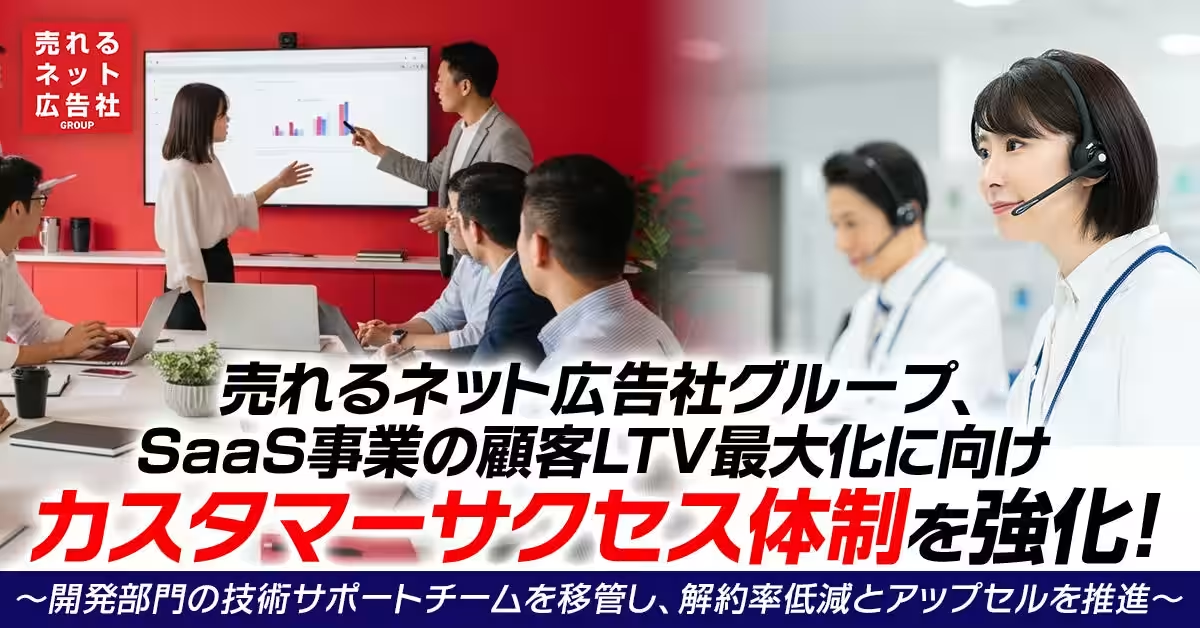
Enhancing Customer Success in SaaS: A Strategy to Maximize Client LTV
Maximizing Customer Success in SaaS
The Ureland Net Advertising Group, with its headquarters in Fukuoka, Japan, has initiated a significant organizational change aimed at enhancing customer success within its SaaS business. Starting from August 2025, the support team, previously a part of the development department, was transitioned to the Customer Success Division of Ureland Net Advertising Co., Ltd., the group's core company. This shift not only represents a change in structure but also brings together essential expertise and frontline insights from both development and sales teams.
Bridging the Gap: Technical Expertise Meets Customer Engagement
Historically, the support team functioned primarily as a back-end unit focused on providing assistance related to the functionalities and specifications of SaaS products like "Ureland D2C Maker". However, client demands have evolved, shifting from being merely about usage to focusing on achieving tangible results. In response to this transformation, support personnel possessing technical knowledge are now integrated within the Customer Success team. This collaboration allows for a swift, three-pronged approach to client engagement encompassing sales, customer service, and client needs.
Today, when sales representatives encounter challenges during client meetings, the support team can quickly provide technical solutions on the spot. This has significantly reduced response times for inquiries, facilitating a more seamless and instantaneous resolution process. The shift from a defensive support role to a proactive one has set the stage for a more dynamic customer engagement strategy.
Integrating Sales with Support: Direct Link to Customer Experience
At the heart of Ureland Net Advertising Group’s value proposition is the robust knowledge base, framed as "The Ultimate Sales Know-How®", backed by over 2,600 A/B tests that have identified effective patterns. The recent structural change has enabled sales staff well-versed in this knowledge to collaborate seamlessly with support and technical teams within the same division. This integrated approach has significantly improved the quality of customer proposals.
For example, during regular meetings in the Customer Success division, any requests for improvements regarding "Ureland D2C Maker" are communicated immediately to the product team for consideration in upcoming updates. This fosters a continuous feedback loop that creates an effective "perpetual motion machine" for customer success, integrating client challenges from the field back into product enhancement.
Early Successes: Realizing the Impact on LTV
From the outset of this integration, client feedback has been overwhelmingly positive, highlighting increased response speeds, enhanced accuracy of technical solutions, and smoother collaboration between support and sales teams. Early quantitative metrics indicate noticeable reductions in response times and an increase in upsell opportunities, reinforcing the belief that improved customer satisfaction directly correlates with lower churn rates and enhanced client lifetime value (LTV).
Strategic Reorganization: Aiming for Maximum SaaS Revenue
This initiative represents more than a mere organizational change; it is a strategic reorganization to strengthen the overall revenue framework of the group. By consolidating the technical expertise of the support team within the Customer Success division, customer success in the SaaS sector—particularly concerning products like "Ureland D2C Maker"—is being amplified. This progress is integral to reducing churn rates and increasing upsells, thereby maximizing LTV.
Looking forward, there are plans to collaborate with "Ureland AI Marketing Co." to implement AI-assisted inquiry analysis and automated recommendations, solidifying a customer success model that leverages the synergy of people, AI, and proprietary know-how.
Paving the Way for New Norms in Customer Success
In the short term, the focus will be on enhancing collaboration among the sales, support, and development teams to maximize response and improvement speeds. In the medium term, the introduction of AI-driven initiatives such as "Customer Satisfaction Scoring" and "Automated Knowledge Accumulation Systems" will further develop a data-driven customer success strategy. In the long run, the goal remains to establish a model where maximizing LTV across the group's overall SaaS business leads to a structure where customer success contributes to growth in profits.
As we embark on this transformational journey, shareholders and investors are invited to witness our evolution from a company that has merely "scientifically quantified sales" to one that designs customer success itself. Embrace this momentous evolution with us.
Topics Consumer Products & Retail)
【About Using Articles】
You can freely use the title and article content by linking to the page where the article is posted.
※ Images cannot be used.
【About Links】
Links are free to use.