



obniz Launches Groundbreaking AI-Enabled MCP Server for Direct Device Control Using Proprietary Technology
Revolutionizing Hardware Control: obienz MCP Server Introduction
In a remarkable development for the world of technology, obniz Corporation has announced the launch of its MCP Server, a cutting-edge platform designed to allow AI clients to directly operate physical devices without the need for programming or complex server setups. This innovative service, available in alpha version for developers, is a significant leap towards what is being termed Physical AI.
What is the MCP Server?
obniz’s MCP Server leverages its proprietary firmware-less technology, enabling AI clients like ChatGPT, Claude, and Cursor to interact with various obniz devices across Japan. With the setup process streamlined to just three easy steps, developers and users can rapidly access sensor data, control devices remotely, and operate existing machinery. This functionality marks the dawn of a new era where AI can manipulate real-world hardware effortlessly, much as it generates text.
Key Highlights of the MCP Server:
1. First in the World: This technology is the first of its kind to facilitate direct control of hardware from AI platforms without the necessity of developing individual firmware or constructing servers.
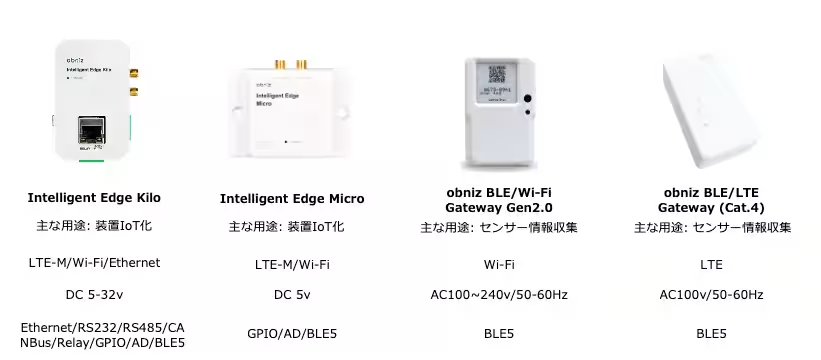
2. Versatile Interfacing: Unlike other MCP-compatible IoT platforms restricted to proprietary devices, the obid MCP Server supports various electronic components, including sensors, motors, PLCs, and existing machinery, providing unmatched flexibility.
3. Simultaneous Control: Users can access multiple obid devices located across different sites simultaneously, making it an ideal solution for chain stores, factories, and extensive infrastructure.
4. High Security: The obid devices operate using a dedicated obidOS, making them secure against unauthorized intrusions and virus infections, unlike conventional Linux-based systems.
5. No Additional Costs: Existing obid users can utilize this platform without incurring extra fees, enhancing its accessibility.
The Emergence of Physical AI
As AI continues to evolve, an essential frontier lies in its ability to interact with the physical world. By 2025, AI agents, integrating with SaaS applications like Slack and Notion, will significantly enhance workflows. The next stage involves using AI to connect meaningfully with physical objects or systems—a version of Physical AI.
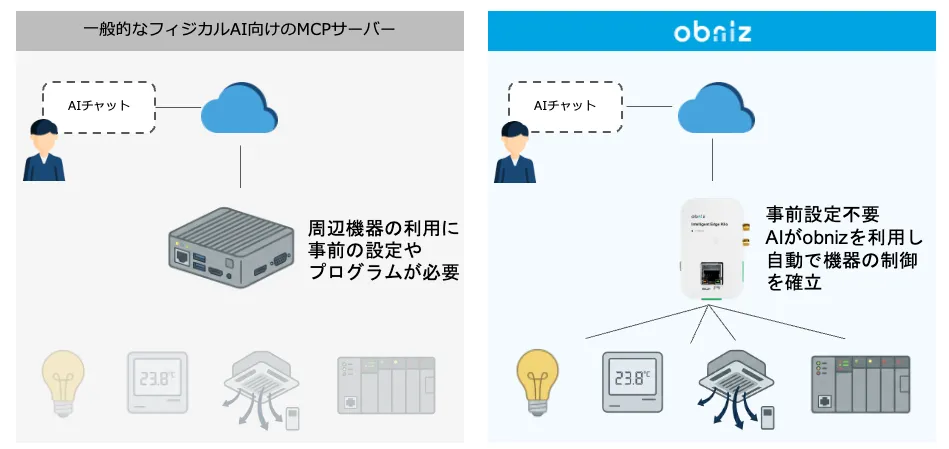
Traditional hurdles to this advancement have included costly device purchases, complex firmware development, and the requirement to build and operationalize cloud servers. However, with obniz’s technology, these hurdles vanish.
| Traditional Physical AI | obid MCP Server |
|---|---|
| ------ | ------- |
| Requires purchasing Linux devices | Setup obid devices only |
| Necessitates firmware development | Unnecessary due to patented tech |
| Limited to predefined peripherals | Can connect and control new devices easily |
| Demands server management | No need for cloud server builds |
| Requires manual API gateway setup | Uses standard API connection |
| Needs extensive security measures | High security from microcontroller design |
| Involves complex setup | Easy three-step setup |
Technical Superiority: obid vs. Competitors
While various IoT platforms are adopting MCP compatibility post-2025, most still confine themselves to proprietary devices, necessitating firmware development for new machine connections. In contrast, obniz operates without the need for additional device programming, permitting AI to freely explore connections with various hardware. This difference is pivotal for broad applications, enabling rapid transitions to new utilities and stronger operational integration across devices.
Use Cases of the MCP Server
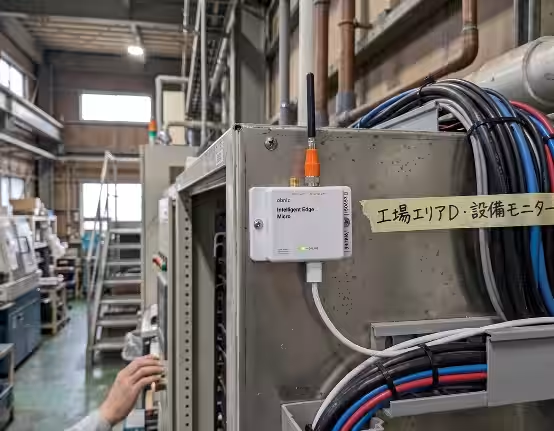
1. Factory Monitoring: Operators can ask AI tools to identify unusual temperature readings across multiple factories, enhancing overall efficiency.
2. Data Analysis: Users can request insights from AI regarding the logs of specific sensors, leading to immediate identification of potential issues.
3. Optimizing Space Condition: Users can command AI to optimize air conditioning systems based on real-time readings from space sensors.
4. Automation: AI can autonomously check sensor values and notify teams of any anomalies without the need for human programming input.
These functionalities come into play through an incredibly simple three-step setting without extra costs or firmware development hindrances.
Getting Started with MCP Server
1. Generate App Token: Create your App Token in obid Cloud and install it on your obid devices.
2. Configure AI Client: Enter the MCP Server’s endpoint and App Token for the AI client of your choice.
3. Device Operation: Simply communicate with your AI client to control your devices.
Additionally, both a remote server version and an open-source version are available for businesses and developers looking to implement the MCP in their environments.
About obid Corporation
Founded in 2014 and headquartered in Tokyo, obid aims to make everything online with its innovative firmware-less technology. With over 40,000 devices sold globally and recognition from prominent investors such as Tokyo University Edge Capital, obid continues to lead the frontier of IoT advancement.
Future Prospects: Transforming Access to the Physical World
The release of the MCP Server marks the advancement of obid in making AI able to access the real world without the need for human intermediaries. As it equips AI with the tools to control physical devices seamlessly, obid accelerates its development ecosystem in the Physical AI space while promoting collaboration with developers and partners towards a future where AI can effortlessly engage with the physical world.
In conclusion, the MCP Server opens up a realm of possibilities in AI application development and advancements in the Internet of Things. Through feedback from users in the alpha phase, obid looks forward to expanding features and preparing for the official version's release.
Company Overview
- - Name: obid Corp.
- - Location: Tokyo, Japan
- - CEO: Yuki Sato
- - Founded: 2014
- - Services: Development and sales of IoT devices and platforms
- - Website: obid.com
- - Key Investors: Tokyo University Edge Capital, Seibu Shinkin Capital, Mitsubishi UFJ Capital, Kajima Ventures, Mizuho Capital, Kintetsu Venture Partners
Topics Consumer Technology)
【About Using Articles】
You can freely use the title and article content by linking to the page where the article is posted.
※ Images cannot be used.
【About Links】
Links are free to use.