



The Discovery of Fluid Dynamics and Logic Gate Functions in Skyrmions Offers New Avenues in Nanomagnetic Structures
Unleashing the Power of Skyrmions: Fluid Dynamics and Logical Computation
Skyrmions, a fascinating class of nanomagnetic structures found in certain magnetic materials, have recently made waves with new findings revealing their fluid-like behavior when clustered together, along with their ability to perform logical operations. These insights illuminate not only the path for advancements in magnetic device applications but also open doors to an exciting scientific domain focused on the fluid dynamics of nanostructures.
The Breakthrough Discovery
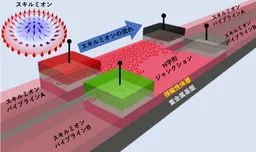
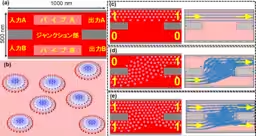
Research conducted by a group from Waseda University, with contributions from Shokyu Zhang, Professor Masahito Mochizuki, and collaborators from Shinshu University, demonstrates that when a multitude of skyrmions, small magnetic entities characterized by intricate topological arrangements, are injected into a magnetic device shaped like the letter 'H', they can orchestrate fluid movements akin to those seen in liquids. This phenomenon allows these skyrmions to act as the fundamental components for logical operations like AND and OR, as demonstrated through numerical simulations.
Typically, manipulating individual skyrmions has posed significant challenges in the realm of nanomagnetic device research. The necessity for precise control of each skyrmion made their application in memory and logic devices cumbersome. However, this new approach suggests employing a collective assembly of skyrmions as information carriers, thereby circumventing the demands for precise individual control.
The Mechanism of Skyrmion Fluids
Skyrmions display behaviors reminiscent of fluids when subjected to current. This fluid-like property leads to their ability to seek pathways through the magnetic H-shaped structure, determining the output based on their inputs. For instance, injecting skyrmion fluids from different terminals results in distinct output paths, mimicking logical operations. Hence, this mechanism resembles classical logic gates in computing, providing a stable, energy-efficient solution for next-generation magnetic devices.
Insights into Skyrmion Dynamics
The research utilized advanced numerical simulations to explore how the skyrmion aggregates behave under different conditions. It was found that these tiny magnetic structures could move with minimal current—markedly less than conventional magnetic structures—thereby offering a means to realize low-power, high-speed magnetic devices. The adaptability of skyrmions to behave as either a fluid or a rigid structure, depending on their environment, serves as a rich ground for exploration in future research.
Implications of Discovering Skyrmion-Based Logic Gates
The implications extend beyond the immediate mechanics of skyrmion fluids; they signal a significant advancement in the field of spintronics—a technology that leverages the electron's spin for data processing and storage. This discovery suggests the potential development of robust, energy-efficient logic gates that can outperform traditional electronics by operating at higher speeds and with lower power consumption.
Future Perspectives
While the discovery establishes a foundational understanding of skyrmion fluid dynamics, it also raises questions about potential applications and the possibility of discovering even more complex phenomena in nanomagnetic structures. Given that similar topologically structured magnetic entities may also exhibit fluid-like behavior, the research foreshadows a burgeoning field centered around the investigation of these dynamics.
Continued exploration into the properties of skyrmions and related structures can lead to the identification of novel functionalities, thus pushing the boundaries of current electronics into realms that may have once seemed unattainable. The integration of classical fluid dynamics concepts into modern physics signifies an exciting paradigm shift and underscores the importance of interdisciplinary research in unlocking these new potentials.
In conclusion, the operational dynamics of skyrmions within this study promise not just novel applications in memory storage and logic devices but also in cultivating a new scientific field surrounding the fluid dynamics of nanostructures. This breakthrough acts as a catalyst for future innovations in nanomagnetic science, ensuring that the potential of spintronic applications can be fully realized.

Topics Consumer Technology)
【About Using Articles】
You can freely use the title and article content by linking to the page where the article is posted.
※ Images cannot be used.
【About Links】
Links are free to use.