



Understanding the Cost Challenges of Generative AI in Businesses: Insights from Recent Research
Understanding the Cost Challenges of Generative AI in Businesses
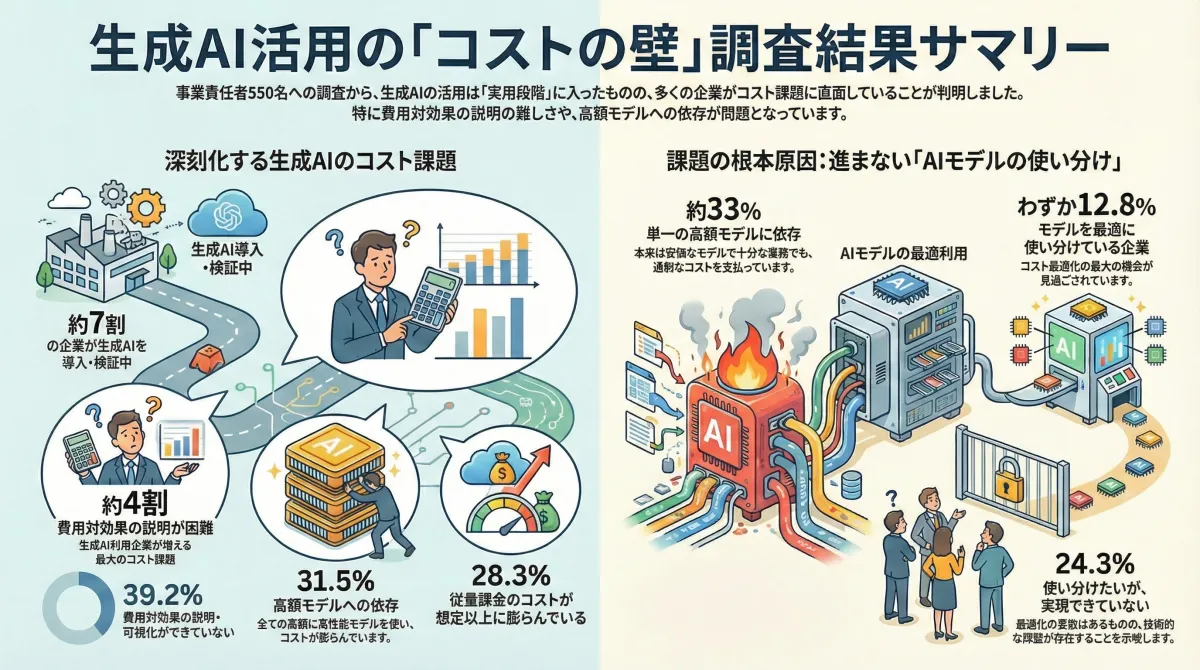
Recently, Ragate Inc. conducted a significant survey among 550 business leaders utilizing generative AI technologies like ChatGPT, Claude, and Gemini. This research aimed to shed light on the current issues surrounding the costs associated with generative AI and their optimization strategies. The results highlight that a staggering 39.2% of businesses using generative AI reported difficulties in demonstrating or visualizing the cost-effectiveness of these technologies.
Survey Insights
The emergence of generative AI has streamlined various operations, but many organizations face substantial hurdles. For instance, 31.5% indicated that their reliance on expensive AI models is a notable challenge. Conversely, only 12.8% of companies reported using a diverse range of AI models tailored for different tasks, suggesting that there is considerable room for cost optimization in numerous organizations.
Cost Transparency Concerns
As companies are increasingly adopting generative AI, common feedback has emerged regarding unexpected expenses. Many organizations express concern over escalating operational costs due to unpredictable consumption-based pricing models. Additionally, transitioning from Proof of Concept (PoC) to full operational use is becoming imperative, raising the need for a scalable cost management system. Ragate’s survey aims to quantitatively evaluate these cost-related challenges, focusing on current management practices and the intent to optimize expenses.
Key Findings
1. Cost Visibility Issues: Nearly 40% of participating companies struggle with laying out the cost-effectiveness of generative AI implementations, illustrating a significant transparency problem in cost management.
- 39.2% of companies admitted they cannot effectively explain or visualize the ROI of using generative AI.
- Other notable responses included 31.5% acknowledging dependency on high-cost models, and 28.3% expecting their usage costs to exceed initial projections, indicating that nearly 70% are grappling with some financial challenge in relation to AI.
2. Limited Model Utilization: Only quite a few companies, about 12.8%, successfully implement a variety of AI models based on specific operational needs. 32.6% operate on a single model, limiting their potential for cost optimization.
- Many companies exhibit hesitance to apply different models due to technical barriers or a lack of understanding, with 24.3% stating they wish to diversify but feel unable to do so.
- Approximately 30% voiced that they do not perceive the need for differentiation, marking an evident gap in awareness of the effectiveness of model diversification.
3. Interest in Cost Reduction Strategies: About 65% of surveyed organizations have expressed an interest in various cost-cutting initiatives. The top strategies include:
- Selecting and configuring the most appropriate models for different tasks (36.2%),
- Optimizing AI workflows to reduce unnecessary calls (28.1%),
- Developing custom LLMs utilizing proprietary data (27.8%).
On the collaboration front, around 32% of companies plan to engage with external partners to optimize their costs, while 42.9% prefer to handle these challenges internally.
Ragate's Recommendations
The survey highlights two critical challenges: the lack of cost transparency and the slow pace of technological optimization in generative AI. With approximately 40% unable to account for their expenditures, prioritizing optimization efforts becomes challenging for many organizations. The low percentage of model diversification further indicates a strong potential for optimization.
To address these issues, the following approaches are recommended:
- - Model Configuration: Selecting appropriate models according to task complexities can lead to substantial cost savings.
- - Custom LLM Development: Fine-tuning AI models with company-specific data can transition expenses from variable to fixed, enhancing budget predictability.
- - Workflow Optimization: Implementing tools like Dify can optimize model routing and reduce unnecessary API calls, leading to cost efficiency.
At Ragate, we are committed to streamlining the process for businesses by providing comprehensive support in identifying optimal models, developing tailored LLMs, and enhancing AI workflows. With our experienced team knowledgeable about leading models, we aim to facilitate significant reductions in generative AI costs.
Conclusion
As the integration of generative AI continues to expand, organizations must prioritize establishing clear visibility of costs and exploring optimization strategies effectively. With tailored approaches to model selection and workflow optimization, substantial savings can be achieved while ensuring effective AI application in business operations. For companies struggling with rising AI costs, Ragate offers various services aimed at improving cost management and enhancing productivity. Reach out to us for specialized support in navigating the complexities of generative AI cost optimization.

Topics Consumer Technology)
【About Using Articles】
You can freely use the title and article content by linking to the page where the article is posted.
※ Images cannot be used.
【About Links】
Links are free to use.