



Advancements in Terahertz Biophotonics for Next-Gen Bio-Measurement Applications
Advancements in Terahertz Biophotonics for Next-Gen Bio-Measurement Applications
Recent collaborative research efforts between Waseda University, Okayama University, and the Japan Science and Technology Agency (JST) have spotlighted the potential of terahertz biophotonics as a groundbreaking technology for biomedical applications. Despite the high promise of terahertz waves in examining biological tissues, cells, and molecular states without invasively damaging them, practical applications in the medical and life sciences have been limited until now.
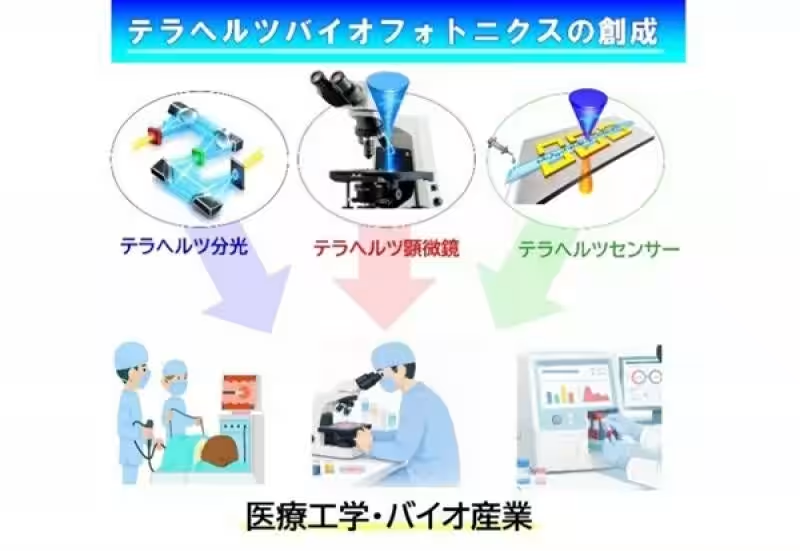
The research initiative aimed to systematically analyze the fundamental challenges that have hindered the development of terahertz biophotonics. By identifying these issues, the team outlined a comprehensive roadmap for overcoming these technical barriers, leading to tangible advancements in this field. This entails an overview of new microscope technologies and high-sensitivity sensor technologies that are critical in moving the biophotonics field forward toward applicable biomedical strategies.
One of the central focuses of this research was on optimizing the use of terahertz waves for monitoring hydration states in biological specimens and analyzing intermolecular interactions. Traditionally, the implementation of optical technologies like visible light in medical practices has progressed at a faster pace than that of terahertz technologies. Therefore, the goal of this research is not only to present a detailed analysis of the challenges faced but also to delineate new technological directions that provide feasible applications in medical and biodiagnostic measurements.
The publication of these findings in the prestigious Journal of Physics Photonics on May 29, 2026, marks an important milestone, serving as a beacon of hope for the future of biophotonics in healthcare. It also emphasizes the need for collaborative efforts across industries and disciplines to accelerate the integration of innovative technologies into real-world applications. The anticipated benefits of this research are expected to not only enhance the capabilities of medical professionals but also improve patient outcomes through non-invasive measurement techniques.
In addition to enhancing the medical measurement landscape, the successful integration of terahertz biophotonics could have broader repercussions for various sectors, likely leading to increased collaborations between academia and industry. The insights provided by these researchers can foster fusion across diverse fields, ultimately contributing to the advancement of biotechnology and improving the healthcare infrastructure.
The lead researchers, Kazunori Serita from Waseda University and Masayoshi Tonouchi from Okayama University, have meticulously documented the historical progress and contemporary advancements in terahertz biophotonics, reinforcing the significance of this research area. They emphasize the critical need for a strategic approach to harness these technologies effectively, which could redefine biomedical methodologies in the coming years.
This research is backed by significant funding from various programs, including the JST's Exploratory Research Support Program and the JSPS's Grants-in-Aid for Scientific Research. These programs underlie the financial foundation essential for fostering pioneering research in terahertz technology and its applications.
In summary, the exploration of terahertz biophotonics holds immense potential for revolutionizing the future of biomedical measurements. This emerging technology represents a forward-thinking approach to non-invasive diagnostics, offering hope for improved methodologies in understanding bio-molecular interactions and cellular environments. The collaborative effort across institutions and the integration of new sensor technologies reflect a promising horizon for the medical sector, as it steps into an era where sound scientific exploration meets practical medical application.


Topics Health)

【About Using Articles】
You can freely use the title and article content by linking to the page where the article is posted.
※ Images cannot be used.
【About Links】
Links are free to use.