




New Discoveries on Plant Cell Division Enhance Understanding of Evolution
Unraveling the Mechanism of Plant Cell Division
In a groundbreaking study, researchers from Nagoya University, Okayama University, and Kobe University have unveiled a significant advancement in our understanding of how land plants regulate cell division. The study centers on the role of the CORD gene, which has been discovered to be essential for controlling the direction of cell division. This discovery not only enhances our comprehension of plant biology but also sheds light on the evolutionary trajectory of plants transitioning from aquatic environments to land.
Research Overview
The research, led by Takema Sasaki and Yoshihisa Oda at Nagoya University, in collaboration with Hiroyasu Motose at Okayama University and Kimitsune Ishizaki at Kobe University, delves into the molecular mechanisms governing cell division in plants. Using model organisms such as the moss Physcomitrella patens (a basal land plant) and the flowering plant Arabidopsis thaliana, the team analyzed the function of the CORD gene during cell division events.
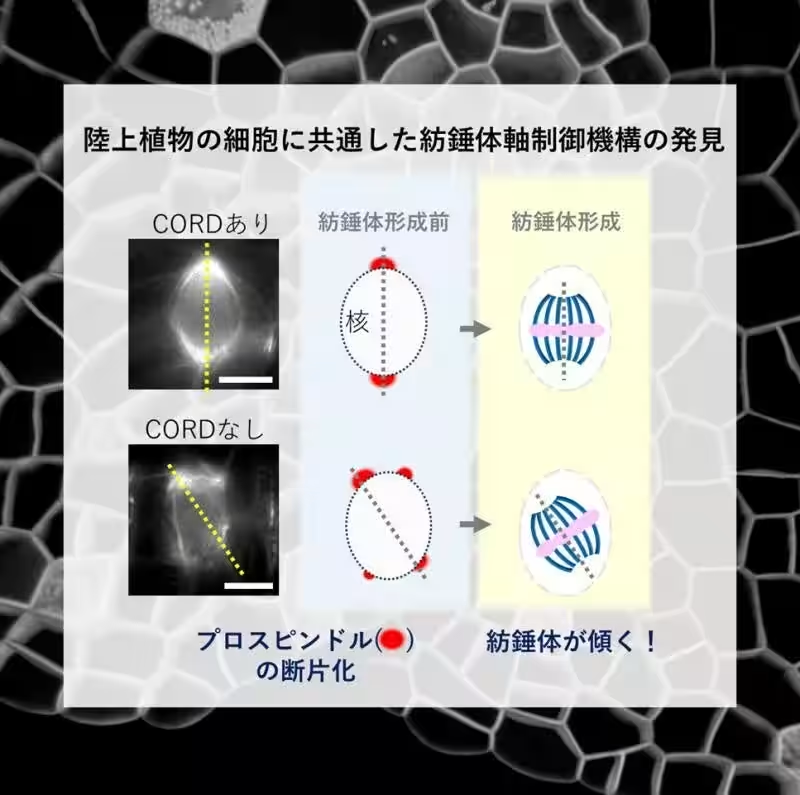
The results demonstrated that the CORD protein stabilizes the orientation of the spindle apparatus, a critical structure needed for proper cell division. This stabilization ensures that cells divide in the correct direction, facilitating organized growth and development.
Evolutionary Implications
Remarkably, the CORD gene appears to be a shared characteristic among terrestrial plants, suggesting its acquisition during the evolutionary transition from green algae to land plants. This finding is pivotal as it provides new insights into how plants adapted to life on land, developing the complex structures and functions necessary for survival in a terrestrial environment.
The research team expresses optimism that their findings will contribute to a deeper understanding of plant evolution and its implications for biodiversity. This research highlights the intricate connections between genetic mechanisms and evolutionary biology, emphasizing the importance of studying these foundational processes.
Publication Details
The results of this study were published online on September 13, 2025, in the prestigious scientific journal Current Biology. The paper, titled "The conserved machinery of bipolar prospindle formation controls acentrosomal spindle orientation in land plants," delineates the methodologies and findings in detail, showcasing the collaborative efforts of the involved universities.
For further reading, the article can be accessed through this link.
Conclusion
The collaborative research conducted by these institutions not only pushes the boundaries of plant biology but also has broader implications for understanding evolution. As the scientific community continues to explore the intricacies of plant life, findings like these are essential in piecing together the evolutionary puzzle of life on Earth.
This exciting development invites further research into the functional pathways of the CORD gene and its role in enhancing plant adaptability and resilience in various environments, potentially influencing agricultural practices and conservation efforts in the future.





Topics Environment)
【About Using Articles】
You can freely use the title and article content by linking to the page where the article is posted.
※ Images cannot be used.
【About Links】
Links are free to use.