



Revolutionizing Voice Technologies: GlobalData's New Insights on AI Innovations
Transforming Voice Services in the AI Era
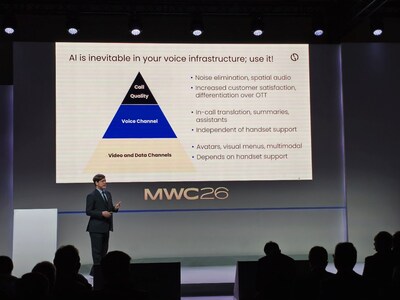
At the MWC 2026, esteemed GlobalData analyst Andy Hicks unveiled a significant white paper titled "Reinventing Voice: A Converged, AI-Enabled, and Multimodal Voice Core for the Next Generation of Telecommunications." This pivotal document emphasizes how advancements in artificial intelligence can empower operators to leverage a fully converged voice network, fostering innovation in service offerings and enhancing the overall value of voice services.
The Need for Converged Voice Networks
With the advent of 5G-A technology, the evolution of global networking standards has been anything but uniform. Some carriers are still maintaining 2G and 3G networks to support crucial services like Machine-to-Machine (M2M) communication and international roaming, despite their impending obsolescence. In this context, it is imperative for operators to adopt a fully converged voice network capable of managing services across 2G, 3G, 4G, and 5G. Such networks not only address operational challenges but also pave the way for seamless future developments.
Moreover, the global shift towards containerization enables these converged architectures to transition effortlessly from virtual machines to containers. This strategic path significantly reduces overall ownership costs while ensuring continuous innovation and agile updates to voice services.
The Three Phases of AI-Voice Integration
Hicks identifies three crucial phases through which AI will transform the value of voice services:
1. Enhancing Basic Call Experience: The initial phase focuses on utilizing AI to improve core calling experiences, giving operators a competitive edge over Over The Top (OTT) applications. Innovations like intelligent noise suppression and enhanced spatial audio immersion are set to elevate standard call communications to a more sophisticated level.
2. Integrating AI into Audio Channels: The second phase aims to embed AI within the audio channels to facilitate the launch of groundbreaking features such as simultaneous interpretation and smart meeting summaries. Notably, these services don't place extra demands on end devices, allowing operators to deploy them quickly and gain an early advantage in AI-driven voice innovations.
3. Expanding to Multimodal Interactions: The final phase envisions integrating AI into video and data channels, thereby transitioning voice services from singular modes to multimodal experiences. This development enables innovative offerings like interactive customer support or health assistant services, fully realizing the vision of Call-as-a-Service.
Hicks emphasized that operators should seize the vast opportunities that AI presents. By establishing a fully converged voice network as their foundation, these prospects can drive service innovations and profoundly transform the fundamental value of voice offerings, fueled by advancements in both 5G-A technologies and AI capabilities.
In conclusion, the insights shared in this white paper not only reflect the current trends but also outline a clear roadmap for operators aiming to thrive in the voice service domain amidst rapid technological changes. To read the full white paper, follow the link provided.
Topics Telecommunications)
【About Using Articles】
You can freely use the title and article content by linking to the page where the article is posted.
※ Images cannot be used.
【About Links】
Links are free to use.