



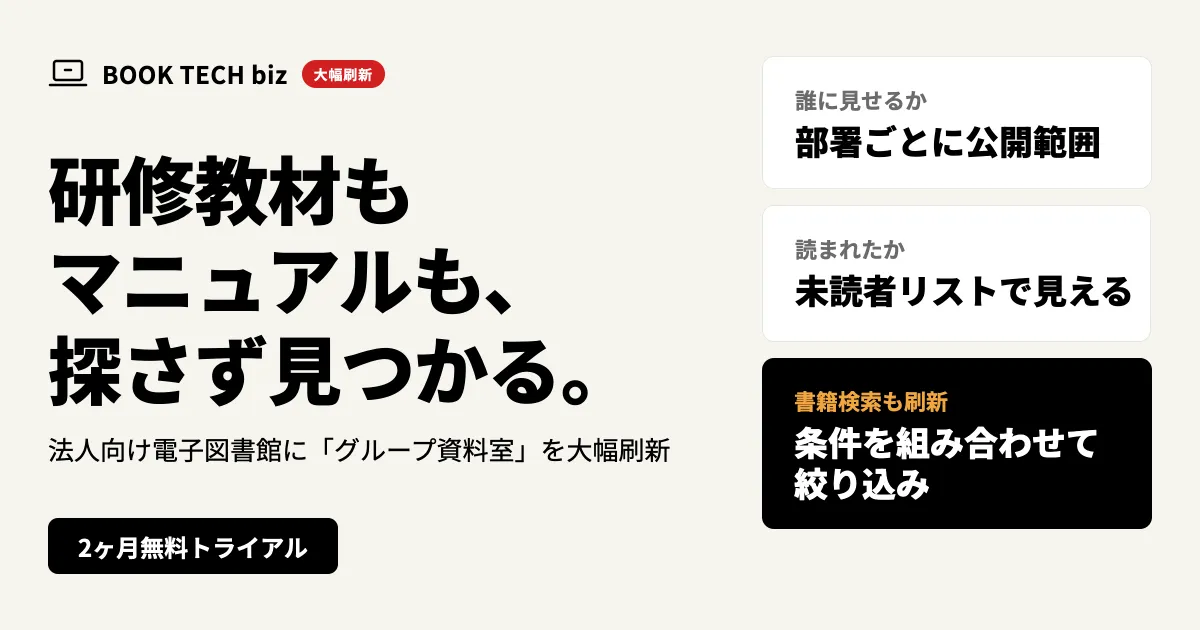
Revamping Corporate Knowledge Sharing with BOOK TECH biz's New Group Document Room
Introduction
In an effort to enhance corporate knowledge-sharing capabilities, BOOK TECH Inc. from Chiyoda, Tokyo has made a monumental redesign of the Group Document Room feature in its corporate electronic library service, BOOK TECH biz, as of September 14, 2026. This upgrade addresses common challenges faced by corporations, such as outdated information and lack of access to crucial documents, by providing a streamlined system where training materials and manuals can be easily accessed when needed.
The Need for Improved Knowledge Sharing
Typically, corporate knowledge sharing has revolved around creating new content on internal communication platforms like wikis or corporate social media. However, many organizations find that pre-existing documents, such as training texts, operation manuals, and proposals, often remain underutilized as they are scattered across personal computers and shared folders. Businesses frequently struggle with issues like identifying the latest versions of documents, helping new employees navigate resources, and understanding whether essential materials have actually been reviewed. This problem crosses industry lines and varies in scale.
Recognizing these challenges, BOOK TECH biz has been offering a personal corporate library service, allowing employees to borrow purchased books among themselves. The latest update to the Group Document Room integrates company documents into this system, allowing users to access both books and internal materials with a consistent user experience and shared categorization. This means that companies can arrange both commercial business texts and their own training materials side by side.
Key Features of the Group Document Room
1. Easy Document Upload and Accessibility
By simply uploading their PDF files, internal documents can seamlessly transition into a shared resource accessible by the entire company. Features include preview release dates, setting documents as public or private, and controlling download permissions. Unlike physical books, published digital documents can be accessed anytime via a PC or smartphone browser. Moreover, the embedded bookmarks from PDFs are automatically converted into a table of contents, allowing users to jump to their desired section immediately.
2. Department-Specific Access and Authority Control
Companies can set up departmental hierarchies where they specify which groups have access to each document. If no specific department is designated, the document is accessible to all employees. Access permissions—ranging from viewing to uploading to analytic rights—can be tailored at the department level or even modified at the individual member level as needed. Hence, staff from sales or training departments can add or update resources independently, ensuring that relevant materials remain current.
3. Effective Document Organization with Labels
Labels can be applied to categorize content based on job roles, themes, target levels, or document types. Members can then easily filter searches using these labels or keywords to find their desired materials. The system also features sorting options based on popularity or bookmarks, naturally guiding users to frequently used documents. The labels used for books and materials are consistent, making it easy for users to transition between the two.
4. Monitoring Engagement
In addition to tracking checkmarks for “read” and “understood” for each table of contents section, administrators can view individual member’s reading histories and times spent on documents. There’s even a “not read” list indicating which members within a specified access group have not viewed the material, which can easily be converted into a CSV file for reminders.
5. Version Control and Comments
When documents are re-uploaded, a version history is maintained, enabling reference to past versions. Members can leave comments on documents, and frequently-used resources can be bookmarked. Sharing URLs generated from reading pages within internal chats ensures only members of the organization can access these documents.
Anticipated Use Cases
- - Training Materials: Training texts are available for not only onboarding but throughout their subsequent assignments, improving support for new hires.
- - Operation Manuals: Step-by-step guides and protocols can be segmented by departments, ensuring everyone receives the latest updates immediately.
- - Sales and Proposal Knowledge: Proposal templates and case studies can be shared among sales teams, turning individual knowledge into collective resources.
- - Archiving Past Events: Slides from internal workshops and retrospective project documentation remain easily accessible.
Revamped Book Search Functionality
BOOK TECH has also introduced a faceted search feature across its ebook platform, enabling users to filter their searches by genre, categories, tags, authors, and more. Searches provide real-time updates, ensuring that results are up to date and sharable via URL links. This enhancement not only simplifies the process of selecting materials but aligns closely with how users search for documents in the Group Document Room.
Pricing and Accessibility
The Basic Plan for the Group Document Room offers competitive pricing starting at just 200 yen per user per month, which can be discounted further based on volume. A trial period allows corporations to explore all the features without incurring initial costs.
Conclusion
In conclusion, the updated Group Document Room of BOOK TECH biz represents a significant advancement in how corporate knowledge-sharing can be effectively managed. With a focus on accessibility, ease of use, and enhanced organizational control, BOOK TECH continues to lead in the transformation of business resource libraries.
Topics Consumer Products & Retail)









【About Using Articles】
You can freely use the title and article content by linking to the page where the article is posted.
※ Images cannot be used.
【About Links】
Links are free to use.