




Successful Deployment of the First 2 Tbit/s Optical Space Communication System
Introduction
The National Institute of Information and Communications Technology (NICT) has made history by achieving the world’s inaugural successful demonstration of a 2 Tbit/s optical space communication system. This remarkable feat saw the deployment of compact optical communication terminals on satellites and High Altitude Platform Stations (HAPS), enabling exceptionally high-speed data transmission over vast distances.
The Experiment
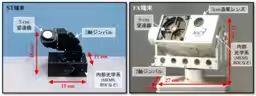
Conducted between two distinct types of small optical communication terminals — the high-functionality FX (Full Transceiver) set up at NICT headquarters in Koganei, Tokyo, and the simpler ST (Simple Transponder) placed 7.4 kilometers away in Chofu, Tokyo — the experiment maintained stable communication amid urban atmospheric turbulence. The world-first demonstration employed wavelength division multiplexing (WDM) technology and achieved stable transmission at a colossal rate of 2 Tbit/s, equivalent to transmitting approximately ten full-size 4K UHD movies per second.
Meeting Challenges
Previous endeavors in optical space communication primarily concentrated on terrestrial testing under controlled conditions, often reliant on bulky, fixed installations. NICT, however, ensured that its devices met stringent size and weight constraints suitable for mobility in dynamic environments, overcoming the critical challenges of atmospheric disturbances prevalent in urban settings.
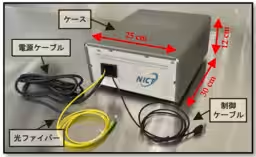
The compact terminals were purposefully designed for integration with CubeSat satellites while satisfying Size, Weight, and Power (SWaP) requirements. This included the development of new optical components that can withstand harsh environmental conditions, such as a 9 cm telescope and specially modified steering mirrors to handle high-output laser light. This innovative approach significantly reduced the overall size and power consumption of the system while retaining essential operational capabilities.
Future Initiatives
Looking ahead, NICT plans to further miniaturize these devices for implementation in 6U CubeSat satellites. Experimental trials set for 2026 aim to prove the feasibility of high-speed optical communication links between low-Earth orbit satellites (at approximately 600 km altitude) and ground stations, followed by additional tests between satellites and HAPS in 2027 at 10 Gbit/s.
Groundbreaking Research
The recent success of this experiment indicated a monumental leap forward in the pursuit of constructing non-terrestrial networks (NTN) for Beyond 5G/6G applications. NICT's innovative beam divergence control technology dynamically adjusts the beam spread based on the link situation, enabling highly efficient communications suited for various operational scenarios. This flexibility stands in stark contrast to traditional fixed-base configurations.
Preparing for Tomorrow
As NICT embarks on the next phase of their research journey, they are gearing up for experimental trials that mimic realistic communications protocols involving moving platforms. These experiments will validate the performance of coarse and fine tracking systems under dynamic conditions, forging paths for multi-terabits optical backbones specifically designed for a non-terrestrial 6G network. With plans for a CubeSat satellite mission set to launch in 2026, NICT aims to combine an FX terminal with a 10 Gbit/s modem for rigorous operational testing.
Conclusion
With sights set on achieving terabit-capable optical communication links between satellites, HAPS, and ground stations within the next decade, NICT is advancing toward a future of extraordinarily high-speed data transfer in the digital communication landscape. The successful demonstration of the 2 Tbit/s optical space communication system underscores the institute's pivotal role in shaping global communications technology, marking a significant step toward the realization of next-generation communication frameworks.

Topics Consumer Technology)
【About Using Articles】
You can freely use the title and article content by linking to the page where the article is posted.
※ Images cannot be used.
【About Links】
Links are free to use.