



Innovative Financial Education Model Launched in Chiba Prefecture Schools
Revolutionary Financial Education Initiative in Chiba
In a significant advancement for financial literacy in Japan, the Japan Financial Education Support Organization, co-represented by Risa Hirai and Nana Abe, has collaborated with Chiba Prefectural Chiba Junior High and High School to introduce an innovative model for measuring the effectiveness of financial education. This ground-breaking project marks a pivotal step towards establishing a comprehensive financial education framework for public schools nationwide.
The Project Overview
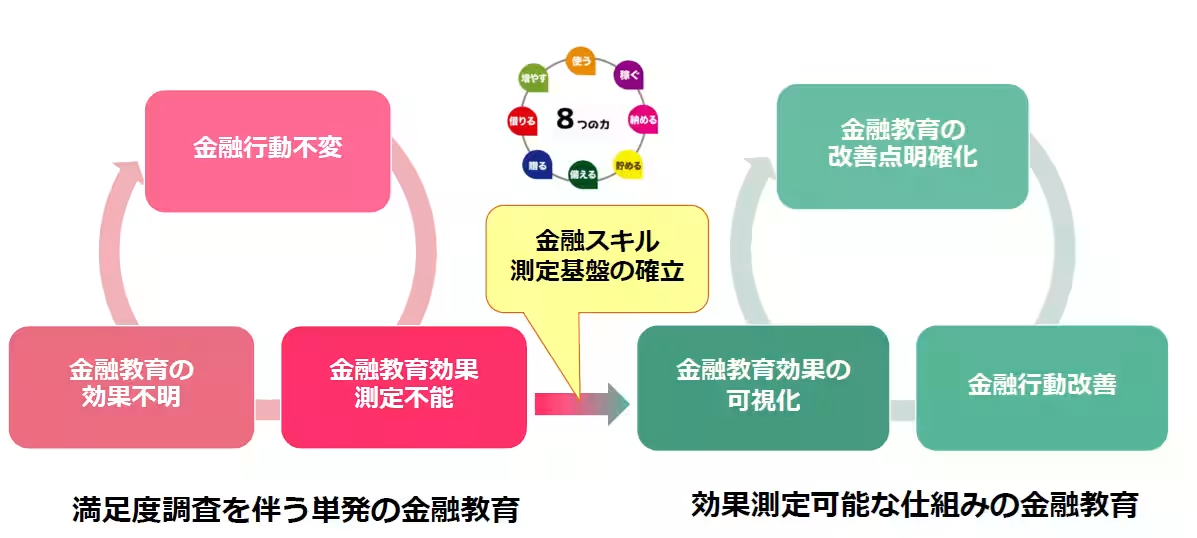
This initiative combines practical lessons in financial literacy with the organization’s newly established “Practical Financial Skills Certification.” The goal is to create a model that accurately assesses the educational outcomes of financial literacy lessons, as well as shifts in students' mindsets—an aspect that has been notoriously challenging to visualize in the past.
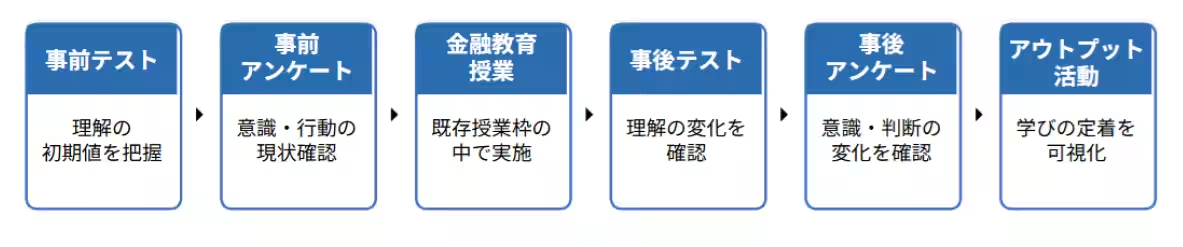
Additionally, the program aims to integrate student outputs, such as participation in the “FES Contest®,” which is a financial education program targeted at high school students. By creating a unified model that connects lessons, assessments, and inquiry activities, the initiative seeks to effectively evaluate the impact of financial education on students’ learning.
Context and Importance
The demand for financial literacy has surged recently due to changes such as the lowering of the legal adult age and the rapid expansion of cashless transactions, making it increasingly vital for younger generations to understand financial principles. However, the current scenario in schools tends to define success simply as the execution of the class, rather than the subsequent understanding, attitude, or behavioral changes among students—a gap the Japan Financial Education Support Organization aims to fill.
By emphasizing the significance of measuring and visualizing the effectiveness of financial education, the organization is establishing a system that quantifies learning outcomes while simultaneously improving educational practices. This initiative stands out as a pioneering effort at public schools, intending to create a sustainable financial education model that endures beyond isolated lessons by tracking learning progress and incorporating it into future curriculum designs.
Implementation Timeline and Target Group
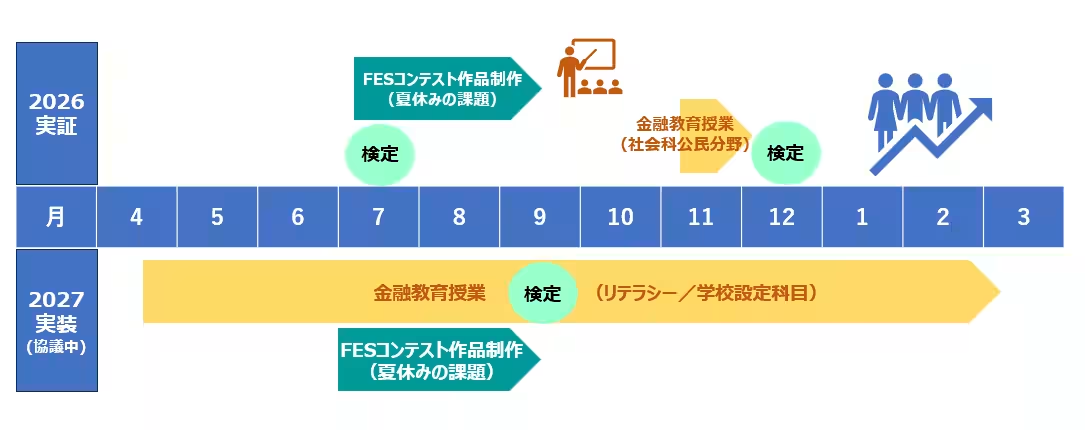
Set to launch in 2026, the project targets 80 third-year junior high students from Chiba Prefectural Chiba Junior High School. Key components include:
- - Pre-class assessment utilizing the Practical Financial Skills Certification in July 2026
- - Delivery of educational sessions in financial literacy between mid-November and late November 2026
- - Post-class assessment also utilizing the Practical Financial Skills Certification, scheduled for mid-December 2026
- - Administering pre-and post-class surveys
- - As a capstone, students will create financial education videos as part of their inquiry activities
This concerted effort aims to visualize and analyze changes in students' comprehension and engagement in financial subjects through both certification and surveys; ultimately building a robust model for assessing the educational impact of such programs.
Building an Integrated Educational Framework
A cohesive design, which will potentially be incorporated into school curricula, is fundamental to this project. The strategy calls for trial implementation within the social studies curriculum for third-year students, with a full-fledged integration into the school’s specially designated subject, “Learning Literacy,” planned for the following academic year.
This model aligns with educational guidelines that advocate for deep, interactive, and self-directed learning, paving the way for a financial education framework that transcends mere knowledge of monetary concepts.
Moreover, financial education is not just about knowledge; it incorporates how information is interpreted, how financial data is assessed, and how students can contribute positively as active members of society. The synergy between the school’s “Learning Literacy” initiative and financial education is poised to yield significant benefits.
Collaboration with the FES Contest
To further enrich students' learning experiences, the Japan Financial Education Support Organization is positioning the “FES Contest®” as a prominent output venue for students’ learning results. Conducted nationwide, this program invites high school participants to apply their financial knowledge in practical settings, offering students a platform to showcase their financial literacy skills.
Future Prospects
This initiative at Chiba Prefectural Chiba Junior High and High School will serve as a foundational model for disseminating the financial education framework across various schools and regions in Japan. With a focus on packaging key components such as lesson design, assessment strategies, certified evaluations, and connectivity with inquiry activities, the organization aims to facilitate a holistic financial education model that can be adopted throughout the country.
By fostering a comparison and analysis mechanism for financial educational outcomes on both school and regional levels, the initiative seeks to contribute to the overall enhancement of financial education quality across Japan. As Chiba Prefectural Chiba Junior High School continues its ongoing efforts, the hope is that this innovation will resonate throughout the broader public education landscape, encapsulating the essence of inquiry-driven financial education for future generations.


Topics Other)
【About Using Articles】
You can freely use the title and article content by linking to the page where the article is posted.
※ Images cannot be used.
【About Links】
Links are free to use.