



Exploring Magnetoacoustic Quantum Oscillations in YbB12 Insulator Phase
In an exciting breakthrough, researchers have delved into the enigmatic properties of the Kondo insulator YbB12, utilizing advanced ultrasonic experiments aimed at investigating magnetoacoustic quantum oscillations (MAQO). Conducted under extreme conditions—up to 65 Tesla magnetic fields and minimum temperatures of 485 mK—the study identified that the MAQO phenomenon appeared solely within the magnetically-induced metallic phase, leaving the insulating phase devoid of observable quantum oscillations.
The team, led by Assistant Professor Ryosuke Kurihara of Tokyo University of Science, alongside co-researchers from prestigious institutions such as the University of Tokyo and Kobe University, embarked on this collaborative effort to gain insight into the fascinating realm of quantum oscillations within this complex material. YbB12, known for exhibiting magnetic resistance, magnetic torque, and specific heat anomalies indicating quantum effects, posed a challenge due to the mystery surrounding the origin of these behaviors in its insulating phase.
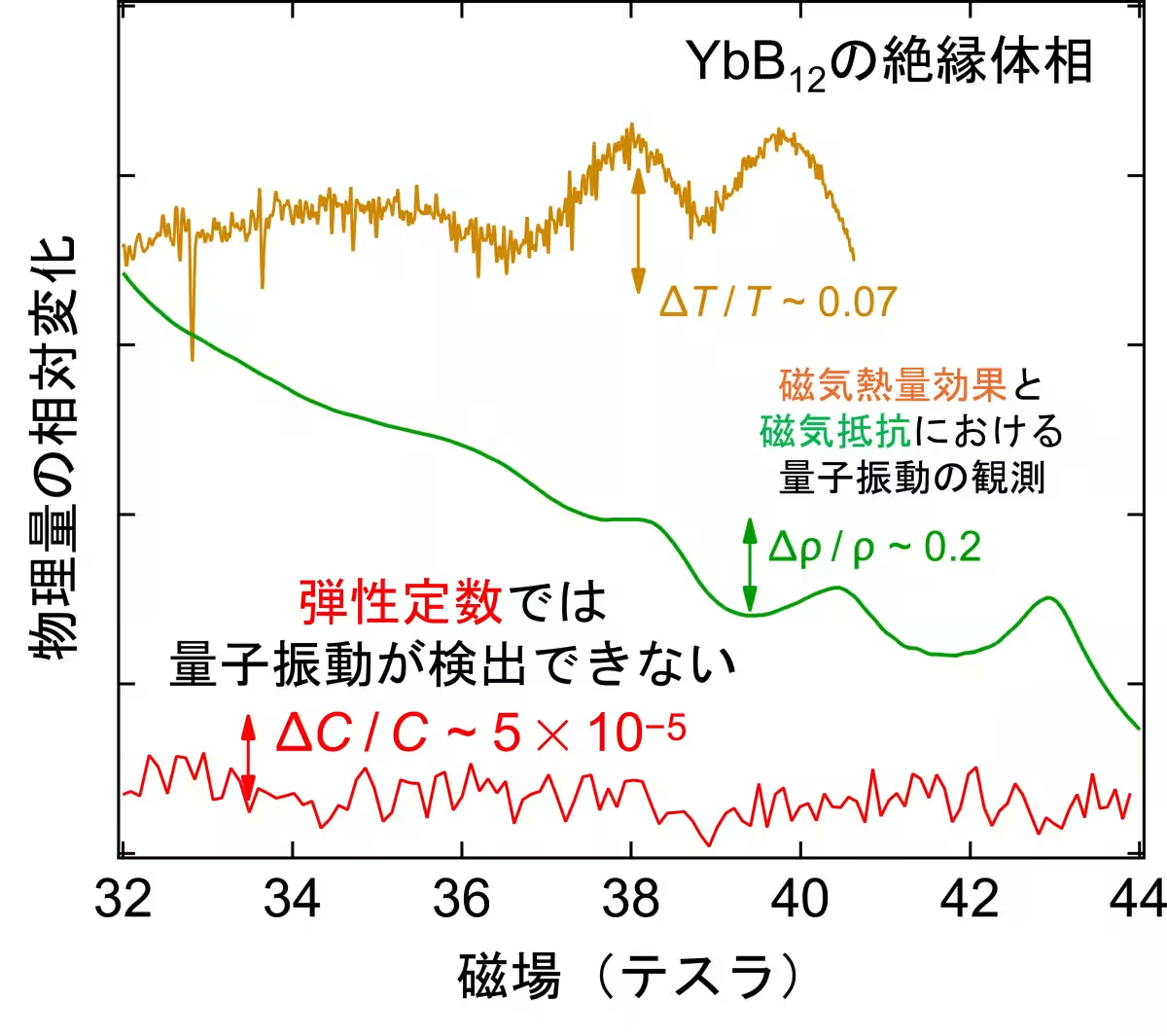
Through careful experimentation, they ensured a high bulk sensitivity as they probed the acoustic response within the crystal structure. While earlier studies had confirmed MQO through measurements of electrical transport properties such as electrical resistance and magnetic torque, the new ultrasonic approach uniquely addressed whether quantum oscillations truly existed in the insulating phase. Their findings corroborated previous observations of MQO in magnetic resistance and magnetic thermal effects but failed to detect MAQO in the insulating phase, starkly contrasting the responses seen in the metallic phase.
The team explored the materials further, revealing the distinctive acoustic responses, underscoring a significant difference between the responses of the insulating and metallic phases. This suggests a weak coupling of the Fermi particles, responsible for MQO, with the acoustic phonons in the insulating phase, contributing vital information towards unraveling the origin of quantum oscillations in insulators.
In addition to confirming the absence of MAQO in the insulating phase, the researchers also noted a remarkable elastic anomaly in the vicinity of 39 T in the insulating state, indicating a possibly unexplored change in electronic states at low temperatures.
Assistant Professor Kurihara remarked, “The presence of quantum oscillations in an insulating state could potentially open new avenues for understanding unique physics. My previous attempts to identify quantum oscillations in YbB12 through ultrasonic measurements had failed, emphasizing the need for high-quality samples, as quantum oscillations are known to be material-dependent.” This commitment to uncover deeper physical mechanisms at play not only demonstrates the complexities of YbB12 but also highlights the importance of interdisciplinary collaboration in science.
The significant outcomes of this research reinforce the critical understanding of Kondo insulators and provided new experimental insights into their acoustic properties. Published on June 16, 2026, in the esteemed journal Physical Review B, the paper was also honored as an 'Editors’ Suggestion' for its outstanding contributions to the field. As researchers continue to explore these low-temperature quantum phenomena, YbB12 stands out as a key material that could lead to new discoveries in quantum physics.
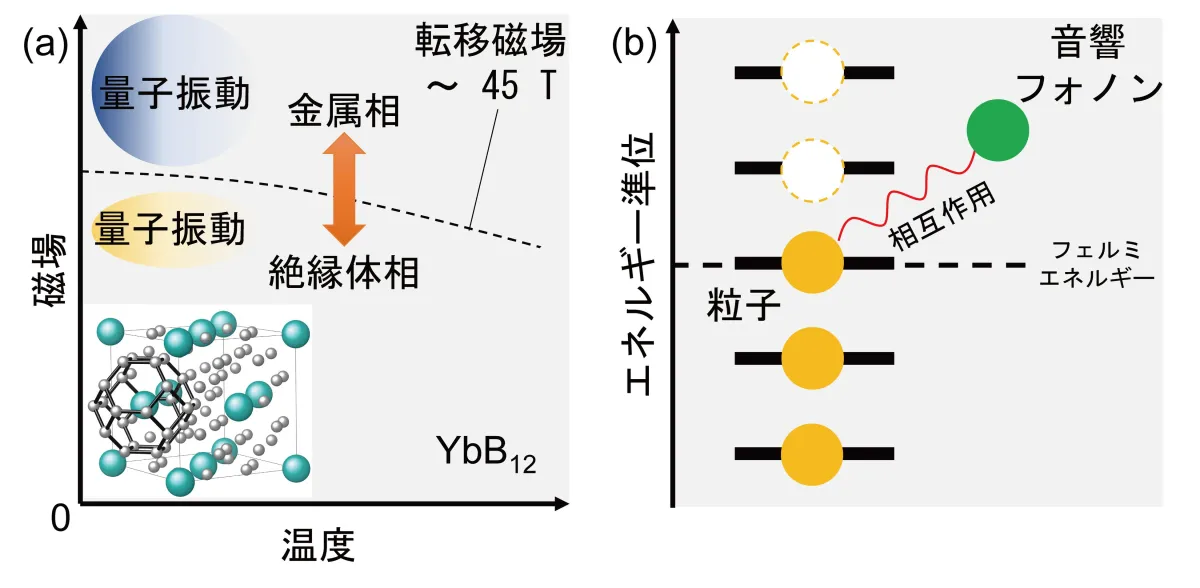
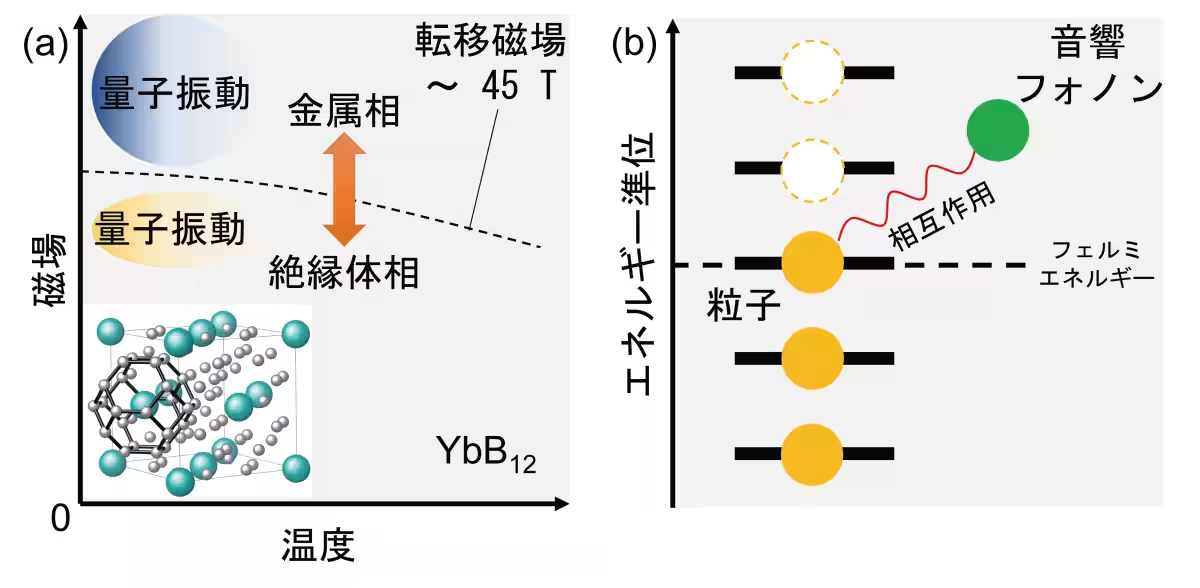
For insightful visual aids, refer to Figure 1, which illustrates the crystal structure and phase diagram of YbB12, and Figure 2, detailing the variations in magnetic thermal effects, magnetic resistance, and elastic constants under high magnetic fields. This collaborative endeavor received support from the Japan Society for the Promotion of Science (JSPS) grants and emphasizes the crucial interplay of theoretical and experimental approaches in advancing modern physics research.
The team, led by Assistant Professor Ryosuke Kurihara of Tokyo University of Science, alongside co-researchers from prestigious institutions such as the University of Tokyo and Kobe University, embarked on this collaborative effort to gain insight into the fascinating realm of quantum oscillations within this complex material. YbB12, known for exhibiting magnetic resistance, magnetic torque, and specific heat anomalies indicating quantum effects, posed a challenge due to the mystery surrounding the origin of these behaviors in its insulating phase.
Through careful experimentation, they ensured a high bulk sensitivity as they probed the acoustic response within the crystal structure. While earlier studies had confirmed MQO through measurements of electrical transport properties such as electrical resistance and magnetic torque, the new ultrasonic approach uniquely addressed whether quantum oscillations truly existed in the insulating phase. Their findings corroborated previous observations of MQO in magnetic resistance and magnetic thermal effects but failed to detect MAQO in the insulating phase, starkly contrasting the responses seen in the metallic phase.
The team explored the materials further, revealing the distinctive acoustic responses, underscoring a significant difference between the responses of the insulating and metallic phases. This suggests a weak coupling of the Fermi particles, responsible for MQO, with the acoustic phonons in the insulating phase, contributing vital information towards unraveling the origin of quantum oscillations in insulators.
In addition to confirming the absence of MAQO in the insulating phase, the researchers also noted a remarkable elastic anomaly in the vicinity of 39 T in the insulating state, indicating a possibly unexplored change in electronic states at low temperatures.
Assistant Professor Kurihara remarked, “The presence of quantum oscillations in an insulating state could potentially open new avenues for understanding unique physics. My previous attempts to identify quantum oscillations in YbB12 through ultrasonic measurements had failed, emphasizing the need for high-quality samples, as quantum oscillations are known to be material-dependent.” This commitment to uncover deeper physical mechanisms at play not only demonstrates the complexities of YbB12 but also highlights the importance of interdisciplinary collaboration in science.
The significant outcomes of this research reinforce the critical understanding of Kondo insulators and provided new experimental insights into their acoustic properties. Published on June 16, 2026, in the esteemed journal Physical Review B, the paper was also honored as an 'Editors’ Suggestion' for its outstanding contributions to the field. As researchers continue to explore these low-temperature quantum phenomena, YbB12 stands out as a key material that could lead to new discoveries in quantum physics.
For insightful visual aids, refer to Figure 1, which illustrates the crystal structure and phase diagram of YbB12, and Figure 2, detailing the variations in magnetic thermal effects, magnetic resistance, and elastic constants under high magnetic fields. This collaborative endeavor received support from the Japan Society for the Promotion of Science (JSPS) grants and emphasizes the crucial interplay of theoretical and experimental approaches in advancing modern physics research.
Topics Other)
【About Using Articles】
You can freely use the title and article content by linking to the page where the article is posted.
※ Images cannot be used.
【About Links】
Links are free to use.