



Taiwan's ITRI Showcases Innovative Power Technologies at NEPCON JAPAN
Taiwan's ITRI Showcases Innovative Technologies at NEPCON JAPAN
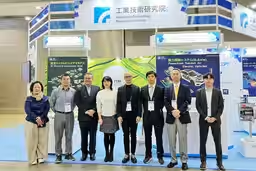
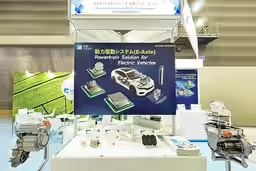
The Industrial Technology Research Institute (ITRI) of Taiwan has made a significant impact at the NEPCON JAPAN, one of the largest electronic manufacturing exhibitions in Japan, with a presentation of 14 cutting-edge technological achievements. This event, supported by the Ministry of Economic Affairs' Department of Industrial Technology, prominently featured the newly developed high-output density 3-in-1 eAxle, a product of collaboration with Taiwan's startup, Jie Neng Power Technology.
Evolving EV Powertrain Solutions
The eAxle is an integrated system that combines an electric motor, motor controller, and a reduction gearbox into one compact unit. It utilizes ITRI’s proprietary 1700V/400A silicon carbide (SiC) power chips and advanced heat sink technology designed for optimal thermal management. This innovative solution is designed specifically for high-voltage and high-power electric vehicle (EV) applications.
Both validation tests conducted by third-party organizations and a completed patent application in Taiwan and the United States demonstrate the system's robust performance. ITRI Director Zhang Shijie has stated that SiC is the most widely used power semiconductor globally due to its high efficiency, output density, voltage, and thermal durability. ITRI has focused on developing compound power semiconductors for years and actively supports Taiwan’s technological development initiatives.
Advancing Taiwan's Semiconductor Industry
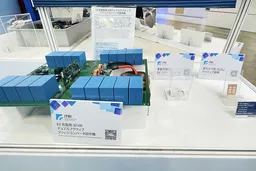
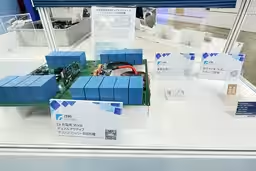
The ITRI's display not only showcases the eAxle but also includes the EV charging 30kW dual-active bridge converter prototype co-developed with Nagoya University. This prototype responds to the high efficiency and high output density required in the rapid EV charging market, emphasizing ITRI’s commitment to addressing industry needs.
The exhibition further featured advancements in SiC power semiconductor solutions developed in partnership with the third-generation semiconductor material company, ChaoNeng High-Tech. These solutions incorporate Si₃N₄ ceramic substrates that meet the high reliability and heat resistance demands for automotive power electronics, thus promoting enhanced product quality and service lifespan for electric vehicles.
Beyond automotive applications, ITRI's solutions address energy storage needs, particularly in artificial intelligence (AI) data centers. The presentation highlighted a total solution from compound semiconductor power devices to power modules and system integration, focusing on energy efficiency, reliability improvements, and enhanced system flexibility, which sets a new standard in the global power infrastructure landscape.
ITRI’s unique 650V vertical GaN devices and associated packaging technologies were also part of the showcase. These innovations, developed through simulation optimization, offer a combination of reliability and manufacturing flexibility that promise to expand applications in various fields, including automotive drive and charging systems, industrial robots, and AI data centers.
The Future Prospects
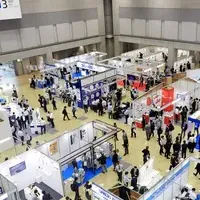
As one of Asia's leading exhibitions for the electronic manufacturing industry, NEPCON JAPAN serves as the necessary platform for ITRI to strengthen Taiwan's competitive edge in advanced electronic and semiconductor sectors. Last year's exhibition welcomed over 100,000 attendees, showcasing significant global suppliers and buyers across semiconductor, PCB, automation, and automotive electronic domains.
ITRI aims to accelerate the industrialization of its research outcomes and enhance international collaborations by presenting over 14 innovative results exploring significant themes, including EV SiC power semiconductor solutions, DC microgrid power semiconductor solutions, and GaN power device implementation technologies. These moves are expected to bolster Taiwan's standing in the realm of cutting-edge technology and set a precedent for further advancements in the EV and semiconductor sectors.
With these innovations, ITRI is set to play a crucial role in the ongoing revolution of smart technology and sustainable energy solutions, ultimately contributing to Taiwan's economy and global competitiveness.
Topics Consumer Products & Retail)





【About Using Articles】
You can freely use the title and article content by linking to the page where the article is posted.
※ Images cannot be used.
【About Links】
Links are free to use.