



QUO Card Implements AI-Powered Search Service to Enhance Customer Satisfaction
Enhancing Customer Support with AI: QUO Card's Approach
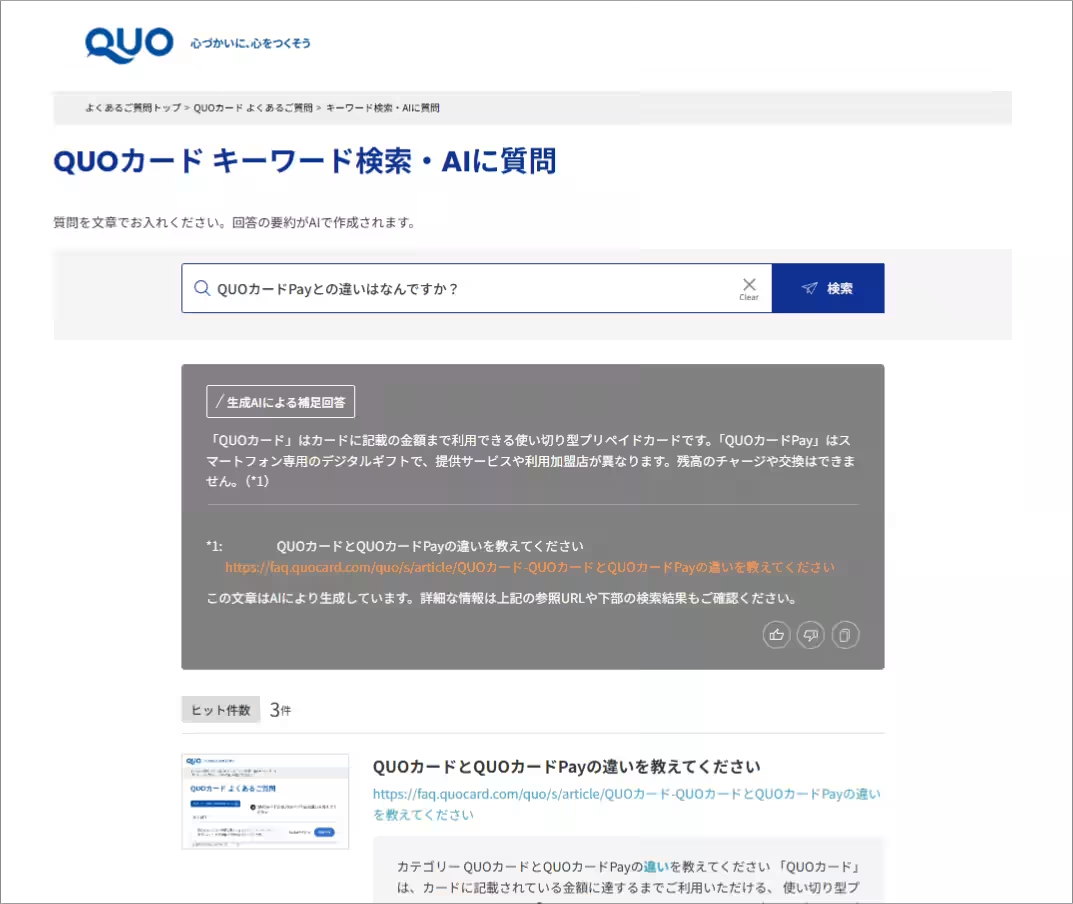
In a move to improve customer service, QUO Card has integrated a new AI-powered search service, 'Cogmo Enterprise Generative AI', into its FAQ system, effective March 30, 2026. Developed by AI Act, this innovative system is designed to assist customers in finding solutions without the frustration of navigating traditional FAQ pages.
Addressing Customer Challenges
Despite having operated an FAQ site for QUO Cards and QUO Card Pay, QUO Card faced significant challenges. Many users expressed frustration, stating that they couldn’t find answers despite the availability of information on the site. This led to approximately 550 monthly inquiries through phone calls and emails, indicating a pressing need for improvement. The integration of the Cogmo service aims to convert these unsatisfactory experiences into efficient self-resolution opportunities for customers.
Key Features of Cogmo Enterprise Generative AI
The decision to implement 'Cogmo' stemmed from several compelling features that directly address customer pain points:
1. AI-Driven Search Functionality:
The search engine uses advanced natural language processing, allowing users to enter queries in everyday language. This capability means that even with typos or informal phrasing, customers can still receive appropriate answers, reducing the likelihood of leaving the site without resolution.
2. Summarization Capabilities:
Even when customers arrive at the relevant FAQ page, they may struggle with complex terminologies or may need to cross-reference multiple pages. Cogmo tackles this by providing summarized answers that synthesize information across various pages, not just limited to the FAQ site but also incorporating details from related corporate pages about QUO Card and QUO Card Pay. This feature significantly enhances user comprehension and satisfaction.
3. High Answer Accuracy with RAG:
Cogmo utilizes a Retrieval-Augmented Generation (RAG) mechanism, generating responses specifically from the information available on the designated site. This minimizes hallucination—where AI generates inaccurate information—and includes a unique no-code precision adjustment feature that allows non-technical staff to manage AI accuracy effectively.
4. Reduced Operational Overhead:
Unlike traditional chatbots that often require complicated scenario planning, the search-oriented approach of Cogmo simplifies operational demands. This ensures lower ongoing maintenance burdens while still delivering high-quality responses.
Future Direction for Customer Satisfaction
The integration of Cogmo reflects QUO Card's commitment to enhancing user experience by allowing customers immediate access to desired information. By lowering the psychological stress associated with inquiries and minimizing the effort needed to seek help, QUO Card hopes to build trust and elevate overall satisfaction levels. Continued analysis of search logs and user interactions will guide further optimizations of their information delivery systems.
Support System by AI Act
In addition to the implementation of Cogmo, AI Act offers comprehensive support for initial adjustments and ongoing operational assistance. This commitment ensures that QUO Card can continuously refine the service and boost efficiency in handling user inquiries.
AI Act is determined to tackle the challenges of information distribution with AI technology, championing the development of the Cogmo series. The goal is to facilitate more effective AI utilization in public and corporate sectors, ultimately contributing to increased productivity across society.
About 'Cogmo Enterprise Generative AI'
Cogmo Enterprise is positioned as a leading solution in the RAG AI category, built on nine years of experience and innovation. It is specifically designed to prevent inaccuracies that often plague generative AI by allowing for effective management of content quality. Employing a search interface instead of a chat format, it ensures simultaneous display of generated responses and search results, thereby supporting enhanced operational efficiencies. Users can also aggregate scattered documents across multiple websites, leading to improved self-resolution rates and a reduction in inquiries.
For more details:
Topics Consumer Products & Retail)
【About Using Articles】
You can freely use the title and article content by linking to the page where the article is posted.
※ Images cannot be used.
【About Links】
Links are free to use.