



Active Clusters Formed by Nonreciprocal Interactions in Colloidal Systems: A Breakthrough Study
Introduction
In a groundbreaking study led by researchers from Tokyo University of Science, significant insights have been gained into the behavior of colloidal particles under the influence of nonreciprocal interactions. This research sheds light on how these interactions can prevent the expected coarsening of particle clusters, leading to the formation of dynamic active clusters that continue to split and reform.
Background of the Study
The study investigates the fascinating world of active matter, a term that describes systems that can self-propel and organize due to the absorption of energy from external sources. In this context, nonreciprocal interactions are increasingly recognized for their role in creating unique collective behaviors that go beyond traditional forces like attraction and repulsion. The challenge has been to experimentally validate these phenomena in systems with a large number of particles, which is where this research makes substantial contributions.
Experimental Methodology
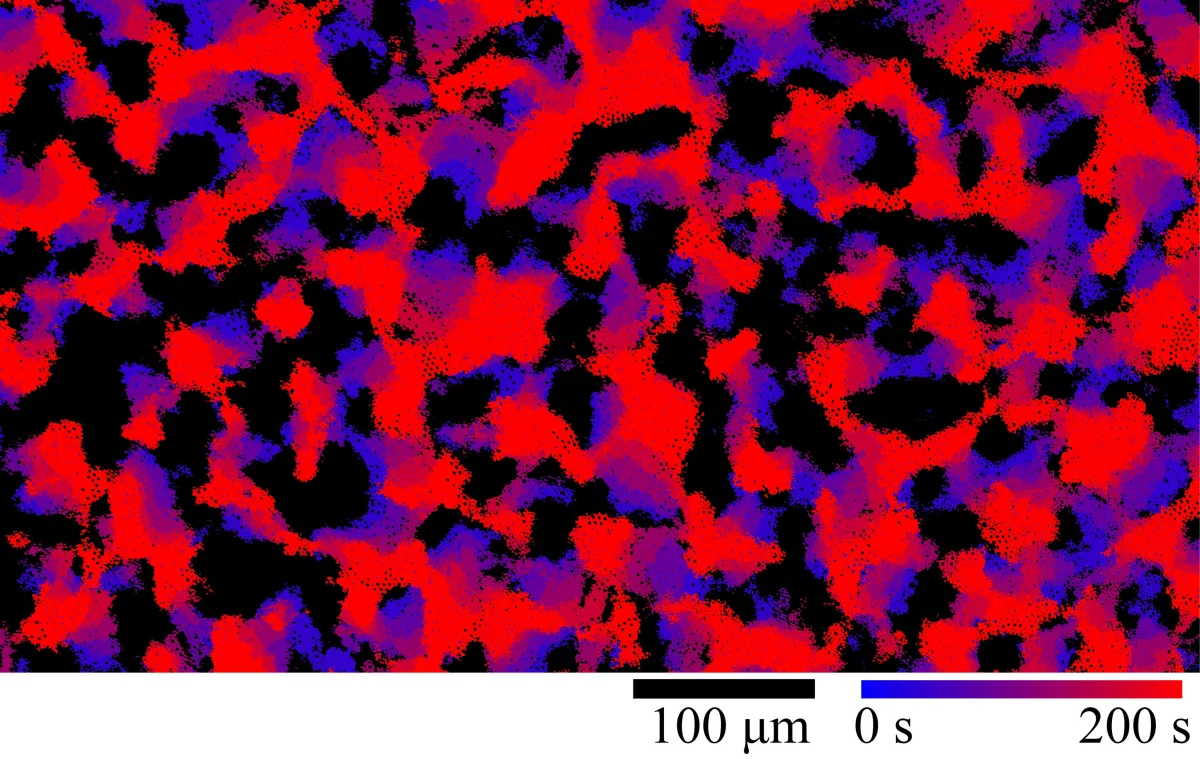
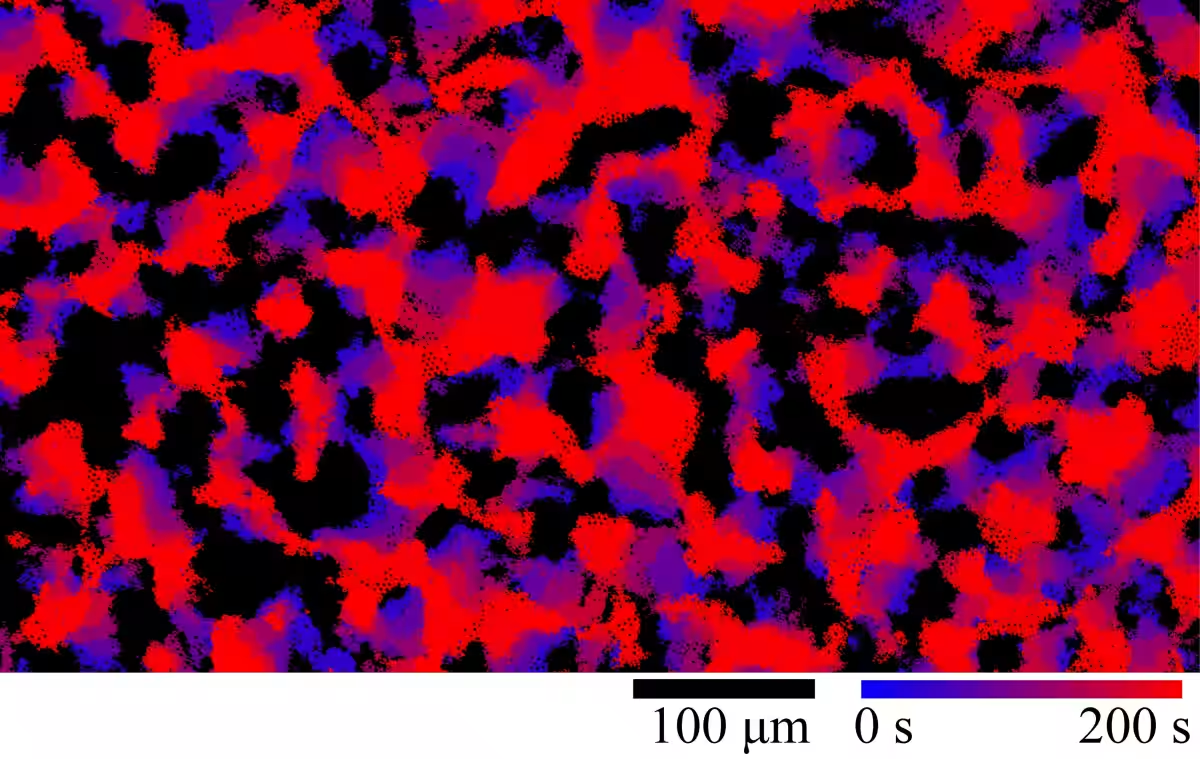
The research team, comprising Shoma Hara, Masazumi Okada, and others, utilized a mixture of polystyrene colloidal particles of two distinct sizes (1 µm and 1.5 µm in radius) suspended in an aqueous solution. By applying an alternating electric field, they found that the particles were capable of forming active clusters that did not evolve into static aggregates, which is typically expected when attractive forces dominate. Instead, the clusters continually split and reorganized, demonstrating a dynamic state that persists over extended periods.
Key Findings
The key to this remarkable behavior lies in the nonreciprocal interactions induced by the electric field. The study revealed that the electrokinetic flow generated by the electric field exhibits a strong dependence on particle size. This asymmetry disrupts the usual force balance between the larger and smaller particles, allowing pairs of different-sized particles to propel themselves. This self-propulsion further sustains the collective dynamic of the entire particle assembly, preventing them from coarsening into larger, static clumps.
Additionally, the researchers employed both an agent-based model and continuum modeling techniques to examine the particles' motions in detail. The findings suggest that the self-propulsion of particle pairs and the divergence of a polarity field based on their orientation combine to inhibit coarsening, resulting in a consistent active state for the clusters.
Implications of the Research
The implications of this study extend beyond theoretical understanding. The ability to control colloidal interactions using external electric fields opens up new avenues for designing materials that could switch between mixed, aggregated, and restructured states on demand. Moreover, the insights gained could lay the groundwork for creating micro-robots based on colloidal particles that could be programmed for specific tasks, pulling from the self-organizing principles observed in this research.
Conclusion
The study concludes that even systems where only attractive interactions are present can maintain a dynamic collective state through the incorporation of nonreciprocal interactions. This discovery enhances our foundational understanding of collective movement and presents a promising direction for future research in non-equilibrium systems. As Professor Yutaka Sumino, one of the lead researchers, stated, "This work stems from a desire to understand life and express its characteristics through the lens of physics, particularly in the realm of non-equilibrium dynamics."
Future Directions
This research, published in the prestigious journal Physical Review Letters, underscores the importance of nonreciprocal interactions in colloidal systems and paves the way for further studies aimed at exploiting these principles in practical applications. Supported by various research grants, the team is excited to explore how their findings can be harnessed to innovate materials designed for specific functions in fields ranging from robotics to advanced material science.
Topics Consumer Products & Retail)
【About Using Articles】
You can freely use the title and article content by linking to the page where the article is posted.
※ Images cannot be used.
【About Links】
Links are free to use.