



Understanding Quantum Behavior with Advanced Attosecond Laser Technology
New Insights in Quantum Control Using Attosecond Lasers
In an exciting development, a research team led by Professor Hiromichi Niikura from Waseda University and Dr. David Villeneuve from the National Research Council of Canada has pioneered a novel method for quantum interference measurement. By utilizing two attosecond laser pulses, they successfully measured the phase oscillation of the electron wave function in helium atoms with remarkable precision down to a few attoseconds. This technique, which allows for the observation of electron dynamics, signifies a substantial advancement in the understanding of quantum states and control.
Key Highlights of the Research
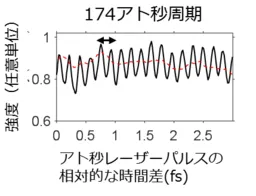
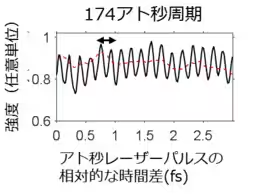
The study focused on how two extreme ultraviolet (XUV) attosecond laser pulses can be employed to observe the oscillation of electronic wave functions at a 174 attosecond period. By constructing a simplified optical system, the researchers have overcome the complexity and cost that traditionally hampered precise measurements in this domain. The implications of this new method extend to the detection and control of molecular and solid samples, enabling potential breakthroughs in quantum state manipulation.
The research results are set to be published in Physical Review A on November 10, 2025, showcasing the study's contribution to the field of quantum physics.
The Technique Behind Attosecond Measurements
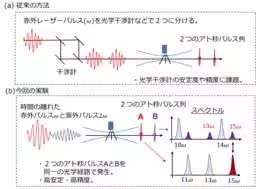
Previously, studies established that electronic behavior—crucial in determining the properties of materials and chemical reactions—can now be precisely measured using attosecond laser pulses. Niikura's team had previously achieved imaging of ionized electron wave functions using a combination of attosecond and infrared laser pulses. However, utilizing two identical attosecond pulses posed challenges due to the need for intricate and expensive measurement systems capable of high temporal precision.
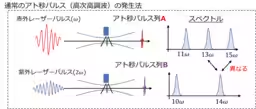
In this groundbreaking research, a straightforward yet effective optical setup was devised, employing two different wavelength attosecond laser pulses. This method ensures that fluctuations in optical path differences don't occur since both pulses travel along the same optical path, simplifying the control of time delays to achieve high precision in measurements.
Anomalous Wave Function Interference
This research unveiled a surprising aspect of attosecond laser pulse generation. While it was expected that different wavelengths—not the same—would emerge from combined infrared and ultraviolet pulses, the researchers demonstrated that controlled timing could yield identical wavelength harmonics from the generated pulses. This vital discovery facilitated the interference measurement of wave functions utilizing the same wave length properties.
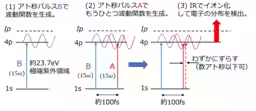
Starting with the first attosecond pulse, they generated an electron wave function within the helium atom’s high electronic state. The intricacies revealed that by adjusting the time delay between the two pulses by mere attoseconds, the overlapping wave functions would exhibit constructive and destructive interference based on the time difference. A subsequent ionization process transformed these overlaps into detectable signals, indicating how phase oscillations relate to quantum coherence maintained over time spans greater than 100 femtoseconds.
Broad Implications and Future Prospects
The implications of this research are profound, suggesting attosecond laser pulses might serve as significantly smaller sources of extreme ultraviolet and soft X-ray radiation compared to traditional synchrotron sources. The key advantage of these coherent sources lies in their ease of combining with multiple laser pulses, enabling the access to quantum information about electron wave function states.
Moreover, the simplicity of this new measurement technique could help broaden the applications of attosecond lasers across various fields, from investigating new quantum properties in complex molecules to enhancing chemical reaction analysis. This could play a pivotal role in the development and validation of quantum computing technologies by securing high-quality measurement data necessary for comparing computational predictions.
Current Challenges and Future Directions
The research has revealed a tantalizing precursor to potential discoveries occurring within the zeptosecond range—the next frontier beyond attosecond measurements. The researchers conclude that future studies will aim to detect phenomena occurring in this even shorter time scale, shedding light on previously unseen quantum dynamics.
Researcher Insights
Professor Niikura commented on the unexpected results of their study, indicating that the common assumptions regarding the generation of wavelengths from different sources were challenged through their quantum interference experiments. He expressed excitement about the upcoming explorations into the zeptosecond range, anticipating new findings that may surprise the scientific community further.
Conclusion
This innovative approach to measuring quantum behavior with attosecond lasers opens new avenues in quantum physics, merging technological advancement with fundamental research. As the understanding of quantum mechanics deepens through these methods, the potential ramifications for technology and science at large are boundless.



Topics Consumer Technology)

【About Using Articles】
You can freely use the title and article content by linking to the page where the article is posted.
※ Images cannot be used.
【About Links】
Links are free to use.