



EY's Insightful Report on Industry Transformation in the AI Era
Decoding Industry Transformation in the AI Era
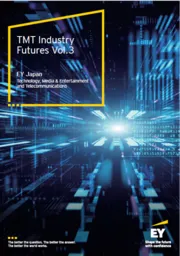
EY Strategy and Consulting (EYSC), based in Chiyoda, Tokyo, recently published a significant report titled "TMT Industry Futures vol.3," which delves into the structural changes and growth opportunities for businesses in the Technology, Media, and Telecommunications (TMT) sectors. With the rapid evolution of generative AI as a pivotal focus, this report consolidates EY Japan's insights into a comprehensive framework, capturing essential management agendas in the AI-driven era.
The report extends its analysis across a range of themes, including physical AI, drones, data centers, semiconductor talent, sustainability disclosures, strategies for workforce in the AI age, revenue models in media and content industries, next-generation communications, as well as tax and finance considerations. This holistic approach enables stakeholders to grasp not only the nuances of each theme but also to understand how technological advancements, infrastructure changes, workforce dynamics, supply chains, governance, customer touchpoints, and revenue models are interlinked, ultimately impacting corporate management.
As AI transcends beyond mere efficiency enhancement and decision-making support, it increasingly influences social infrastructure, supply chains, talent management, governance, customer interactions, and business models. TMT companies are therefore called upon to redefine their management strategies, going beyond merely adopting individual technologies. They must identify their core strengths, establish partnerships wisely, and carve pathways toward sustainable growth.
Highlights from the Report
Drawing on viewership statistics from EY Japan's TMT-related content, the report identifies key areas of interest including generative AI, AI agents, human resource strategies, tax department transformations, semiconductor workforce issues, and physical AI. Within the report, these hot topics are systematically analyzed under several themes:
Human Resource Strategies for the AI Agent Era
The evolution of generative AI and AI agents is reshaping business models, organizational structures, and human resource strategies. This section features insights from discussions among industry leaders, highlighting how adoption rates of AI influence organizational transformation speeds and emphasizing the need for governance structures that ensure transparency and accountability in AI usage while fostering talent for future business prospects.
Redefining the Value of Professionals in an AI-Centric Society
Discussion in this segment revolves around how the roles of corporate management, organizations, and individuals are being altered by the prevalence of AI. The report interrogates the inherent value of human expertise in decision-making, quality management, and governance as they intersect with the efficiency-driven narratives of AI applications.
Transforming Tax Departments with AI Agents
AI agents have significant potential to enhance accuracy and efficiency within tax operations while promoting autonomy within tax departments. The report discusses the automation of complex tasks, allowing professionals to focus on strategic initiatives. However, it stresses that successful implementation requires strict human oversight and a robust data infrastructure to adhere to legal compliance.
Semiconductor Talent Development Strategies in Kansai
Highlighting the critical shortage of design and development engineers in the semiconductor sector, exacerbated by rising demands in AI, 5G, and automotive technologies, this section details a collaborative ecosystem formed by industries, educational institutions, and government bodies in the Kansai region to cultivate high-level talent. Such efforts are essential for fortifying Japan's semiconductor industry's global competitiveness and fostering sustainable regional economic growth.
Will Physical AI Become a New Infrastructure? - Winning Strategies for Japanese Companies
This segment positions physical AI as the next competitive infrastructure that influences operational efficiency in manufacturing and logistics. While generative AI boosts productivity in knowledge work, physical AI is critical for redefining operational capabilities in the physical world. Japanese companies are encouraged to leverage their strengths in component manufacturing, operational rollout, and data utilization to maximize value.
Conclusion
In the face of these profound changes, industry leaders such as Toshiichi Tomita, the head of EYSC's TMT sector, and Partner Takafumi Miura emphasize the collective impact of technology evolution across various verticals within the TMT industry. They stress that understanding individual themes alone is insufficient; companies must adopt a comprehensive view that encompasses business portfolios, investment priorities, partnership strategies, and organizational transformations.
This report serves as a significant resource for TMT companies in strategizing their next growth steps amidst the rapidly changing landscape. For further details, readers are encouraged to access the full report linked below.
[Download TMT Industry Futures vol.3]
About EY
EY is committed to creating new value for clients, its members, society, and the planet, aiming to build a better working world through trust and integrity in capital markets. By leveraging data, AI, and advanced technologies, EY supports clients in shaping their futures confidently, providing solutions to pressing challenges they currently face. The firm's activities span assurance, consulting, tax, strategy, and transactions across over 150 countries and regions.
For more insights about EY and its consulting services, visit ey.com.


Topics Business Technology)
【About Using Articles】
You can freely use the title and article content by linking to the page where the article is posted.
※ Images cannot be used.
【About Links】
Links are free to use.