




Five Key Insights on Vertical SaaS Unveiled by Stripe at the Summit
Stripe Unveils Five Key Insights on Vertical SaaS
During the SaaS Platform Leaders Summit at Stripe Sessions, key figures like Emily Sands of Stripe, Alex Israel of Metropolis, and Danielle Cohen-Shohet of GlossGenius engaged in a discussion about the transformative impact of AI on commerce.
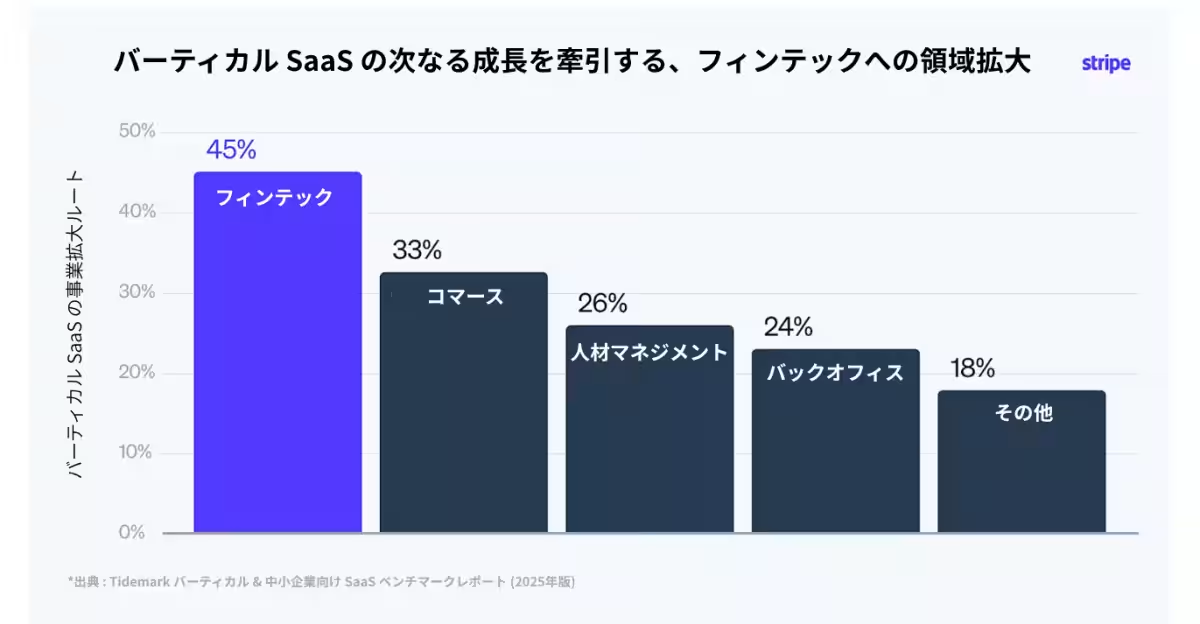
Stripe, known for building programmable financial services, revealed five crucial insights amid a rapidly changing landscape for vertical SaaS platforms, driven by the rise of AI. With over 16,000 platforms spanning sectors from home services to tattoo shops, many are now seeking to expand beyond mere software by integrating financial services like payments and lending.
1. Transitioning from Pure Software in Response to AI
The advent of AI raises concerns about the commodification of software businesses; however, vertical SaaS platforms have a distinct advantage through their deep industry roots. Elena Gomez, President and CFO of Toast, emphasized the need for businesses to engage closely with customer workflows in unique ways that cannot be easily replicated by standard software or AI solutions, stating, "Companies that succeed in vertical SaaS are those deeply embedded in their customers' world, continuously listening to their needs."
One effective method for vertical SaaS companies to deeply integrate into customer operations is through the provision of payment functions. While AI makes it easier to replicate software capabilities, offering payment functionalities transforms these platforms into essential financial operation tools that support transaction processing and cash flow management.
The demand for payment capabilities among users is increasing rapidly, with the median adoption rate rising from 27% in 2024 to 40% in 2025. Yet, challenges in integration persist, leaving a gap between the median platforms and those, like Stripe, that have achieved over 80% adoption. Platforms bridging this gap are prioritizing payment function integration as a top company goal. Catherine Beley, VP of Payments at GlossGenius, stated, "Starting with 'why' is crucial. It’s important to show our leadership that payments represent our largest revenue source, translating it into specific metrics like overall Annual Recurring Revenue (ARR)."
Platforms that achieve high adoption rates consistently align their strategies with product development, market strategies, and customer success initiatives. Phil Acree, VP of Payments at Fullbay, a commercial truck repair platform, suggested incorporating payment metrics into the sales incentive structure, ensuring that all team members, from sales to customer success management, encourage the adoption of payment features at every touchpoint with customers.
According to Tidemark's estimates, for successful platforms, each customer integrating embedded payments brings an average increase of $4,200 in Annual Recurring Revenue. Moreover, the integration of payment functions directly correlates with higher customer retention rates. Stripe's 2026 data reveals platforms offering embedded financial products experience an 11% lower annual churn rate, with companies utilizing multiple product strategies achieving a 49% faster revenue growth compared to their software-only competitors.
Ben Brideaux, Senior VP of Financial Services at Nextech, noted, "It's easy to focus solely on payment revenues, but the true opportunity lies in the secondary effects on overall revenue. Improving customer retention and revenue continuity reveals visible compound effects."
2. Building Strong Competitive Advantages through Deep Integration
As payment function adoption grows, it paves the way for further product offerings and enhanced customer retention. For example, commerce platform Shopify now provides integrated financial products such as payments, funding, and banking solutions. Similarly, Toast began as a restaurant POS system and expanded its functionalities to include payroll and invoicing.
TheCut, a hair salon booking app, introduced Stripe Capital to not only benefit its business but also thousands of barbers using its platform. Within just 24 hours of sending out loan offers, 167 barbers accepted a total of $788,000 in loans. CEO Obi Omile expressed surprise at the rapid acceptance, noting, "We knew there was demand, but the response was astounding. Barbers accepted proposals within minutes of receiving emails; the Capital funding supports equipment purchases and stabilizes cash flow during slow periods."
Competitive advantage does not solely hinge on offering financial services. For example, Moxie provides compliance tools to help medical aesthetics salons avoid losing their business licenses, while Slice negotiates wholesale pricing for pizza boxes on behalf of affiliated restaurants. These services require a profound understanding of the business, making them difficult for AI-centric competitors to replicate from day one.
3. Rise of Vertical SaaS with Unique AI Products
Alongside moving beyond software, platform companies are also evolving in the software layer. According to a Stripe survey, 87% of SaaS platform companies view AI as an opportunity rather than a threat, transitioning rapidly from experimentation to monetization of AI functionalities.
Byron Deeter, a partner at Bessemer, cited non-AI native platforms like Canva and Intercom that accelerated growth by integrating AI agent tools. Canva launched a conversational AI assistant that can automatically generate images, videos, text, and code, while Intercom offers an AI customer service agent named Fin. Deeter highlighted the importance of focusing on what can be achieved with the right mindset rather than fearing AI.
Top-tier vertical SaaS platforms are rapidly adapting to this shift. For example, Toast IQ predicts local food trends to assist restaurants in menu development and marketing accuracy. Quipli generates lead information for equipment rental companies when new construction permits are filed. Additionally, Clio's AI assistant aids legal professionals in drafting documents, summarizing cases, and extracting insights about clients.
Dave Yuan, founder of Tidemark, simply defined this progress as "meeting customer demands," emphasizing that customers desire agent-like solutions capable of supporting their work and automating mundane tasks.
4. Pricing Challenges in AI Functionality
Determining effective pricing models for AI functionalities in SaaS platforms presents challenges. While 86% of SaaS companies with AI functionalities have begun monetizing them, 44% are searching for the optimal model and anticipate multiple price adjustments within the next 12 months.
Some enterprises bundle AI functionalities into existing SaaS fees, while others provide them as standalone products through usage-based or performance-based pricing. Dave Yuan recommends conducting tests before making final decisions on pricing. He elaborated, "There’s a temptation to bundle AI functionalities, which might make sense for prompting upgrades. However, the ultimate measure of value lies in whether customers are willing to pay for it, leading platforms to consider integrating AI functions into premium plans or offering them as separate options."
5. Platforms Expected to Drive Agentic Commerce
The emergence of agentic commerce is altering transactional paradigms, with AI agents taking on more proactive roles in the purchasing processes—from discovery to decision-making and payment. Platforms building infrastructure to cater to this trend are anticipating business opportunities potentially reaching $5 trillion.
Retail platforms face fundamental challenges as the quality of retail data remains a significant concern. Dirk Hoerig, co-founder and managing director of commercetools, pointed out that existing data is often optimized for human shopping or SEO. Customer search behaviors are shifting; instead of searching for "gray jeans," customers are inputting phrases like "recommended outfits for participating in events." In agentic discovery, context has become increasingly essential.
WooCommerce, Commerce, and commercetools are working to ensure their merchants' product catalogs are appropriately searchable and purchasable on popular large language models (LLMs), necessitating a rethinking of product data structures.
The nature of agentic commerce will vary across industries. For instance, in the paddle tennis reservation app Playtomic, an AI agent could facilitate court bookings from start to finish. Meanwhile, Metropolis aims to fully automate parking transactions, where AI reads number plates and charges registered credit cards without human intervention. Conversely, in fields like law and healthcare, human relationships remain central, with AI agents fulfilling supportive roles for scheduling, document creation, invoicing, and follow-ups.
Across industries, businesses expect platforms to effectively address all changes brought by agentic commerce. Vova Tsukur, co-head of payments at Wix, emphasized that no one can predict which AI agent interface will dominate. Thus, the focus should be on ensuring platforms can absorb complex changes without burdening merchants.
Conclusion
Stripe supports some of the world’s most successful vertical SaaS platforms, including Shopify, Mindbody, and Substack. During Stripe Sessions, the company announced dozens of new features designed to support vertical SaaS, including the Platform Growth Studio to maximize revenue and features that allow for quick integration of Stripe Treasury and Stripe Issuing with just a few lines of code. Additionally, a range of tools are now available to ensure rapid customer onboarding, expense payments via cards, handling dispute claims, and access to flexible loan options—all designed to facilitate AI agent interactions.
For a full recap of the announcements at Stripe Sessions, please check here. You can also view on-demand recordings of the keynote and breakout sessions. Register for the upcoming Stripe Tour in Tokyo to engage with business leaders driving Japan’s digital economy and stay updated on Stripe’s latest developments in the region.


Topics Business Technology)
【About Using Articles】
You can freely use the title and article content by linking to the page where the article is posted.
※ Images cannot be used.
【About Links】
Links are free to use.