




Advancements in Robotics: Teaching Care Tasks Through Predictive Processing
Innovations in Robotics: Teaching Robots via Predictive Processing
In recent years, the field of artificial intelligence (AI) has seen remarkable advancements. However, a challenge persists: enabling AI to adapt flexibly to diverse tasks as humans do. Humans seamlessly combine vast sensory information—like sight and body awareness—to switch between various actions based on context. A theory gaining attention as a computational principle in brain science is known as 'Predictive Processing,' or the Free Energy Principle.
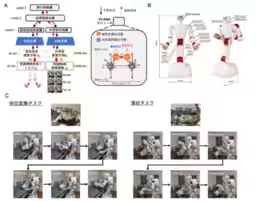
A research group led by Hayato Idei from the National Center of Neurology and Psychiatry (NCNP), alongside scientists from Waseda University, has made significant strides in this area. Implementing an AI model grounded in predictive processing into a multi-degree-of-freedom humanoid robot, they demonstrated the model's ability to learn various caregiving actions while integrating complex sensory inputs.
Study Findings
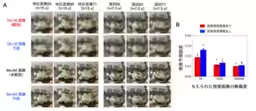
In their recent study, published in the journal Science Advances, the researchers outlined critical findings. They confirmed that the predictive model could process ambiguous visual information to estimate situations based on body senses. The AI autonomously learned task-switching, predicted obscured targets, and recognized shifts in uncertainty based on the context—all traits associated with human cognitive processing. This breakthrough indicates that predictive processing could serve as a fundamental computational principle for robot intelligence, paving the way for next-generation AI systems capable of performing diverse tasks in various environments.
Background of Research
Humans uniquely integrate sensory modalities—sight, touch, and proprioception—empowering them to adapt fluidly to varying tasks and environments. Unraveling the computational principles behind such intelligence is a critical pursuit within neuroscience and AI research. Predictive processing posits that the brain forecasts future sensory inputs, minimizing discrepancies between these predictions and actual sensory experiences—essentially allowing perception, behavior, and learning to occur efficiently.
The team selected caregiving tasks for their experiments due to the pressing global issue of labor shortages in elderly care arising from increasing populations. Tasks like repositioning patients and performing hygiene require flexible interactions with both people and environments, making them ideal for testing adaptive intelligence.
Overview of the Research
The research introduced a novel AI model called 'Scalable PV-RNN,' which was implemented in the humanoid robot AIREC. This model was specifically designed to evaluate if predictive processing could achieve high-dimensional multitasking capabilities.
Key Achievements:
1. High-Dimensional Learning: The AI successfully integrated visual images and three-dimensional body sensory data, around 30,000 dimensions of information, to learn multiple caregiving movements without conventional methods like feature extraction. This method confirmed the potential of a single brain-like AI to manage diverse tasks.
2. Emergence of Human-like Information Integration: Analysis of the AI's internal processing revealed that characteristics comparable to human cognitive processes emerged. It represented entire tasks hierarchically, allowing the robot to detect hidden objects and utilize body senses when visual information was inadequate. This underscores the ability of predictive processing to foster advanced, real-world adaptive intelligence.
Future Prospects
While the current study utilized simulations, it sets a foundation for future applications in real-world robotic control. Beyond caregiving, the principles derived could enhance robots in logistics, disaster response, manufacturing, and home assistance, promoting versatile task execution across various environments.
Moreover, this research doesn’t merely advance robotic AI; it proposes fundamental insights into understanding how human brains achieve flexible intelligence. By applying theoretical knowledge from neuroscience to AI and verifying these principles through AI, a new feedback loop between cognitive science and artificial intelligence research is anticipated.
Conclusion
The success of the predictive processing approach in robot learning significantly contributes to the broader field of AI development. As the understanding of human intelligence as a computational framework deepens, the line between human cognition and machine learning continues to blur, promising a future where robots can operate flexibly in complex, dynamic environments just like humans.
These innovative findings mark a pivotal moment in our quest to harmonize robotic capabilities with the intricacies of human-like intelligence.






Topics Consumer Technology)
【About Using Articles】
You can freely use the title and article content by linking to the page where the article is posted.
※ Images cannot be used.
【About Links】
Links are free to use.