


Okayama University Develops Unique Method for Synthesizing 2D Semiconductor Nanostructures for Hydrogen Production
Pioneering Development of 2D Semiconductor Nanostructures at Okayama University
In a remarkable achievement, a collaborative research team from Okayama University, Nagoya Institute of Technology, Nagoya University, Kanazawa University, and Keio University has successfully developed a unique method for synthesizing dendritic nanostructures of transition metal dichalcogenides (TMDCs). These advancements are anticipated to play a crucial role in the development of next-generation hydrogen production catalysts.
Innovative Approach to Synthesis
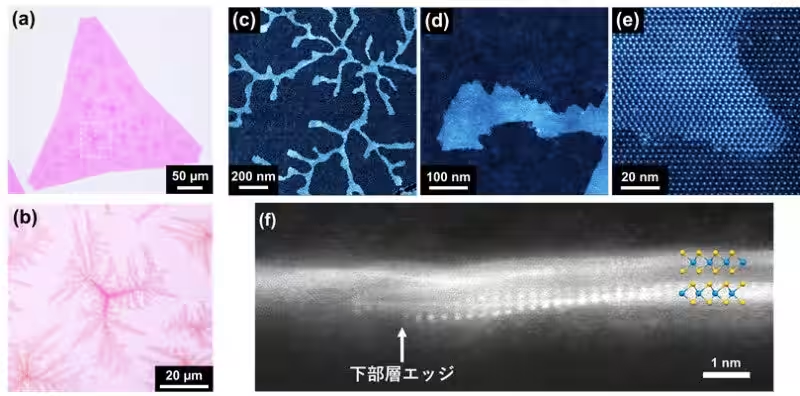
The research group, led by Associate Professor Hiroo Suzuki of Okayama University’s Graduate School of Environmental and Life Science, has employed an innovative approach that utilizes a nano-reactor at the interface of a monolayer TMDC and its growth substrate. This method facilitates atomic-level control during the synthesis process, thereby enabling the creation of nanostructures known as dendrites. The implications of this breakthrough extend to various applications in electronic and electrochemical fields, especially in hydrogen production reactions (HER).
The findings have been published in the scientific journal "Small Structures" by Wiley-VCH on December 4, 2025. TMDCs are two-dimensional materials that are just three atoms thick, featuring remarkable mechanical flexibility alongside superior electrical and optical properties. Transforming these materials into a dendritic nanostructure is expected to enhance their electrochemical functionality significantly.
Significance of the Research
This novel technique enables the synthesis of single-layer TMDC nanoribbons, and it is expected to contribute significantly to the development of future nanoscale optoelectronic devices. The research highlights the potential for using TMDC dendrites in various applications, including batteries, sensors, and catalysis, addressing energy challenges on a broader scale.
Collaborative Effort and Future Directions
The research team deeply values the collaborative atmosphere facilitated by researchers from diverse backgrounds. According to Associate Professor Suzuki, the cooperation fostered the discovery of new insights and underscored the importance of interdisciplinary research. This synergy not only enhances the material’s potential but also sets a precedent for future studies and innovations in the field of nanotechnology.
Visual Highlights
The publication includes high-resolution scanning transmission electron microscopy (STEM) images of the synthesized WS2 dendrites, showcasing the intricate network structures achieved through this innovative synthesis method. Such visual data exemplifies the intricate details attainable at the nanoscale, which are critical for understanding the properties and potential applications of these structures.
Funding and Acknowledgements
The research was supported by various grants including those from JSPS, JST, as well as contributions from private foundations and university programs aimed at fostering innovative academic endeavors. The collaborative spirit embedded in this research reflects a collective effort to advance scientific understanding and technology in hydrogen production and nanomaterials.
For further reading, interested parties can access the detailed research paper through Wiley’s online library here.
This pioneering work marks a significant step forward in the utilization of two-dimensional semiconductors, aligning with global goals for sustainable energy solutions and highlighting Okayama University’s commitment to research excellence and innovation. As the field of nanotechnology continues to evolve, the implications of this research are bound to inspire future advancements in energy technology and manufacturing processes, ensuring that these developments contribute to a sustainable future for generations to come.

Topics Consumer Technology)

【About Using Articles】
You can freely use the title and article content by linking to the page where the article is posted.
※ Images cannot be used.
【About Links】
Links are free to use.