



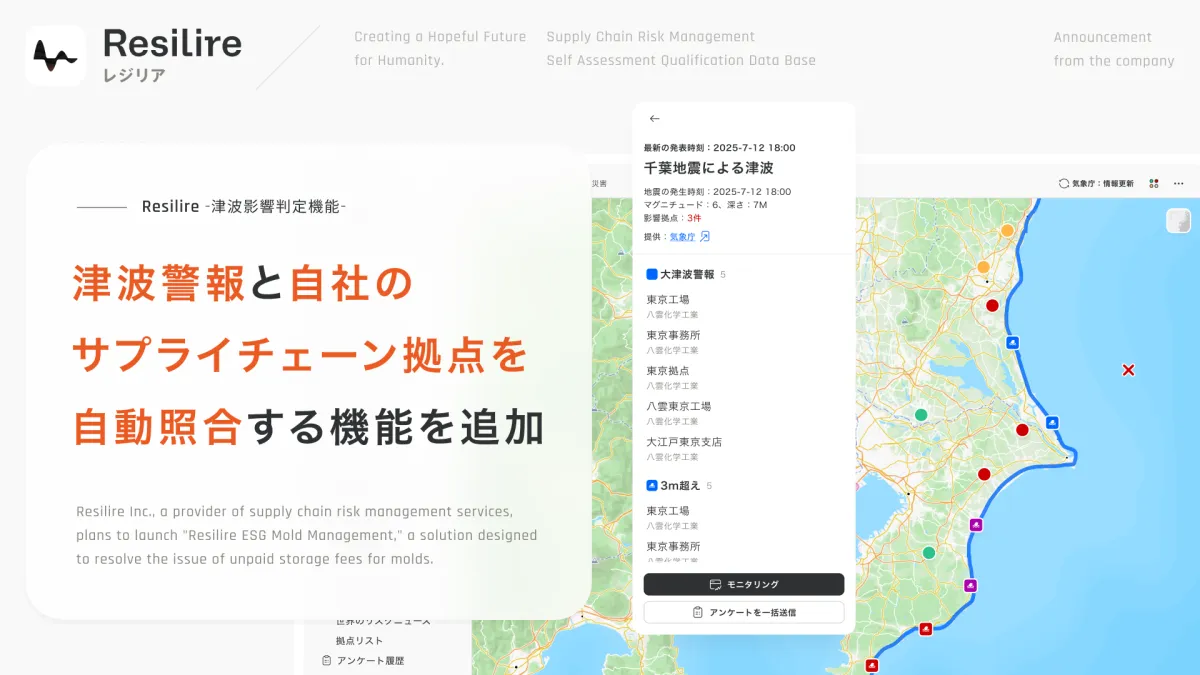
Resilire Launches New Tsunami Impact Assessment Feature for Supply Chain Risk Management
Introduction
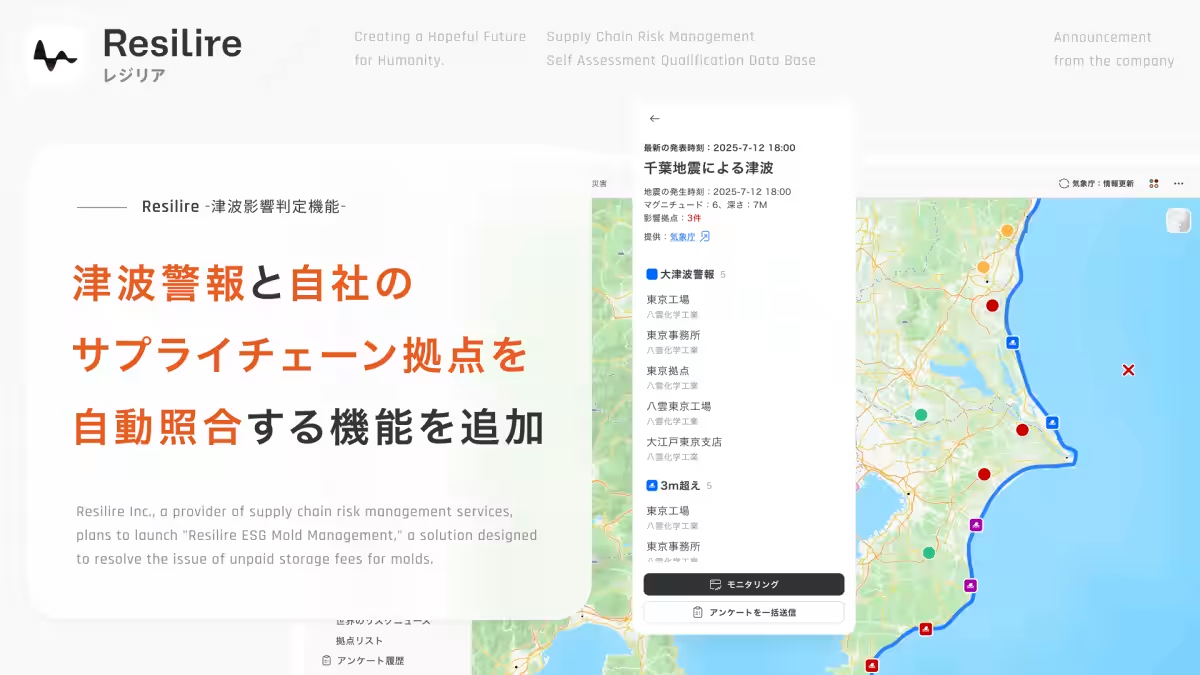
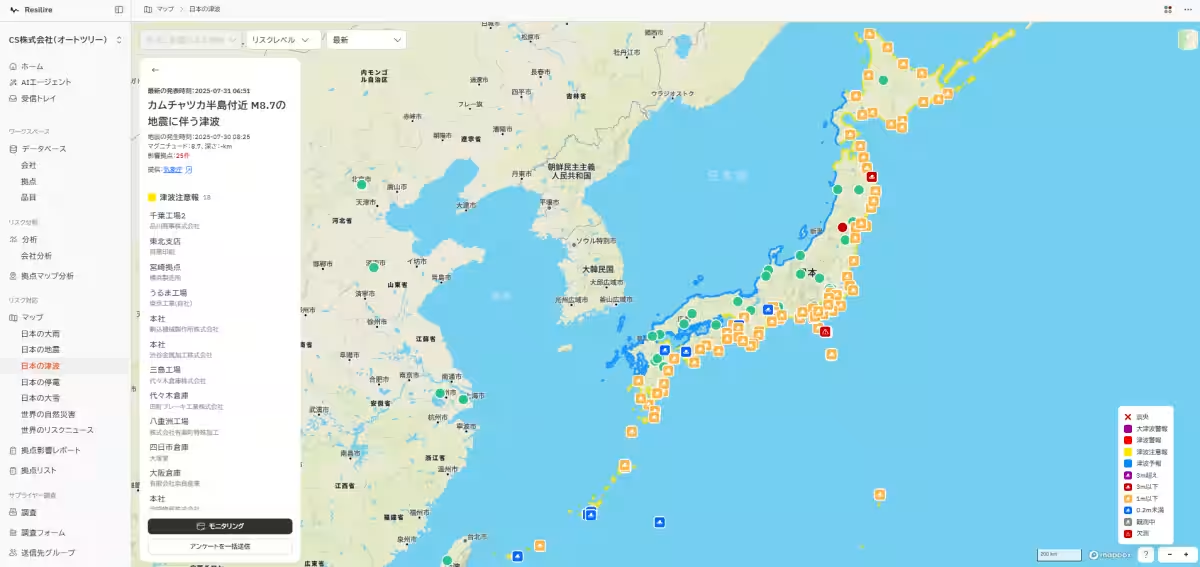
In a significant enhancement to its supply chain risk management service, Resilire, led by CEO Yudai Tsuda, has launched a new feature that automates the assessment of tsunami impacts on corporate supply chain locations. This new capability, known as the Tsunami Impact Assessment Function, retrieves real-time tsunami warnings issued by the Japan Meteorological Agency, allowing crisis management personnel to quickly identify which locations might be at risk during a tsunami event.
Background
Preparation for tsunami risks has become one of the top priorities in Japan's business continuity plans (BCP). Following the lessons learned from the Great East Japan Earthquake, the Cabinet Office's latest disaster prevention plan emphasizes the need for rapid information transmission and securing supply chains during a tsunami.
However, many companies still rely on manually checking each of their locations on a map to determine their vulnerability when a tsunami warning is issued. This labor-intensive process can take a considerable amount of time — often delaying crucial decisions and initial responses that are vital for protecting lives and minimizing business disruptions.
Features and Characteristics
Key Functionalities
1. Real-time Data Integration: The system integrates tsunami warnings into its framework within minutes of them being issued, facilitating immediate awareness of the situation.
2. Automatic Impact Assessment: Utilizing three criteria: 1) tsunami warning zones defined by the Meteorological Agency, 2) distances from coastlines, and 3) projected flooding heights based on hazard maps, the system automatically assesses the impact of a tsunami on various locations. Companies can customize these assessment criteria according to their operational characteristics and risk tolerances.
3. Intuitive Visual Mapping: The interface uses color-coded alerts (purple for major tsunami warnings, red for tsunami warnings, and yellow for tsunami advisories) to help users quickly understand which locations are at risk.
4. Real-Time Tsunami Data Display: The system allows users to monitor the actual height of observed tsunamis and their arrival times, thus providing critical up-to-the-minute information.
5. Multi-Hazard Integration: Users can view tsunami data alongside existing risk information regarding earthquakes, floods, and power outages, enabling them to track secondary hazards after an earthquake causes a tsunami.
6. Automated Emergency Notifications: When a tsunami warning is detected, automated email notifications are dispatched to designated users within the Resilire system, enabling seamless updates on the warning and affected locations.
7. Automatic Surveys for Affected Locations: Users in potentially impacted areas receive automated surveys to assess the damage, ensuring swift communication and data collection.
Expected Benefits
- - Faster Initial Response: The automation significantly reduces the time spent on manual checks, allowing for quick evacuation guidance and consideration of alternative production strategies right after a warning is issued.
- - Reduced Risk of Oversight: The system's thorough automated assessments help to ensure that no affected locations are overlooked.
- - Improved Effectiveness of BCP: By clarifying immediate actions that need to be taken once a warning is received, the system enhances decision-making capabilities during emergencies.
About Resilire
Resilire is a risk management platform that offers comprehensive collection, updating, and visualization of supply chain information, including upstream suppliers. The tool collaborates with suppliers to visualize risks in real-time and assists businesses in analyzing and evaluating risks — from disasters and accidents to geopolitical risks — ultimately helping to fortify supply chain resilience across various manufacturing sectors, including pharmaceuticals, chemicals, and automotive industries. For more information, visit Resilire’s service site.
Company Overview
- - Company Name: Resilire Inc.
- - CEO: Yudai Tsuda
- - Business: Planning, development, operation, and sales of the supply chain management service
Topics Other)

【About Using Articles】
You can freely use the title and article content by linking to the page where the article is posted.
※ Images cannot be used.
【About Links】
Links are free to use.